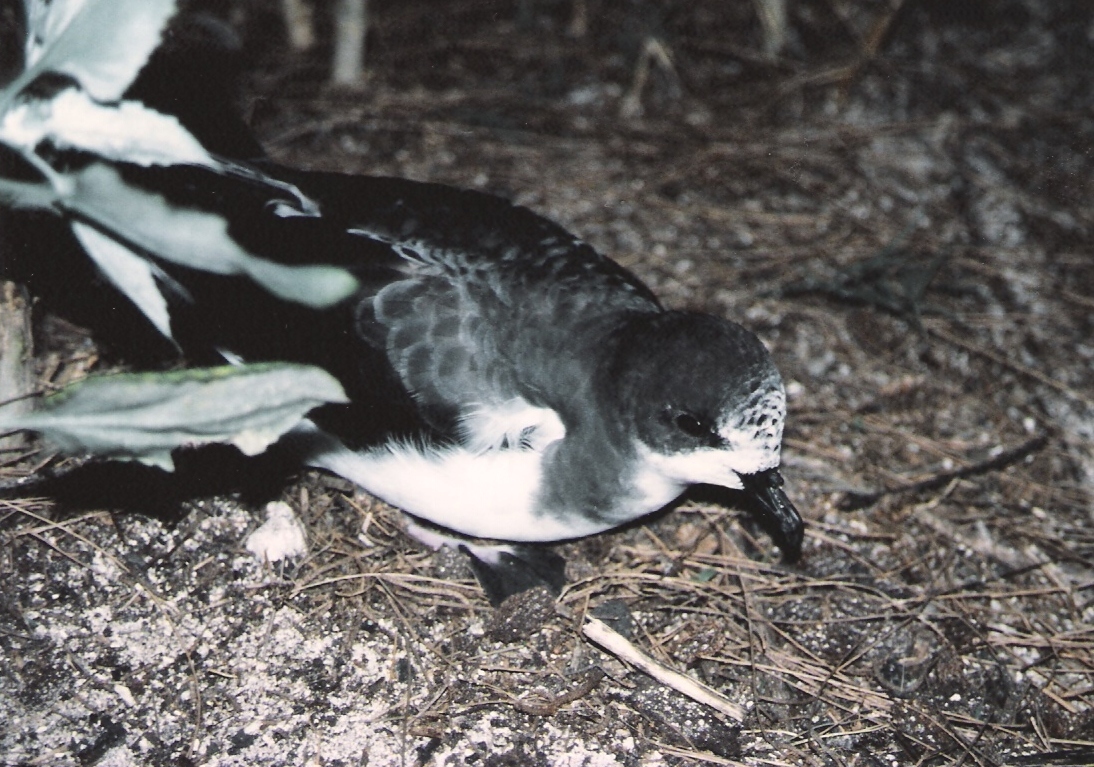
Bonin Petrel
Pterodroma hypoleuca
白额圆尾鹱
Description
A small gadfly petrel, 30 cm long with a wingspan of 67 cm. The head is white with a black cap and face markings, often appearing scaled. Upperparts are pale grey with darker primaries and wing coverts forming an 'M' mark across the back. The underwing is white with dark edging, a patch at the carpal joint, and markings across the underwing coverts. The tail is dark grey, and the remaining plumage is white except for a dark half-collar on the breast. The bill is short, hooked, and black. Legs and feet are pink with dark patches.
Identification
The distinctive 'M' mark across the upperparts and the white head with black cap are key field marks. The dark half-collar on the breast and white underwing with dark edging also aid identification. Similar to mottled petrel and white-necked petrel, but distinguished by smaller size and the specific head pattern.
Distribution & Habitat
Breeds almost entirely in the Northwestern Hawaiian Islands (995,000 birds, 99% of population), with a small population off Japan on the Ogasawara and Volcano Islands (5,000 birds, 1%). After breeding, migrates north to waters off Honshū and Sanriku in Japan, dispersing south and east in August and returning to breeding colonies in September. Not recorded in the east Pacific.
Behavior & Ecology
The only Pterodroma petrel with a fish-dominated diet, primarily feeding on lantern fish and hatchetfish, plus squid. Nocturnal feeder that seizes prey at the surface. Solitary at sea but found in large multi-species flocks occasionally. Breeds in dense colonies, visiting only at night. Nests in burrows 1-3 m long dug in sand or coral substrate. Lays a single egg in late January; both parents incubate for approximately 50 days. Chicks fledge around 80 days after hatching in early June. Likely mates for life and shows strong philopatry.
Conservation
Classified as Least Concern by IUCN. Introduced predators—Polynesian rats and black rats—have caused severe population declines. On Kure Atoll, rats prevented any chicks from fledging for five years in the 1960s. On Midway, black rats reduced the population from 500,000 to 32,000 birds by 1995. Rabbits on Lisianski Island destroyed habitat and undermined burrows. Conservation measures include rat and rabbit eradication, island restoration, and habitat protection across the Northwestern Hawaiian Islands.
Culture
Fossil remains found on Kauai, Oahu, and Molokai in association with Polynesian archaeological sites indicate this species was hunted as food by early settlers. The species was extirpated from the main Hawaiian Islands prior to European arrival. Known locally as 'nunulu' in Hawaiian.
Source: Wikipedia · CC BY-SA 3.0
Taxonomy
- Order
- Procellariiformes
- Family
- Procellariidae
- Genus
- Pterodroma
- eBird Code
- bonpet
Distribution
breeds Volcano, Bonin, and western Hawaiian islands; ranges to Sakhalin and central Japan
Data Sources
Species description from Wikipedia, licensed under CC BY-SA 3.0.
Bird images and sounds sourced from GBIF, contributed by citizen scientists worldwide under Creative Commons licenses.
Taxonomy data from AviList 2025.