Black-bellied Sandgrouse
Pterocles orientalis
黑腹沙鸡
Introduction
A medium-large species in the sandgrouse family (Pteroclididae). The nominate race breeds across the Iberian Peninsula, Northwest Africa, the Canary Islands, Turkey, Iran, Cyprus, and Israel. The eastern form P. o. arenarius occurs in Kazakhstan, western China, and northern Pakistan. It is a partial migrant, with central Asian populations moving south to Pakistan and northern India during winter. This species inhabits dry open plains with some vegetation cover, distinguishing it from some other sandgrouse species that utilize more barren habitats.
Description
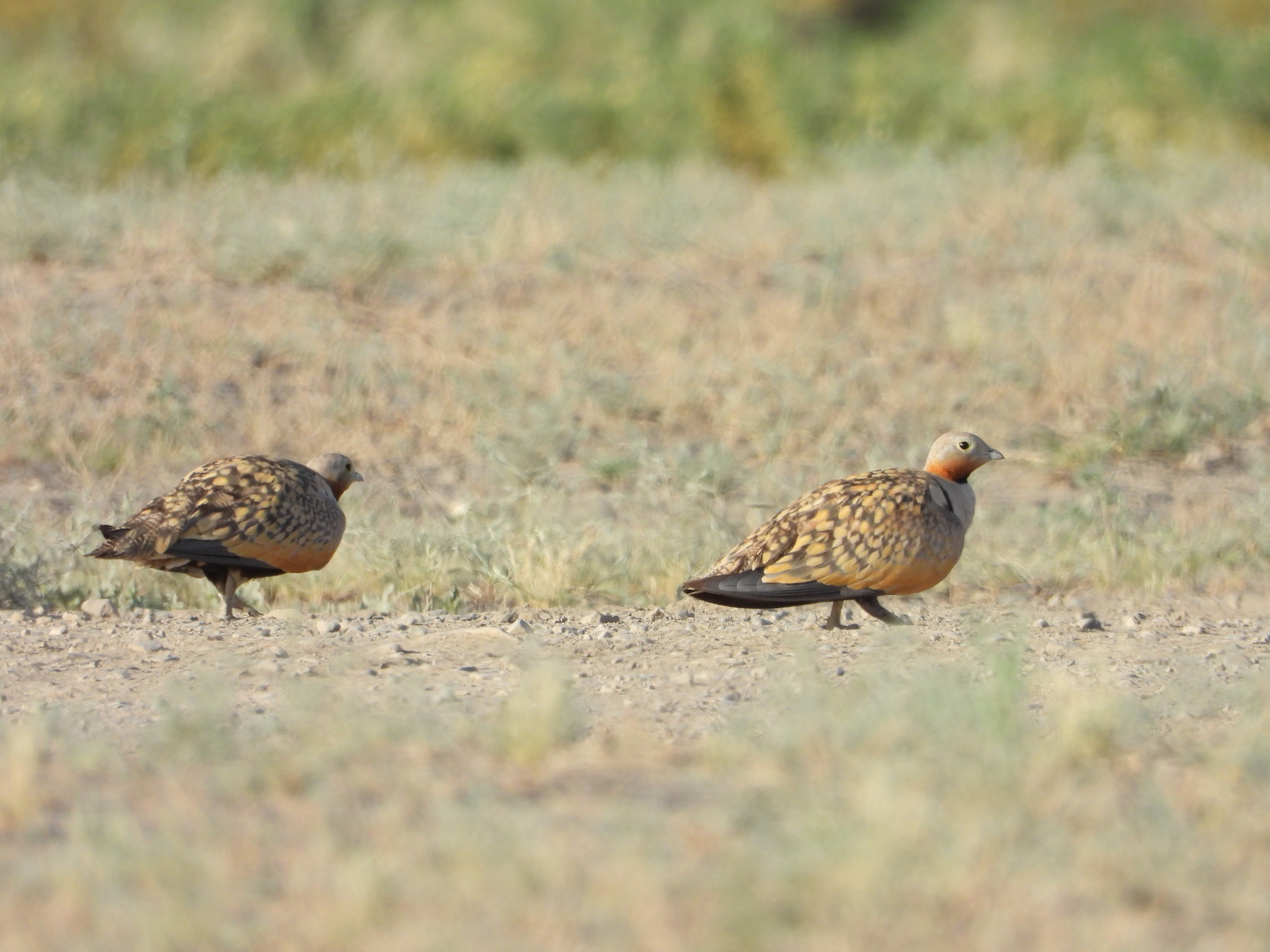
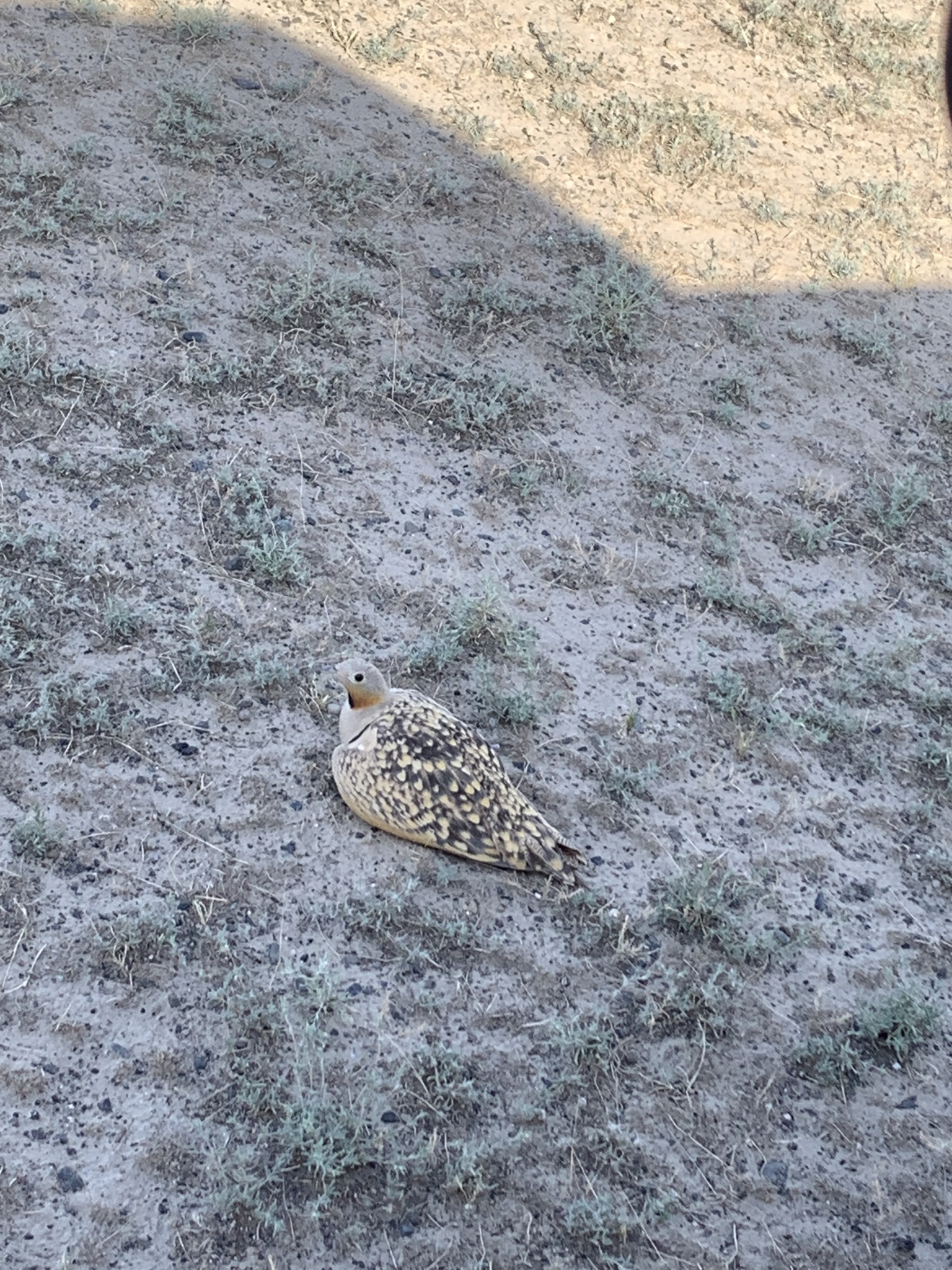
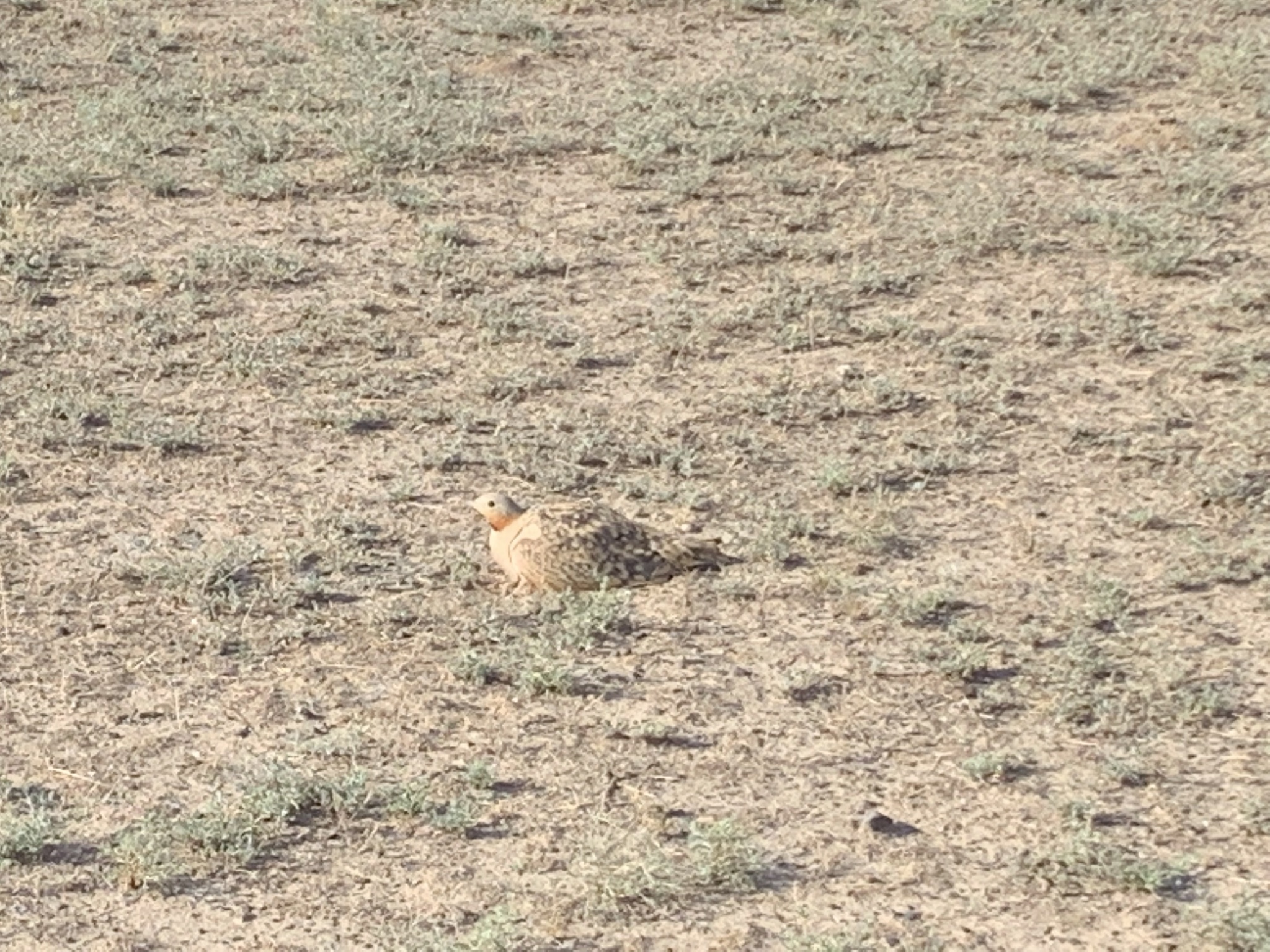
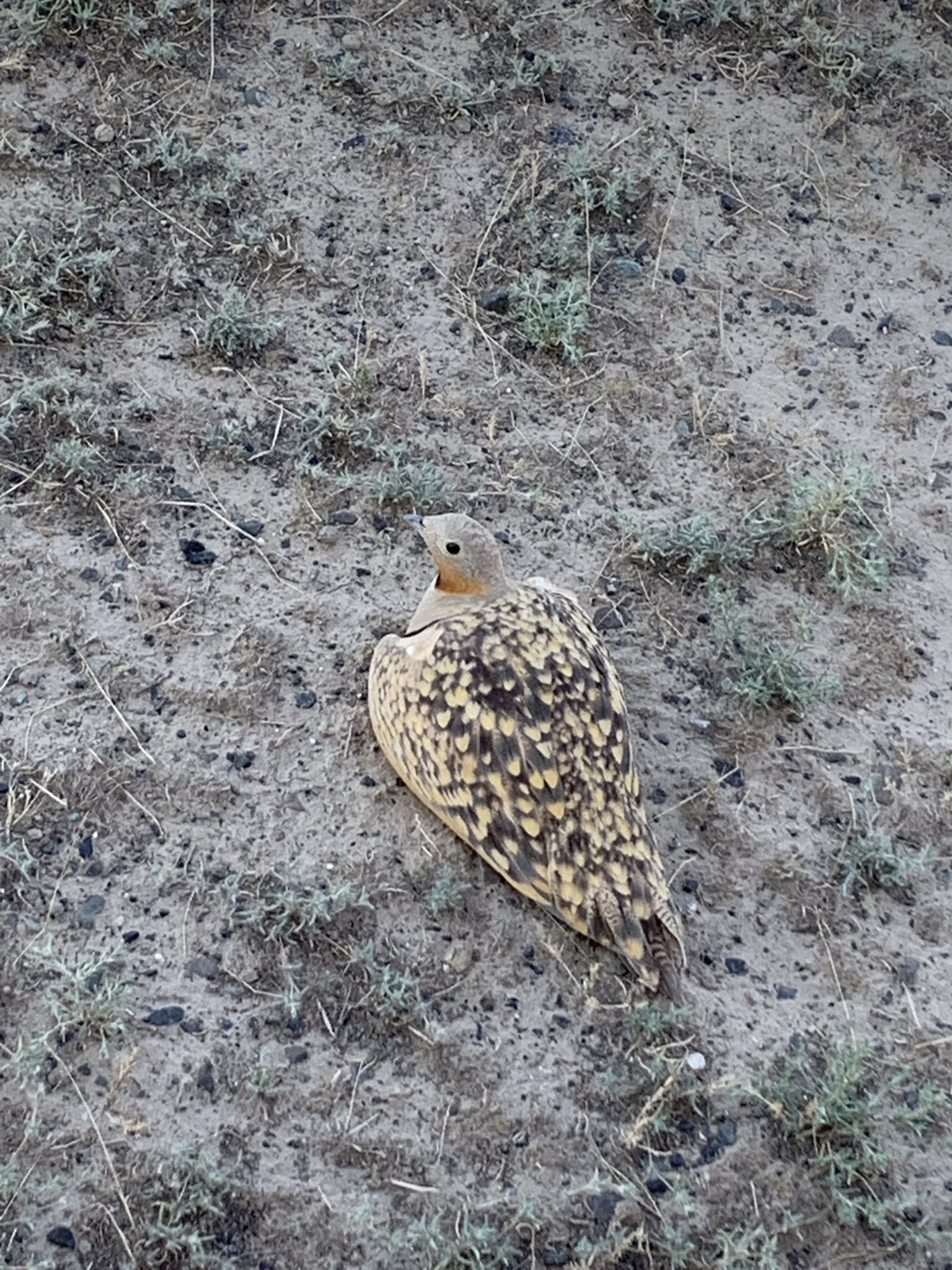
A robust sandgrouse measuring 33–39 cm in length and weighing 300–615 g, it is likely the largest species in its family. The male has a grey head, neck, and breast, with black underparts and golden-brown upperparts marked with darker patterns. A thin black border marks the lower breast, and a chestnut patch adorns the throat. The small, pigeon-like head and neck contrast with a stocky, compact body. The wings are long and pointed, supporting a fast, direct flight. The female is browner overall with finer markings on the upperparts, though the underparts and breast band resemble the male. The eastern race is paler and heavier, with males showing yellower upperparts and greyer underparts compared to western populations.
Identification
Recognizable in flight by the combination of white underwings and a black belly. Flocks characteristically commute to watering holes at dawn, which can aid identification. The call is a soft chowrrr rrrr-rrrr. Unlike the pin-tailed sandgrouse, this species avoids completely bare, unvegetated areas. Males are distinguished by the grey head and breast contrasting with the black belly, while females are more uniformly brown overall with finer plumage markings.
Distribution & Habitat
Breeds across the Iberian Peninsula, Northwest Africa, the Canary Islands, Turkey, Iran, Cyprus, and Israel (nominate race), extending east through Kazakhstan to south Iran, Afghanistan, and northwest China (subspecies P. o. arenarius). Inhabits dry open plains and similar arid habitats with sparse vegetation. Central Asian populations are partial migrants, moving to Pakistan and northern India for the winter months.
Behavior & Ecology
A gregarious species that breeds in loose colonies on the ground. The nest is a simple scrape containing three greenish eggs with cryptic markings. Both sexes share incubation duties, though only the male transports water to chicks by soaking specialized belly feathers at water sources. Flocks make regular flights to watering holes at dawn. The vocalization is a soft chowrrr rrrr-rrrr.
Conservation
IUCN conservation status and population information not provided in source material.
Culture
The eastern subspecies P. o. arenarius is mentioned in the Baburnama, the Chagatai language memoir of Mughal Emperor Babur, who referred to it as qīl-qūyirūgh (horse-tail) and described it as the bāghrī qarā of Transoxiana.
Source: Wikipedia · CC BY-SA 3.0
Taxonomy
- Order
- Pterocliformes
- Family
- Pteroclidae
- Genus
- Pterocles
- eBird Code
- blbsan1
Subspecies (2)
-
Pterocles orientalis arenarius
Kazakhstan to southern Iran, Afghanistan, and northwestern China (northwestern Xinjiang)
-
Pterocles orientalis orientalis
Fuerteventura (eastern Canary Islands), Iberian Peninsula, and Morocco to western Iran
Data Sources
Species description from Wikipedia, licensed under CC BY-SA 3.0.
Bird images and sounds sourced from GBIF, contributed by citizen scientists worldwide under Creative Commons licenses.
Taxonomy data from AviList 2025.