Red-breasted Parakeet
Psittacula alexandri
绯胸鹦鹉
Introduction
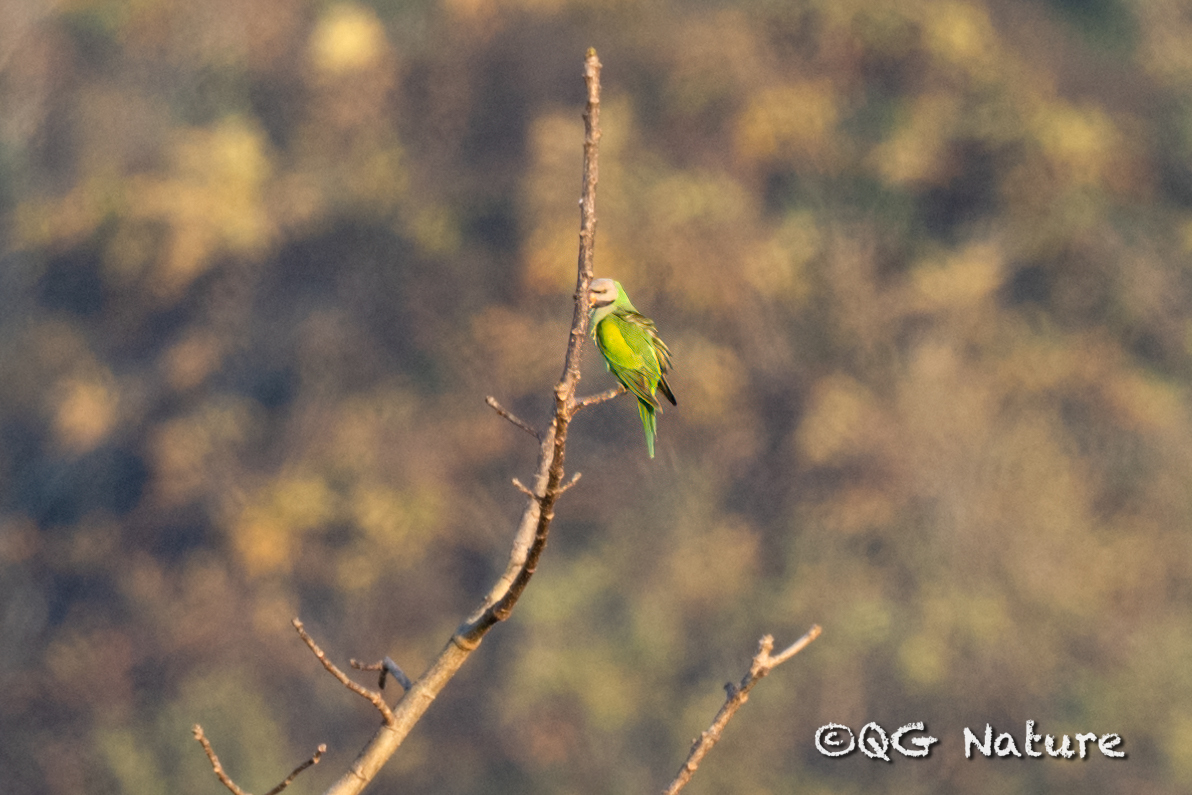
The red-breasted parakeet (Psittacula alexandri) is a parrot species native to Southeast Asia. It belongs to the genus Psittacula, which was established in 1800 by Georges Cuvier. The species is among the more widespread of its genus and exhibits the most geographical variations, with eight recognized subspecies. Most subspecies are confined to minuscule Indonesian islands, though one subspecies occurs in the Andaman Islands and another ranges across continental Southeast Asia into northeastern South Asia along the Himalayan foothills. The species is readily identified by the prominent red patch on its breast. Conservation concerns exist, as some island races face threats from the wild bird trade, and the nominate race in Java is considered close to extinction. Feral populations have established in several cities including Mumbai and Singapore.
Description
The red-breasted parakeet is a medium-sized parrot with distinctive plumage. The most notable feature is the large red patch covering the breast, which serves as a key identification mark. The sexes show sexual dimorphism, with males displaying more vibrant coloration. The alternative common name 'moustached parakeet' refers to the distinctive facial marking resembling a moustache found in some subspecies. The overall plumage is primarily green, typical of many Psittacula parakeets.
Identification
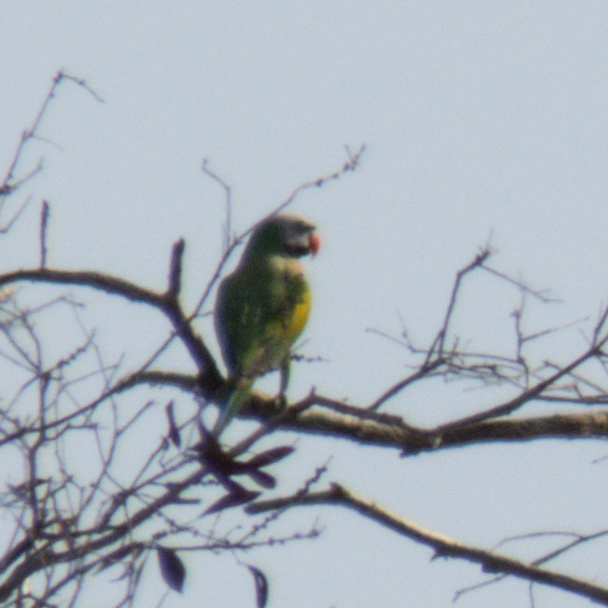
The large red breast patch is the most distinctive field mark, making this species relatively easy to identify within its range. The 'moustache' marking on the face provides additional identification cues. Separating subspecies can be challenging due to the high degree of geographic variation across its range. Care should be taken to distinguish it from other Psittacula parakeets, particularly where range overlaps occur.
Distribution & Habitat
This species occupies a broad geographic range across Southeast Asia and parts of South Asia. Subspecies occur across continental Southeast Asia from northern India through south China to Indochina, the Andaman Islands, and throughout the Indonesian archipelago including Java, Bali, south Borneo, Nias, and numerous smaller islands. The species has established feral populations in urban centers such as Mumbai and Singapore, with smaller numbers in Chennai and Bangalore.
Behavior & Ecology
Information on specific behavioral characteristics including diet, breeding biology, social structure, and vocalizations was not provided in the source article.
Conservation
Conservation status varies significantly among subspecies. The nominate race occurring in Java is classified as close to extinction. Several island subspecies face threats from the wild bird trade, which targets these populations for international commerce. The species' fragmented island distributions make many populations particularly vulnerable to decline.
Culture
No cultural significance or folklore was provided in the source article.
Source: Wikipedia · CC BY-SA 3.0
Taxonomy
- Order
- Psittaciformes
- Family
- Psittaculidae
- Genus
- Psittacula
- eBird Code
- rebpar4
Vocalizations
Subspecies (8)
-
Psittacula alexandri abbotti
Andaman Islands
-
Psittacula alexandri alexandri
Java, Bali, and far southern Borneo
-
Psittacula alexandri cala
Simeulue Island (off western Sumatra)
-
Psittacula alexandri dammermani
Karimunjawa Islands (Java Sea)
-
Psittacula alexandri fasciata
northern India to Nepal, Myanmar, Thailand, Indochina, and Hainan
-
Psittacula alexandri kangeanensis
Kangean Islands (Java Sea)
-
Psittacula alexandri major
Lasia Island and Babi Island (off Sumatra)
-
Psittacula alexandri perionca
Nias Island, off western Sumatra; may now be very rare
Data Sources
Species description from Wikipedia, licensed under CC BY-SA 3.0.
Bird images and sounds sourced from GBIF, contributed by citizen scientists worldwide under Creative Commons licenses.
Taxonomy data from AviList 2025.