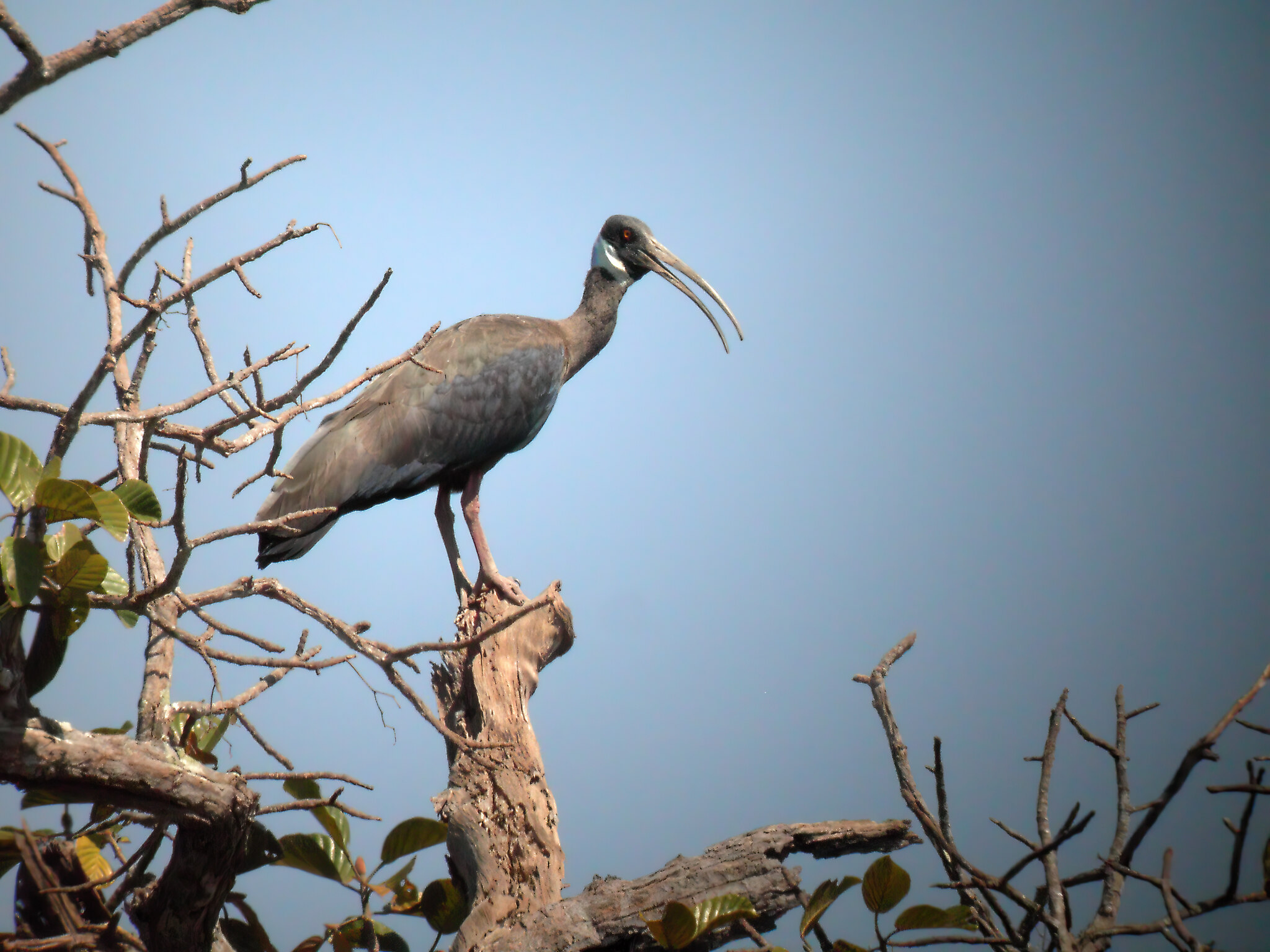
White-shouldered Ibis
Pseudibis davisoni
白肩黑鹮
Introduction
Large wading bird in family Threskiornithidae (order Pelecaniformes). Native to Southeast Asia, ranging historically from Myanmar and Thailand through Malaysia, Cambodia, Laos, Vietnam to Yunnan in China, with current populations restricted to northern and eastern Cambodia, southern Vietnam, extreme southern Laos, and East Kalimantan in Indonesian Borneo. Distinctive traits include being largely terrestrial in foraging behavior (unlike sympatric wading birds) and strong reliance on human-mediated agricultural practices that create and maintain its preferred microhabitats. Classified as Critically Endangered by IUCN, with an estimated global population of 1,000 individuals (approximately 670 mature).
Description
Large ibis measuring 60-85 cm in height, with males slightly larger and having longer bills. Plumage is brownish-black overall with glossy blue-black wings and tail. The bare head is slate-black (occasionally reported as blue or white). A conspicuous bluish-white neck collar of bare skin extends from the chin around to the nape, broader at the back and narrower at the front; may appear completely white in some individuals. Legs are dull red, iris orange-red, and the large bill is de-curved and yellowish-grey. The species derives its name from white patches on the upper neck and chin that appear as 'white shoulders' in flight. Juvenile has dull-brown plumage with brown feathers on the bluish-white nape, grey-brown iris, pale yellow legs, and dull white feet.
Identification
Similar in appearance to the black or red-naped ibis (Pseudibis papillosa) but lacks the red tubercles on the nape characteristic of that species. Larger and more robust with a longer neck and legs than the black ibis. The tail appears shorter and spreads downwards rather than extending straight. In flight, shows a conspicuous white wing patch visible as a thin white line when wings are closed. The bluish-white neck collar is a key distinguishing feature.
Distribution & Habitat
Formerly widespread across Southeast Asia from Myanmar to Thailand, Malaysia, Cambodia, Laos, Vietnam, and Yunnan, China. Current distribution is highly fragmented, with populations restricted to northern and eastern Cambodia, southern Vietnam, extreme southern Laos, and East Kalimantan. Cambodia holds 85-95% of the global population, with the largest known subpopulation (minimally 346 individuals) in Western Siem Pang Important Bird Area. Other significant Cambodian sites include Kulen Promtep Wildlife Sanctuary, Lomphat Wildlife Sanctuary, and the central Mekong River. Functionally extinct from Thailand, Myanmar, and southern China; very scarce in Indonesian Borneo and southern Laos. Inhabits dry dipterocarp forest, margins of seasonal pools, fallow rice fields, shrubby grasslands, forested lakesides, river margins, and sandbanks.
Behavior & Ecology
Terrestrial forager that rarely forages in open water. Preys on large worms, mole crickets, leeches, insect and beetle larvae, amphibians (Fejervarya limnocharis and Microhyla species), and eels. Forages singly, in pairs, or family groups of up to 14 individuals; larger flocks form during wet non-breeding season. Solitary breeder nesting December–April in Cambodia (mid- to late dry season) in dipterocarp tree canopies 10-25 m above ground. Clutch contains 2-4 pale blue eggs measuring 61.0-68.2 mm by 43.9-46.7 mm, incubated 28–31 days by female. Nestling period 26–40 days. Vocalizations include loud, mournful screams described as 'weird and unearthly,' with territorial calls of 'errrrh' or 'errrrrroh' and honking screams of 'errrrh owk owk owk owk owk.' Sedentary but makes small movements over 5 km; becomes gregarious during wet season July–October, roosting communally in trees with congregations up to 185 individuals.
Conservation
Classified as Critically Endangered. Global population estimated at 1,000 individuals (670 mature), with 973 counted in Cambodia's 2013 census and 30-100 estimated in Indonesia. Severe population declines in the late 20th century. Primary threats include habitat conversion through wetland drainage for agricultural plantations, unsustainable rural development, changing land management, infrastructural developments, and proposed dams. Approximately 75% of roosting individuals occur outside protected areas. Modern agricultural mechanization threatens the traditional ungulate grazing practices that maintain the bird's habitat by creating forest clearings and seasonal pools. Additional threats include nest predation by jungle crows and mammals, high winds, and fire damage to habitat. Nest guarding schemes have shown no significant reduction in nest failure, indicating natural causes of mortality predominate.
Culture
No significant cultural or folklore traditions documented for this species. Not commercially valued for trade; only one captive record exists (imported to Thailand from Cambodia in 1989, held at Queen's Bird Park near Bangkok in 1990). While opportunistically exploited for food by local people, it is not a targeted species. The species' reliance on human agricultural activity brings it closer to human habitation than similar sympatric species, sometimes roosting and nesting in trees near active rice paddies.
Source: Wikipedia · CC BY-SA 3.0
Taxonomy
- Order
- Pelecaniformes
- Family
- Threskiornithidae
- Genus
- Pseudibis
- eBird Code
- whsibi1
Distribution
southwestern China to Myanmar, peninsular Thailand, and Indochina
Data Sources
Species description from Wikipedia, licensed under CC BY-SA 3.0.
Bird images and sounds sourced from GBIF, contributed by citizen scientists worldwide under Creative Commons licenses.
Taxonomy data from AviList 2025.