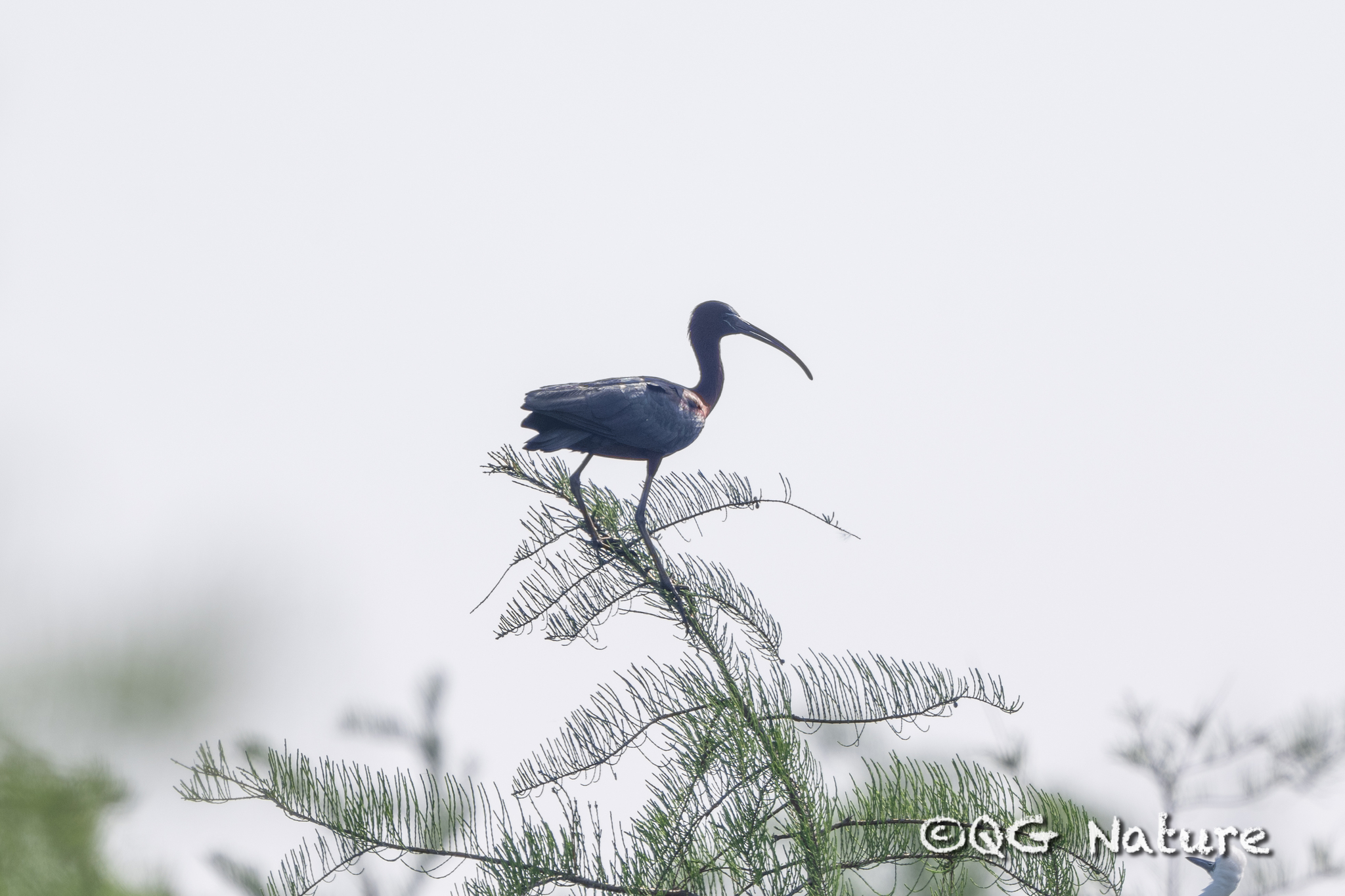

Glossy Ibis
Plegadis falcinellus
彩鹮
Introduction
The most widespread of all ibis species, this waterbird naturally colonised northern South America in the 19th century before spreading into North America. Since the 1940s, populations have expanded northward substantially, and in the 1980s the species expanded further west. In Europe, after centuries of decline due to hunting, legal protection has allowed populations to recover, with breeding colonies now established in Spain and France. The species breeds in Britain and Ireland since 2022. It occupies various wetland habitats, including natural marshes, agricultural wetlands, and sewage ponds. It typically occurs in small flocks, forages in shallow water, and flies with necks outstretched in V formations.
Description
A mid-sized ibis measuring 48-66 cm in length with an average of 59.4 cm and a wingspan of 80-105 cm. Adults weigh between 485-970 g. Breeding plumage is striking, with reddish-brown bodies and highly iridescent wing feathers that shift between bottle-green, bronze and purple depending on light angle. A narrow white facial band frames the bill, though this is much less conspicuous than in the similar white-faced ibis. The bill measures 9.7-14.4 cm and is brownish in colour. Non-breeding adults and juveniles display duller overall plumage, with dark brown head and neck finely streaked with white. Legs are red-brown, and facial skin ranges from blue-grey in non-breeders to cobalt blue during breeding season. Unlike herons, this species flies with the neck fully outstretched in a graceful, often V-shaped formation.
Identification
The most reliable distinguishing feature from the closely related white-faced ibis is the much less prominent white facial marking. In flight, the outstretched neck immediately separates ibises from herons, which retract their necks. The iridescent wing feathers in breeding plumage are highly distinctive and catch the light dramatically. Juveniles can be confused with other brown waders but are best identified by their distinctive sickle-shaped bill and the fine white streaking on the head and neck. In non-breeding plumage, the overall darker appearance and lack of the prominent white facial band of the white-faced ibis are key clues.
Distribution & Habitat
The most widespread ibis species globally, breeding across warm regions of Europe, Asia, Africa, Australia, and the Atlantic and Caribbean regions of the Americas. European populations migrate to Africa for winter, while North American birds from the Carolinas northward move further south. In India, however, the species is resident rather than migratory. Western India supports year-round populations that breed in colonies amongst wetlands, forests with bamboo thickets, and agricultural areas. Recent decades have seen expansion northward in Europe and the establishment of breeding colonies in Britain for the first time in 2022. Birds disperse widely outside breeding season, with individuals reaching New Zealand annually and occasionally breeding there amongst royal spoonbill colonies.
Behavior & Ecology
Highly nomadic and dispersive after breeding, with northern populations undertaking full migration across broad fronts including the Sahara Desert. Ringed birds from the Black Sea winter primarily in West Africa's Sahel region, while Caspian Sea populations migrate to East Africa, Arabia and as far as Pakistan and India. In western India, numbers fluctuate seasonally with peaks in winter and summer, declining during monsoons as birds move to suitable breeding areas. Temperate populations breed in spring, while tropical populations time nesting with rainy seasons. Nesting occurs in mixed-species colonies, with platforms of twigs positioned 1-7 m above water in dense vegetation. Foraging occurs in very shallow water in small flocks, though post-breeding gatherings can exceed 100 birds. The species is generally quiet but produces various croaks and grunts, including a hoarse 'grrrr' during breeding. Roosting occurs communally in large flocks, often in trees distant from feeding areas.
Conservation
The species is protected under the Agreement on the Conservation of African-Eurasian Migratory Waterbirds (AEWA). After severe declines in the 19th and early 20th centuries due to uncontrolled hunting and habitat loss, populations have recovered significantly across Europe, particularly in Spain where thousands of pairs now breed. However, illegal hunting remains a problem in some regions such as Italy, where breeding numbers remain low at only 10-50 pairs. The primary ongoing threat is wetland habitat degradation and loss through drainage, increased salinity, groundwater extraction and invasion by exotic plants. Despite these pressures, the species has shown remarkable adaptability and expanding range in recent decades.
Culture
Historical references to this species appear in Anglo-Saxon literature, and it was known as the 'black curlew' in Norfolk until the early 19th century. Despite this literary presence, the species lacks the rich mythological associations that some other ibis species hold in Egyptian culture. The historical naming and literary references provide interesting context for birdwatchers exploring the species' natural history in Britain and Ireland, where it remains a relatively recent colonist despite its earlier documentation in the region.
Source: Wikipedia · CC BY-SA 3.0
Taxonomy
- Order
- Pelecaniformes
- Family
- Threskiornithidae
- Genus
- Plegadis
- eBird Code
- gloibi
Distribution
locally in eastern North and southern South America, Africa, Eurasia, and southern Asia to Australasia
Vocalizations
Data Sources
Species description from Wikipedia, licensed under CC BY-SA 3.0.
Bird images and sounds sourced from GBIF, contributed by citizen scientists worldwide under Creative Commons licenses.
Taxonomy data from AviList 2025.