Pine Grosbeak
Pinicola enucleator
松雀
Introduction
A species of true finch in the family Fringillidae. It is the sole species in the genus Pinicola. Range spans coniferous forests across Alaska, the western mountains of the United States, Canada, subarctic Fennoscandia, and across the Palearctic to Siberia. Inhabits boreal coniferous forests year-round but exhibits irruptive behavior in years when fruit crops are poor, moving long distances south or downslope in search of food. Primarily frugivorous in winter, favoring small fruits such as rowans. Conservation status not assessed in article.
Description
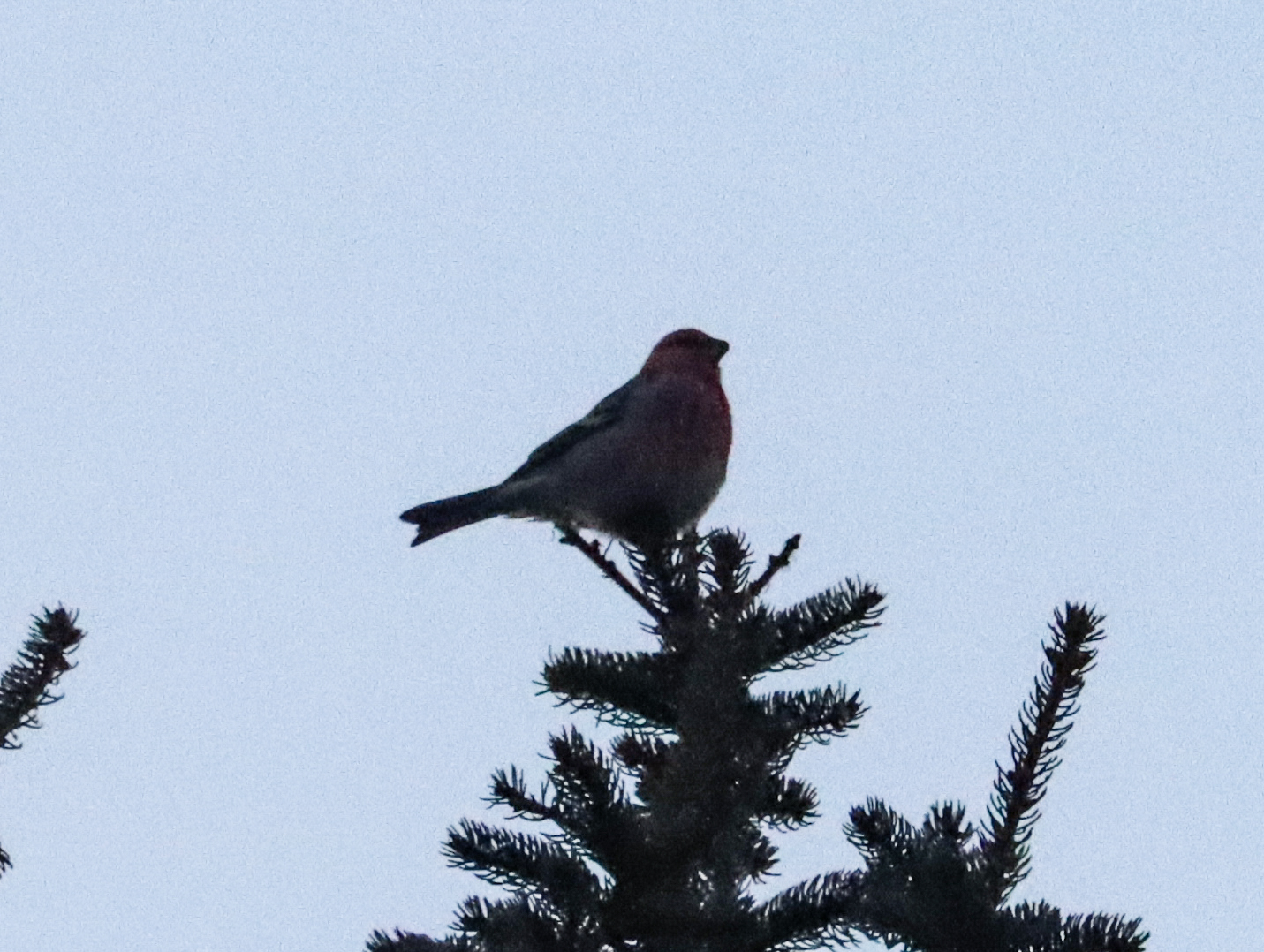
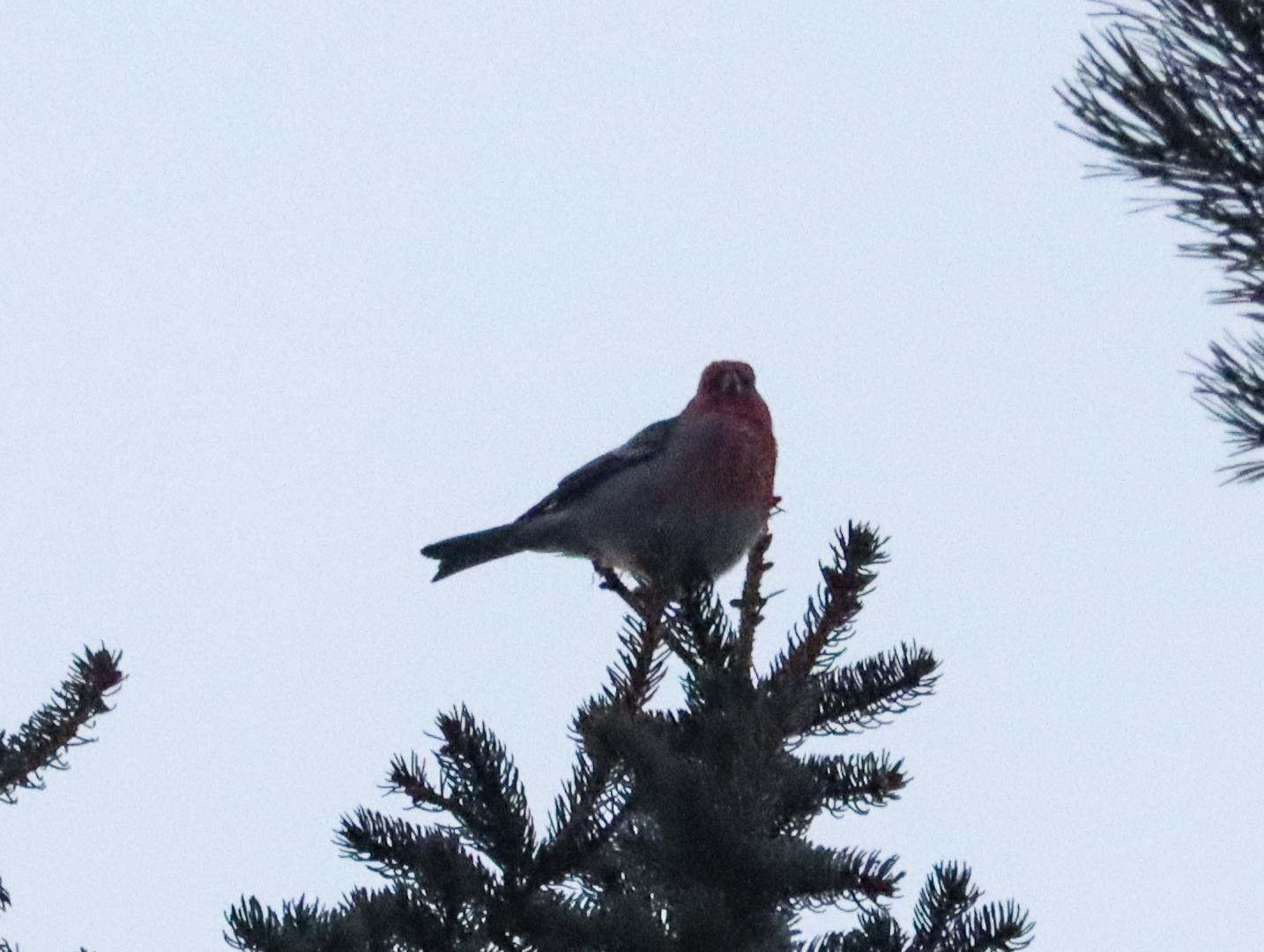
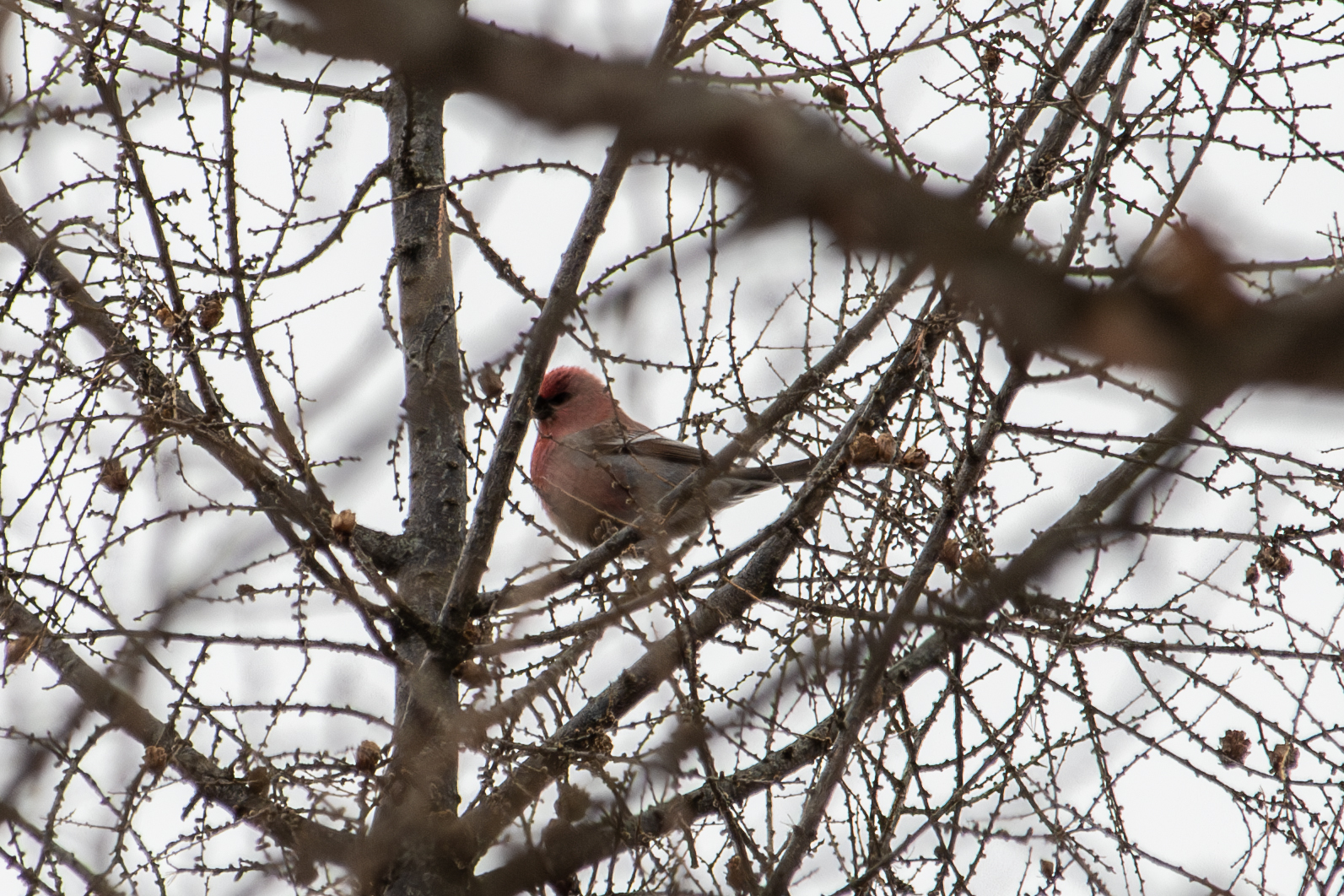
One of the largest true finches, measuring 20-25.5 cm in length and weighing 52-78 g with a 33 cm wingspan. Adults have a long forked black tail, black wings with white wing bars, and a large conical bill. Males display rose-red coloration on the head, back, and rump with black wings and tail. Females show olive-yellow on the head and rump with grey upperparts and underparts. Immature birds have less contrasting plumage and appear shaggy when moulting their colored head feathers.
Identification
Distinctive large finch with forked tail and white wing bars. Males are unmistakable with rose-red plumage. Females identified by combination of grey body, olive-yellow head and rump, and forked tail. Larger and less contrastingly colored than similar finches. Voice includes a whistled 'pui pui pui' or 'chii-vli' call and a short musical warble song.
Distribution & Habitat
Breeds in boreal forests across northern Eurasia and North America. Typically resident near breeding grounds or migrates short distances to southern boreal forest edges. During irruption years, moves further south, reaching the northern Great Lakes region and northern New England in the United States. Very rare vagrant to temperate Europe, with fewer than 4 individuals recorded annually in Germany since 1980. Inhabits coniferous forests and associated woodlands.
Behavior & Ecology
Breeding habitat is coniferous forests where nests are placed on horizontal branches or in tree forks. Both sexes develop gular pouches for storing seeds before feeding young. Forages in trees and bushes, consuming seeds, buds, berries, and insects. Outside breeding season, feeds in flocks. Vocalizations include a whistled 'pui pui pui' or 'chii-vli' call and a short musical warble song. Resident through most of range but may migrate south when food is scarce.
Conservation
IUCN status not explicitly stated in article. Population trends and specific threats not detailed. As an irruptive species dependent on fruit crops, may be affected by changes in fruiting plant availability.
Culture
No cultural significance or folklore mentioned in article.
Source: Wikipedia · CC BY-SA 3.0
Taxonomy
- Order
- Passeriformes
- Family
- Fringillidae
- Genus
- Pinicola
- eBird Code
- pingro
Subspecies (8)
-
Pinicola enucleator californica
Sierra Nevada Mountains (eastern California)
-
Pinicola enucleator carlottae
islands and coasts of British Columba from Haida Gwaii to Vancouver Island
-
Pinicola enucleator enucleator
northern Scandinavia to Russia and western Siberia (Yenisey River)
-
Pinicola enucleator flammula
breeds southern Alaska to northwestern British Columbia; winters to northwestern USA
-
Pinicola enucleator kamtschatkensis
northeastern Siberia
-
Pinicola enucleator leucura
breeds in the boreal zone of North America, from Alaska eastward to southern Quebec and Newfoundland; resident, but some disperse southward in winter
-
Pinicola enucleator montana
interior central British Columbia to Rocky Mountains of southwestern USA
-
Pinicola enucleator sakhalinensis
Sakhalin, Kuril Islands, and high mountains of Hokkaido
Data Sources
Species description from Wikipedia, licensed under CC BY-SA 3.0.
Bird images and sounds sourced from GBIF, contributed by citizen scientists worldwide under Creative Commons licenses.
Taxonomy data from AviList 2025.