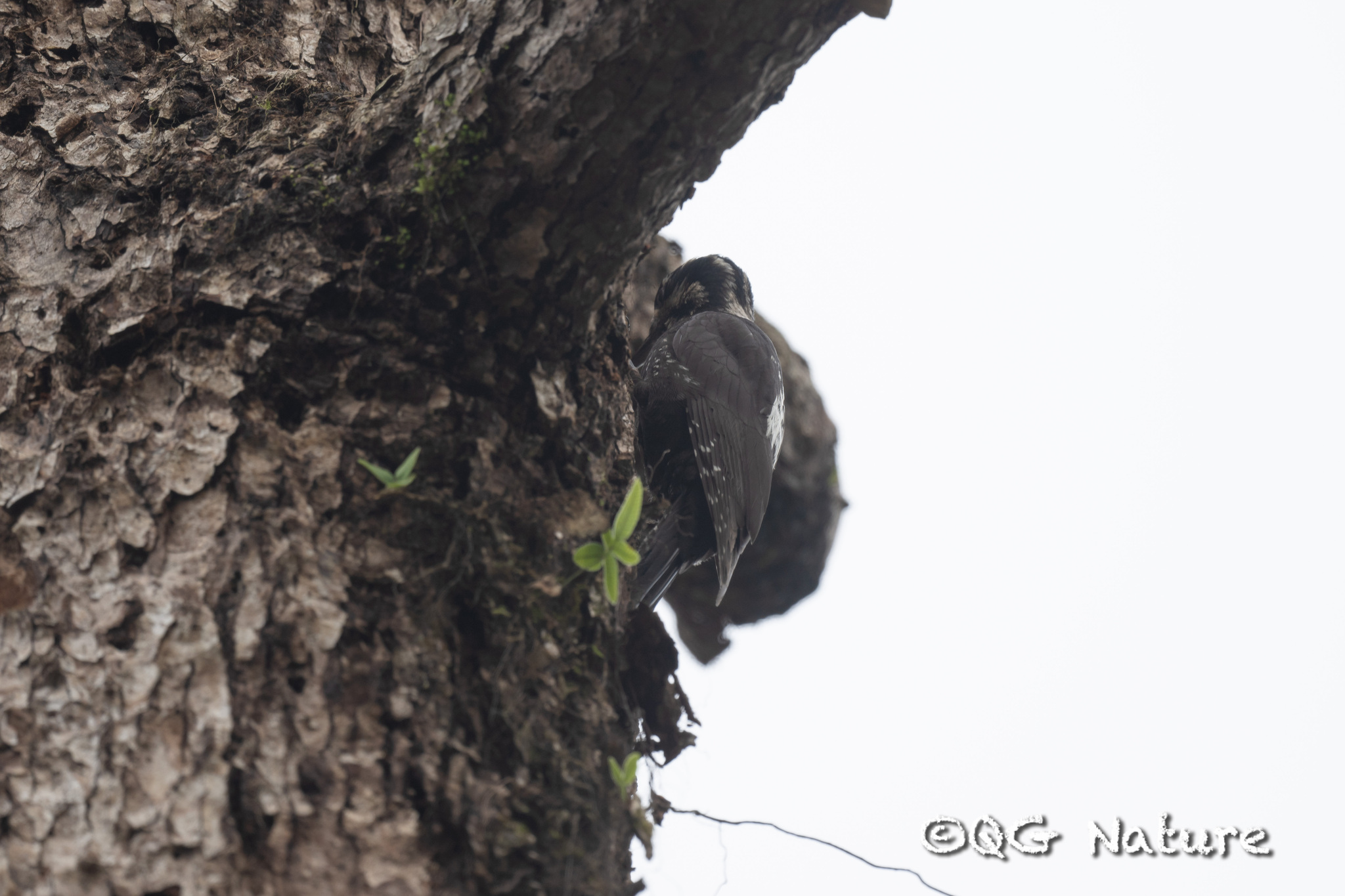
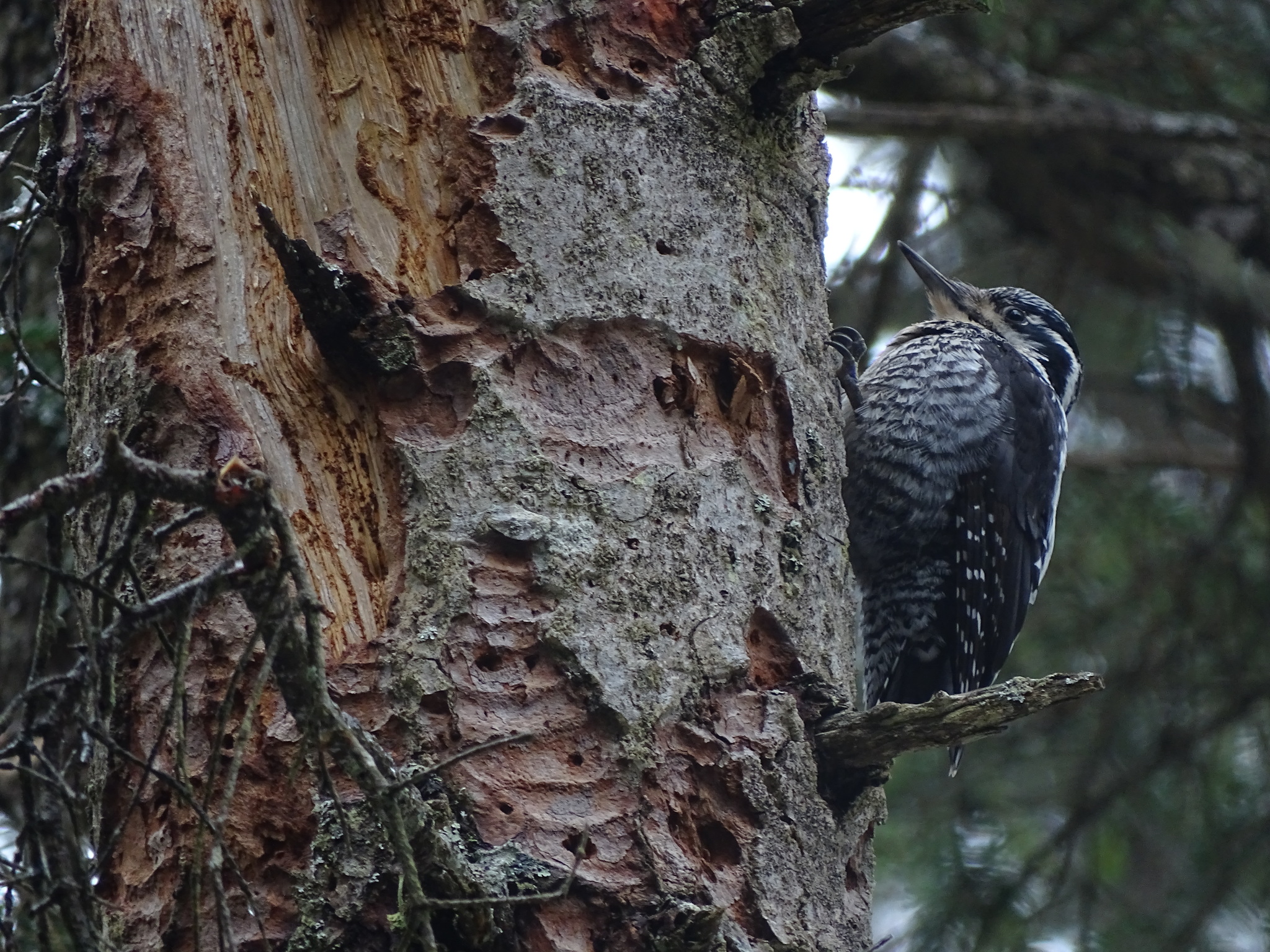
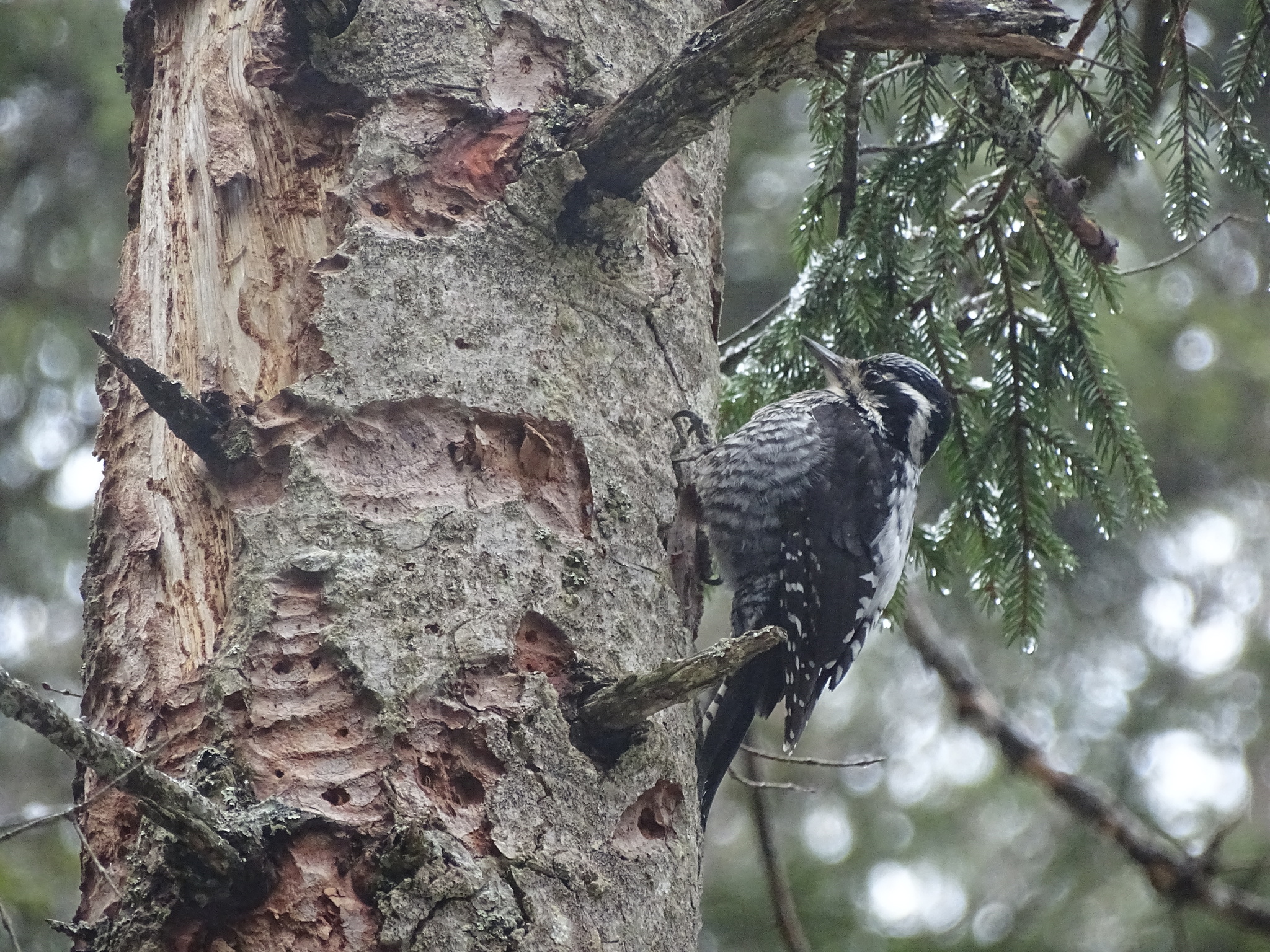
Eurasian Three-toed Woodpecker
Picoides tridactylus
三趾啄木鸟
Introduction
A woodpecker species (Picidae family) found across the boreal coniferous forest zone of the Palearctic, ranging from northern Europe through northern Asia to Japan, including populations in the Alps and Carpathian Mountains. Distinguished by having only three toes (zygodactyl arrangement with two forward, one back) and being among the few woodpecker species where males and females lack red plumage. This species often follows forest disturbances, moving into burned or flooded areas with insect-infested trees. Eight subspecies are recognized, with P. t. funebris sometimes treated as a separate species. Classified as Least Concern by the IUCN due to its wide range and large population.
Description
A medium-sized woodpecker, 21–22 cm (8.3–8.7 in) in length, slightly smaller than the great spotted woodpecker. The plumage is predominantly black and white. Adults have black wings and rump, white underparts from throat to belly with black-barred flanks, and a white back with black bars. The tail is black with white outer feathers barred with black. The most distinctive feature is the yellow crown, present in adult males; unlike most woodpeckers, neither sex has any red feathers. Juveniles of both sexes also show a yellow crown.
Identification
The combination of black-and-white plumage with yellow crown (males) and absence of red feathers distinguishes this species from other European woodpeckers. The three-toed foot structure is not visible in the field. Compared to the similar American three-toed woodpecker, the Eurasian species has a white, not black, back with black bars. The call is a sharp kik or chik, delivered singly or in series.
Distribution & Habitat
Boreal coniferous forest zone across the Palearctic from Norway to Korea, including the Alps and Carpathian Mountains. The range extends across northern Europe to the southern Urals and southeastern Siberia, with subspecies occupying central and southeastern Europe, the Urals to eastern Siberia, Kamchatka, Kazakhstan and western China, northeastern China and Korea, Hokkaido, and central China. Northern populations are somewhat nomadic, with birds moving south in winter; high-elevation populations descend to lower levels seasonally.
Behavior & Ecology
Forages on conifers for wood-boring beetle larvae and other insects, also consuming fruit and tree sap. Constructs a new nest cavity annually in dead conifer trees, occasionally in live trees or poles. Normally permanent residents, though northern populations exhibit southward movements in winter, and high-elevation birds descend to lower elevations. Often appears in numbers following forest fires or flooding, exploiting increased beetle populations in damaged trees. The call is a sharp kik or chik.
Conservation
IUCN status: Least Concern. The 2015 BirdLife European population survey estimated 1,200,000–2,900,000 adults, representing roughly 20% of the global population of 6,000,000–14,500,000 adults. Although some decline occurred in European populations between 1970 and 2000, the overall trend is considered stable. Large range and substantial population support the current classification.
Source: Wikipedia · CC BY-SA 3.0
Taxonomy
- Order
- Piciformes
- Family
- Picidae
- Genus
- Picoides
- eBird Code
- ettwoo1
Subspecies (8)
-
Picoides tridactylus albidior
Kamchatka Peninsula
-
Picoides tridactylus alpinus
central and southeastern Europe to western Ukraine and Romania
-
Picoides tridactylus crissoleucus
northern taiga from Ural Mountains to Sea of Okhotsk
-
Picoides tridactylus funebris
southwestern China to Tibet
-
Picoides tridactylus inouyei
Hokkaido (Japan)
-
Picoides tridactylus kurodai
northeastern China and northern Korean Peninsula
-
Picoides tridactylus tianschanicus
eastern Kazakhstan and western China
-
Picoides tridactylus tridactylus
northern Europe to northern Mongolia, Manchuria, and Sakhalin
Data Sources
Species description from Wikipedia, licensed under CC BY-SA 3.0.
Bird images and sounds sourced from GBIF, contributed by citizen scientists worldwide under Creative Commons licenses.
Taxonomy data from AviList 2025.