Common Chiffchaff
Phylloscopus collybita
叽喳柳莺
Introduction
The chiffchaff (Phylloscopus collybita) is a leaf warbler species breeding across Europe and the Palearctic. It inhabits open woodlands with mature trees and sufficient ground cover. The species has expanded its range northward into Scandinavia in recent decades. It is characterized by tail-wagging behavior and a diagnostic 'hweet' call. Some populations now winter in increasingly northern areas of western Europe, including urban centers like London, where mild microclimates allow individuals to remain year-round.
Description
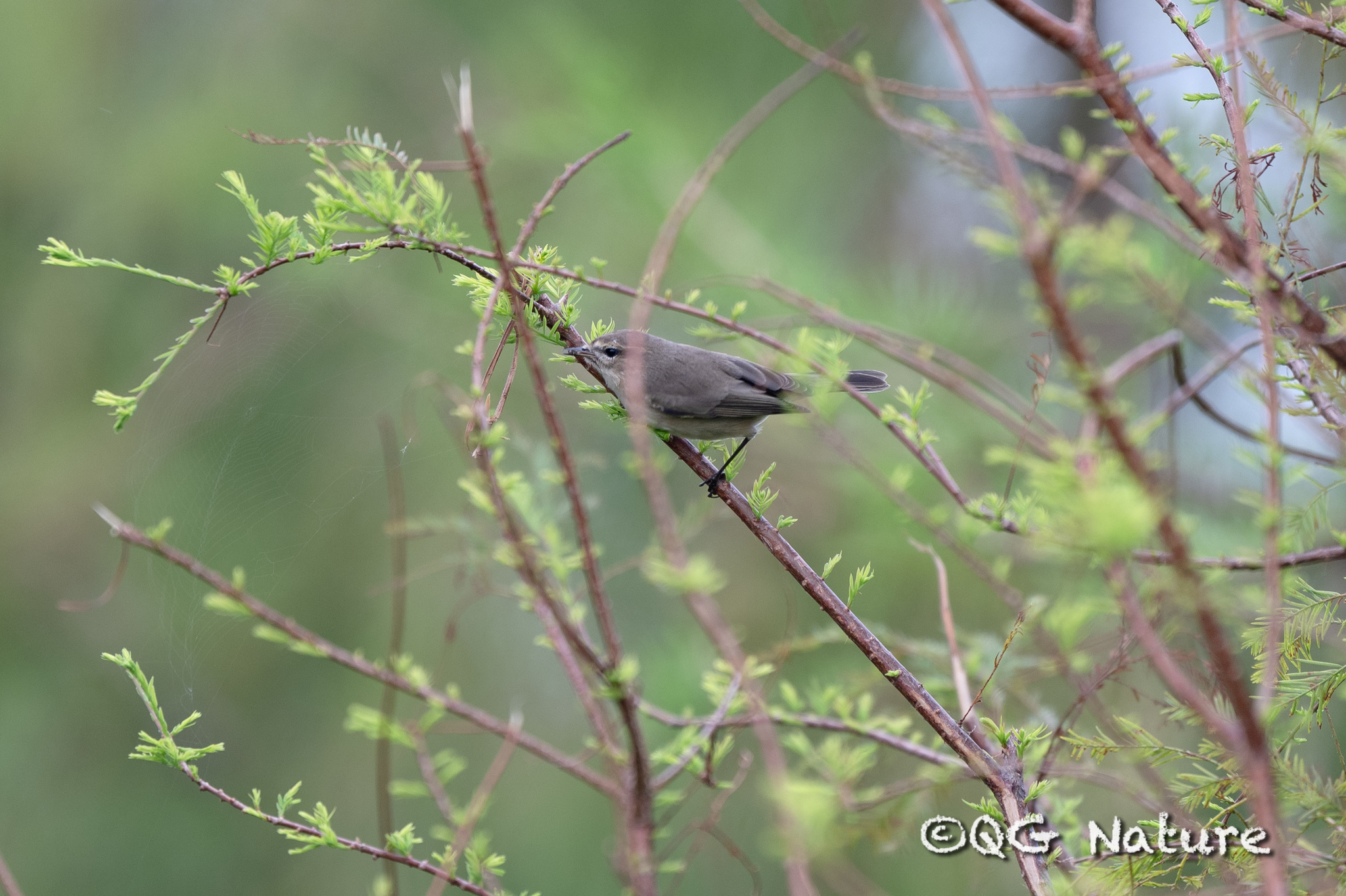
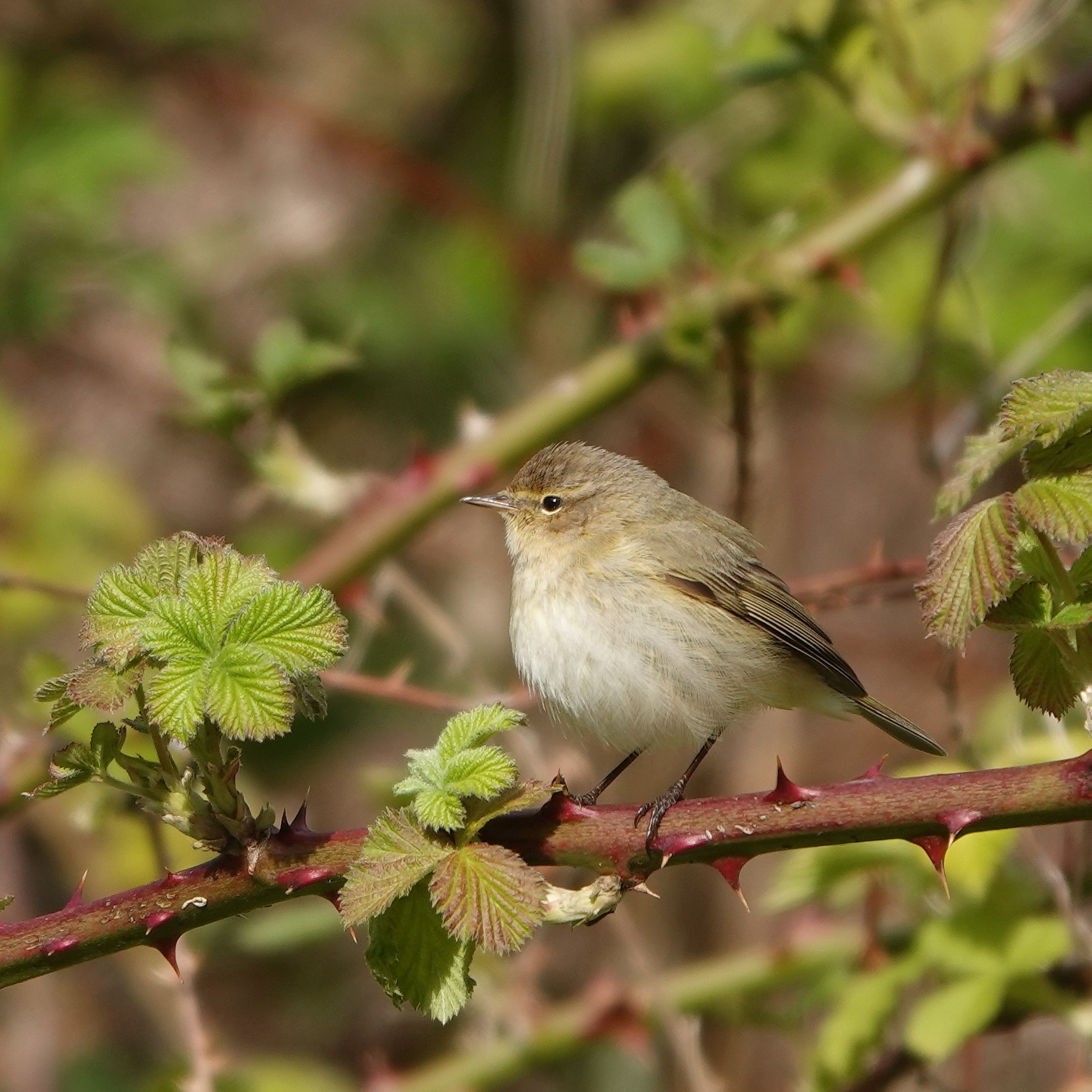
This diminutive warbler measures 10-12 centimeters in length, with males weighing 7-8 grammes and females slightly lighter at 6-7 grammes. The nominate western subspecies has brown-washed dull green upperparts with off-white underparts that show yellowish tones on the flanks. It possesses a short whitish supercilium, dark legs, and a fine dark bill. The primary projection—the extension of flight feathers beyond the folded wing—is noticeably short. As the breeding season progresses, plumage becomes duller and browner, though a complete moult occurs after nesting before migration restores brighter colors. Juveniles are browner above with yellow-white underparts before their first moult. The rounded wings in flight and characteristic tail movement—a dip followed by a sideways wag—provide additional identification features.
Identification
Distinguishing non-singing chiffchaffs from the similar willow warbler presents the greatest challenge. The willow warbler has a longer primary projection, paler legs, and a sleeker, brighter appearance overall. The chiffchaff's call is a shorter, less disyllabic 'hweet' compared to the willow warbler's 'hooeet.' The characteristic tail-wagging motion is diagnostic among Phylloscopus warblers and has earned the species the alternative name 'tailwagger' in India. Iberian chiffchaffs in southwestern Europe can be particularly problematic when not singing, though vocal differences are usually reliable. Eastern subspecies such as abietinus and tristis are generally paler and greyer, with tristis showing very little yellow in its plumage. Bonelli's warbler may be confused with tristis but has a plain face with green in the wings.
Distribution & Habitat
The breeding range extends across Europe and Asia eastward to eastern Siberia, reaching approximately 70°N latitude, with isolated populations in northwest Africa, northern and western Turkey, and northwestern Iran. This is one of the earliest returning passerines in spring and among the last to depart in late autumn. Breeding habitat consists of open woodlands containing trees at least five meters high with an understory of grasses, bracken, or nettles. The species winters more widely in scrub and other habitats, often near water, throughout southern and western Europe, southern Asia, and north Africa. There is an increasing tendency for birds to overwinter in western Europe north of traditional areas, particularly in coastal southern England and urban areas.
Behavior & Ecology
During breeding, males defend territories of about 20 meters across with great ferocity, attacking even dangerous predators like stoats that approach the nest. The female builds a domed nest on or near the ground concealed in low vegetation, taking sole responsibility for incubation of the two-to-seven cream-colored eggs over 13-14 days. She also broods and feeds the altricial chicks for another 14-15 days until fledging, with males rarely participating in feeding. The diet consists almost entirely of insects, particularly flies from more than 50 families, along with butterfly and moth eggs and larvae. The species feeds continuously to build fat reserves for migration, requiring approximately one-third of its body weight in insects daily. After breeding, they abandon territories and may join mixed flocks before migration. The simple, repetitive 'chiff-chaff' song is one of the first signs of spring return.
Conservation
With an enormous global range of approximately 10 million square kilometers and a European population of 60-120 million individuals, this species is evaluated as Least Concern by the IUCN. Global population trends have not been quantified, but the species does not approach thresholds for significant decline. The range appears to be expanding northward in Scotland, Norway, and Sweden, with population increases reported in Denmark and the Czech Republic. The eastern subspecies abietinus and tristis occupy huge geographic areas, and woodland conservation policies in the range of the nominate subspecies bode well for the species' future. Only P. c. exsul of the Canary Islands is considered probably extinct, disappearing from Lanzarote by 1986. Main threats include habitat loss from woodland clearance, predation by cats, and collisions with structures.
Culture
The species' name is onomatopoeic, derived from its distinctive repetitive song, and similar names exist in other European languages including Dutch tjiftjaf, German Zilpzalp, Welsh siff-saff, and Finnish tiltaltti. Gilbert White was among the first naturalists to distinguish this species from the willow warbler and wood warbler by their songs, as documented in his 1789 work The Natural History and Antiquities of Selborne. In some languages, the tree-dwelling habit is reflected in the vernacular name; in Swedish, gransångare combines 'spruce' with 'singer.' The scientific name Phylloscopus derives from Greek for 'leaf' and 'to look at,' reflecting the genus's habit of feeding in trees, while collybita references a 'money changer' for the jingling quality of the song.
Source: Wikipedia · CC BY-SA 3.0
Taxonomy
- Order
- Passeriformes
- Family
- Phylloscopidae
- Genus
- Phylloscopus
- eBird Code
- comchi1
Subspecies (6)
-
Phylloscopus collybita abietinus
Scandinavia to Urals, Caucasus, Transcaucasia, and northern Iran
-
Phylloscopus collybita brevirostris
highlands of western Türkiye and Black Sea coastlands of northern Türkiye
-
Phylloscopus collybita caucasicus
east of range of brevirostris at lower elevations southward to Armenia
-
Phylloscopus collybita collybita
breeds British Isles eastward to southern Sweden, and from France and northern Spain to Poland and northwestern Türkiye; non-breeders move mostly to Mediterranean and from northwestern and western Africa (including Canary Islands) to Middle East
-
Phylloscopus collybita menzbieri
northeastern Iran (eastern Elburz Mountains and Khorasan Mountains) and southwestern Turkmenistan
-
Phylloscopus collybita tristis
Ural Mountains to northeastern Iran, northern India, and Bangladesh
Data Sources
Species description from Wikipedia, licensed under CC BY-SA 3.0.
Bird images and sounds sourced from GBIF, contributed by citizen scientists worldwide under Creative Commons licenses.
Taxonomy data from AviList 2025.