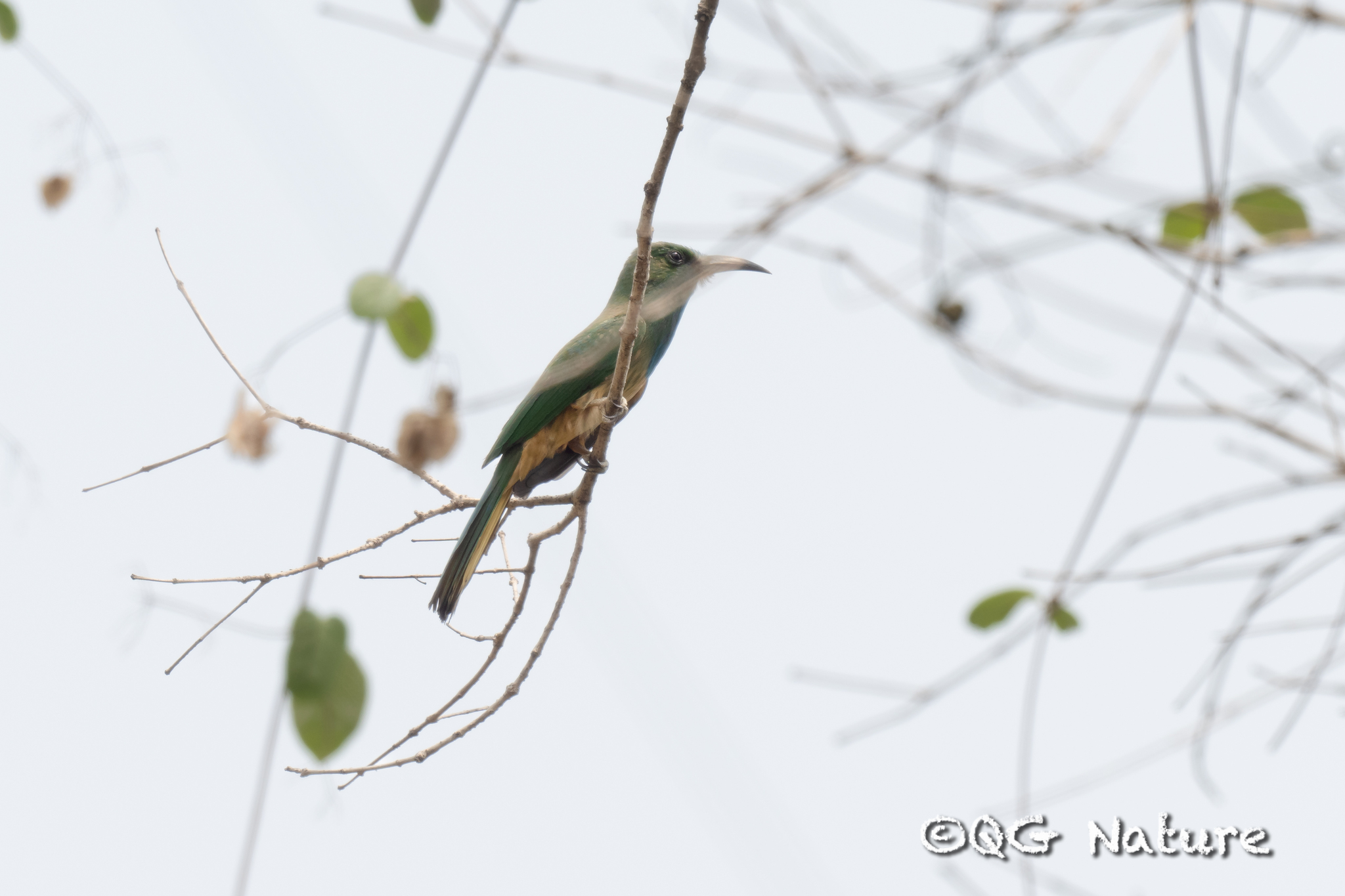
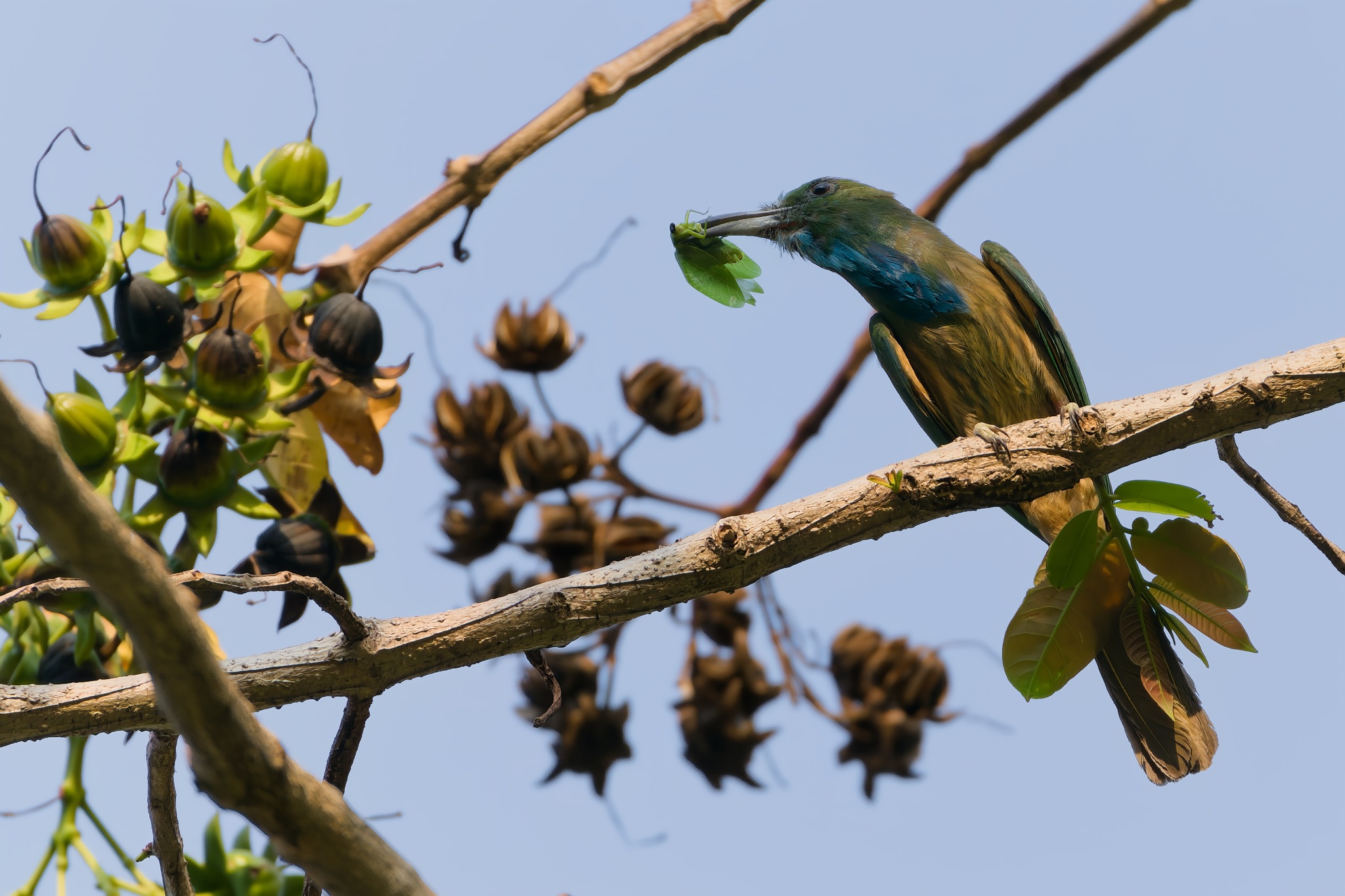
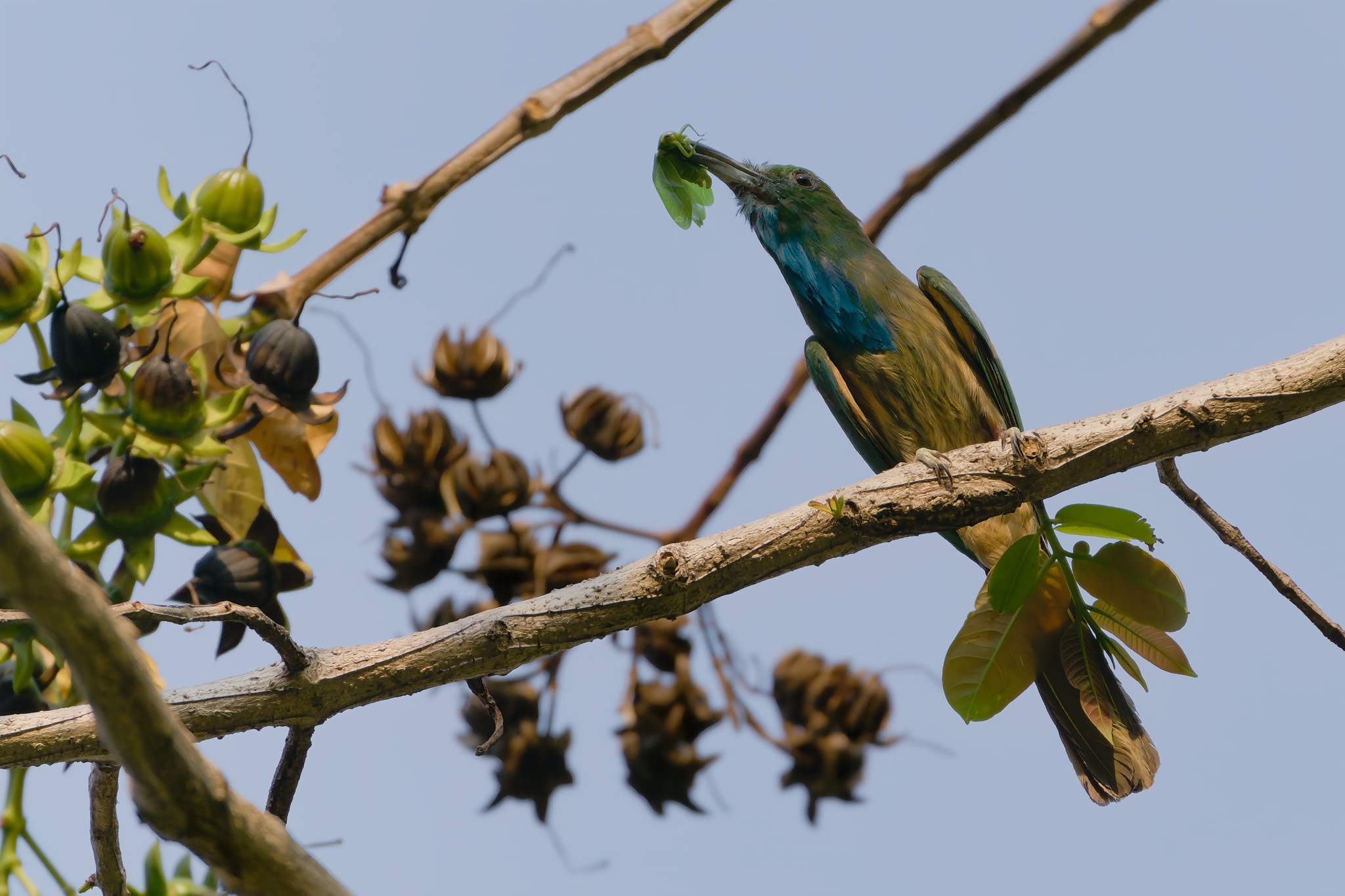
Blue-bearded Bee-eater
Nyctyornis athertoni
蓝须夜蜂虎
Introduction
Family: Meropidae (bee-eaters). Found throughout the Indian subcontinent and parts of Southeast Asia, with core range in the Malayan region extending west into peninsular India. Inhabits forest clearings and thin to fairly thick forest at medium elevations below 2000m altitude. Distinguished by elongated blue throat feathers that form a 'beard' when fluffed. Unlike smaller bee-eaters, this species is not particularly gregarious or active, and has a square-ended tail lacking the central feather 'wires' typical of other bee-eaters. Has a loud call but does not call frequently.
Description
The largest species of bee-eater, measuring 31-35 cm in length and weighing 70-93 g. Features a large sickle-shaped bill and square-ended tail without the typical 'wires' of other bee-eaters. Plumage is grass green overall with turquoise forehead, face, and chin. The elongated throat feathers create a bearded appearance when fluffed. Belly is yellowish to olive with streaks of green or blue. Populations in peninsular India are paler green than those in northeast India. Sexes appear similar, though males show higher ultraviolet reflectivity on blue throat feathers.
Identification
Larger than other bee-eaters with distinctive square-ended tail lacking central feather extensions. The elongated blue throat feathers set it apart from all other bee-eater species. The combination of large size, grass green plumage, turquoise face, and bearded throat appearance is diagnostic. Not as active or gregarious as smaller bee-eaters, making it less frequently observed.
Distribution & Habitat
Occurs throughout the Indian subcontinent including hill regions of the Satpuras, Western Ghats, Eastern Ghats, Nilgiris, Chota Nagpur, and Sub-Himalayan forests. Extends into mainland Southeast Asia. An insular population (brevicaudatus) exists on Hainan. Inhabits forest clearings and thin to fairly thick forest at medium elevations below 2000m. Found singly or in small groups of up to three in very patchy distribution.
Behavior & Ecology
Vocalizations include cackling hornbill-like calls, a dry 'Kit-tik... Kit-tik' series, and hollow nasal 'kyao' calls. Pairs engage in duets ending in purring notes. Flight is undulating and barbet-like. Breeding occurs February to August in India; courtship involves ritual feeding, bowing, and tail fanning. Nests are deep tunnels in mud banks containing four spherical white eggs. Feeds mainly on bees, exploiting Giant honey bee (Apis dorsata) defensive behavior by provoking mass releases of guard bees. May glean from bark and occasionally visit Erythrina and Salmalia flowers. Joins mixed-species foraging flocks.
Conservation
No IUCN assessment mentioned. Historically described as 'very rare' and found in 'thickest jungles.' Patchily distributed and easily overlooked despite its large size.
Culture
Named after Lieut. John Atherton (13th Light Dragoons, died 1827), who provided the specimen to P.J. Selby. Described by Jardine and Selby in Illustrations of Ornithology (1828).
Source: Wikipedia · CC BY-SA 3.0
Taxonomy
- Order
- Coraciiformes
- Family
- Meropidae
- Genus
- Nyctyornis
- eBird Code
- bbbeat1
Subspecies (2)
-
Nyctyornis athertoni athertoni
India to southwestern China and southeastern Asia
-
Nyctyornis athertoni brevicaudatus
Hainan (southern China)
Data Sources
Species description from Wikipedia, licensed under CC BY-SA 3.0.
Bird images and sounds sourced from GBIF, contributed by citizen scientists worldwide under Creative Commons licenses.
Taxonomy data from AviList 2025.