Northern Nutcracker
Nucifraga caryocatactes
星鸦
Introduction
A passerine bird in the crow family Corvidae, slightly smaller than the Eurasian jay but with a much larger bill and a slimmer crestless head. This species inhabits the vast taiga conifer forests across northern Europe and Asia from Scandinavia to Japan, with disjunct populations in mountain forests of the Alps, Carpathians, and Balkans. Two key adaptations distinguish this bird: specialized seed-caching behavior that enables forest regeneration, and a uniquely forked, keratinized tongue tip for handling conifer seeds. The species is not migratory but performs irruptions when cone crops fail. Four subspecies are recognized, differing primarily in bill size and geographic distribution. The species has a range of 10,000,000 km² and a European population estimated at 800,000-1,700,000 individuals.
Description
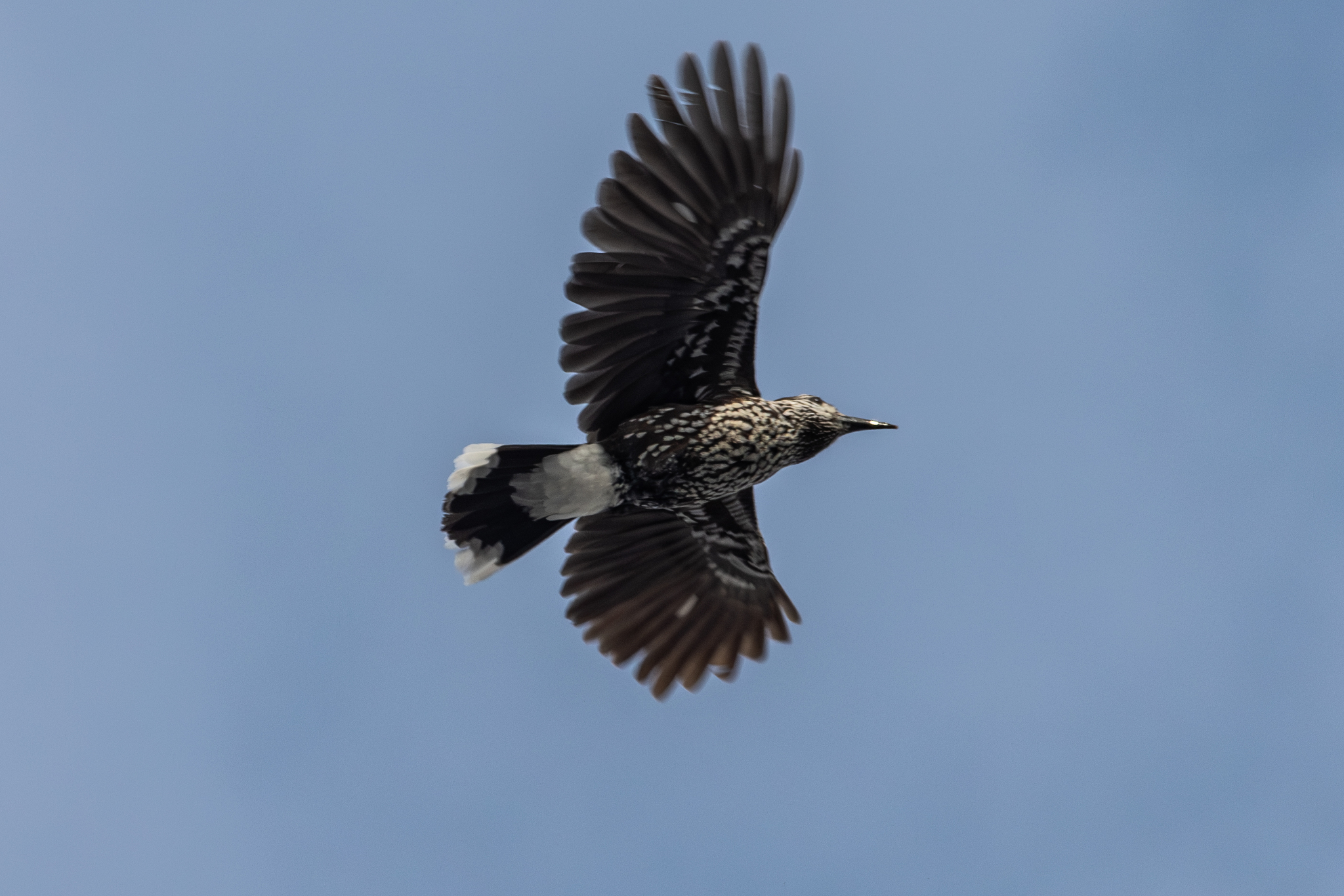
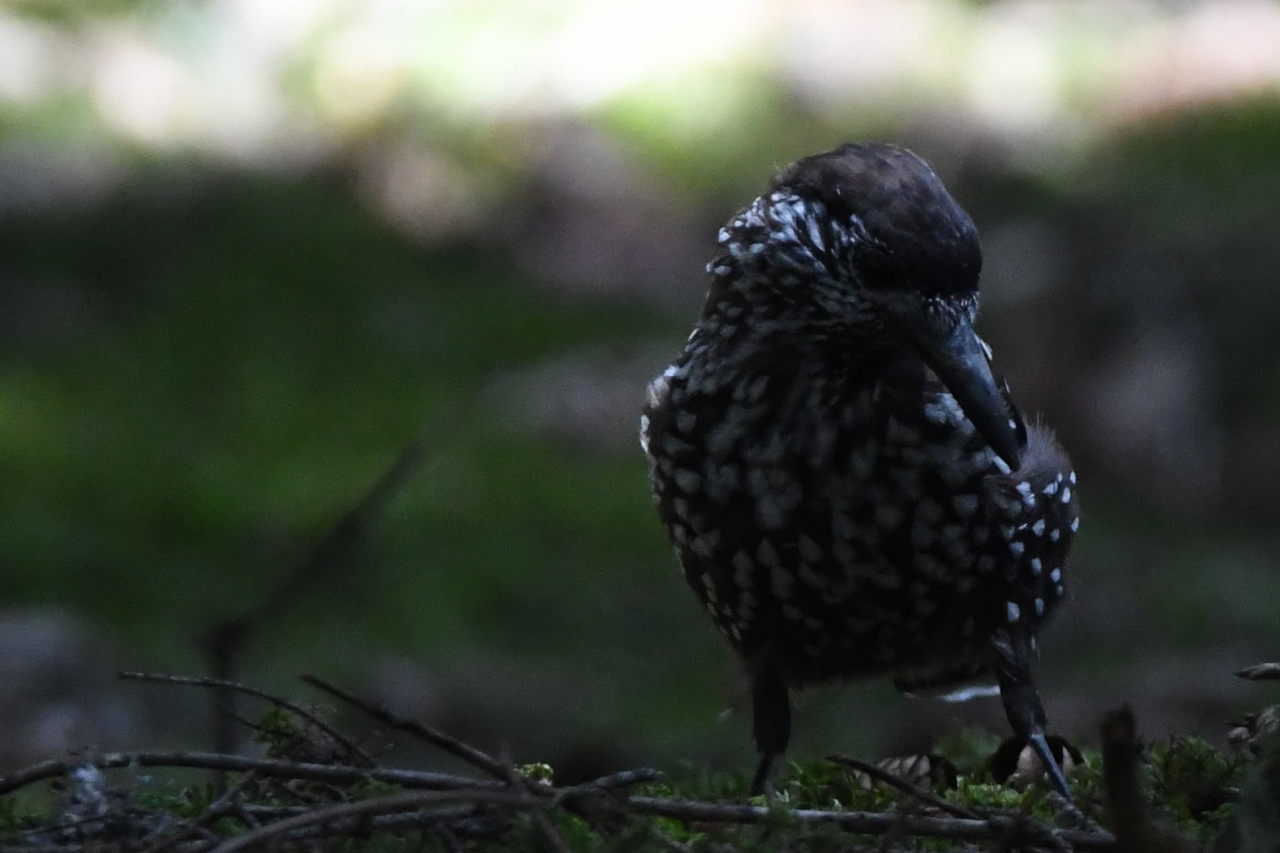
A dark brown, broad-winged, short-tailed corvid measuring 32-38 cm in length with a wingspan of 49-53 cm. Body plumage is mid-to-dark chocolate brown, heavily spotted with white on the face, neck, mantle, and underparts. The head features a large white loral spot and white eye-ring, with a blackish-brown cap extending onto the nape. Wings are dark blackish with a greenish-blue gloss. The vent is entirely white. The tail is dark with white corners and a white terminal band on the undertail. The black bill is slender to stout, long, and sharply pointed. Iris, legs, and feet are black.
Identification
Slightly smaller than the Eurasian jay but distinguished by a much larger, sharply pointed bill and a slimmer head lacking a crest. The predominantly chocolate-brown plumage with heavy white spotting is distinctive. In flight, the broad wings, white vent, and short tail are conspicuous, with an undulating flight style. The voice is loud and harsh, similar to a jay but lower pitched and more monotonic, described as kraak-kraak-kraak-kraak. Some subspecies differ in bill thickness, with hazel nut-specialized populations having thicker bills.
Distribution & Habitat
Ranges broadly east-west from Scandinavia across northern Europe and Siberia to eastern Asia, including Japan and the Kuril Islands. Inhabits the taiga conifer forests throughout this range, with disjunct populations in mountain conifer forests of central and southeast Europe including the Alps, Carpathians, and Balkan Peninsula mountains. The European population alone is estimated at 800,000-1,700,000 individuals. While not migratory, thin-billed eastern populations (N. c. macrorhynchos) may erupt outside their range during cone crop failures. Britain receives sporadic vagrants, with notable irruptions including over 300 birds in 1968.
Behavior & Ecology
Diet centers on pine seeds, particularly from cold-climate white pines including Swiss pine, Korean pine, Japanese white pine, Macedonian pine, Siberian dwarf pine, and Siberian pine. Where these pines are absent, spruce seeds and hazel nuts become important. Populations specializing in hazel nuts have thicker bills with special ridges for cracking shells. The tongue tip is forked with two keratinized pointed appendages for handling seeds. Surplus seeds are cached for later use, enabling this species to sow new forests. The diet also includes insects, small birds, eggs, nestlings, rodents, and carrion; bumblebee and wasp nests are actively excavated. Pairs stay together for life, maintaining territories of 20-30 hectares. Nesting begins early to exploit cached pine nuts, with nests built high in conifers on sunny sides. Clutches contain 2-4 eggs incubated for 18 days. Both parents feed young, which fledge around 23 days and remain with parents for many months to learn food-storage techniques.
Conservation
Not provided in the source article.
Culture
Not provided in the source article.
Source: Wikipedia · CC BY-SA 3.0
Taxonomy
- Order
- Passeriformes
- Family
- Corvidae
- Genus
- Nucifraga
- eBird Code
- eurnut3
Subspecies (4)
-
Nucifraga caryocatactes caryocatactes
Scandinavia to northern and eastern Europe; winters to southern Russia
-
Nucifraga caryocatactes japonica
central and southern Kuril Islands, Hokkaido, and Honshu
-
Nucifraga caryocatactes macrorhynchos
northern and northeastern Asia; irruptions to northern Iran, Korea, and northern China
-
Nucifraga caryocatactes rothschildi
Tien Shan Mountains (Kazakhstan)
Data Sources
CBR Notes: 中文名由星鸦改为北星鸦,英文名由Spotted Nutcracker改为Northern Nutcracker
Species description from Wikipedia, licensed under CC BY-SA 3.0.
Bird images and sounds sourced from GBIF, contributed by citizen scientists worldwide under Creative Commons licenses.
Taxonomy data from AviList 2025.