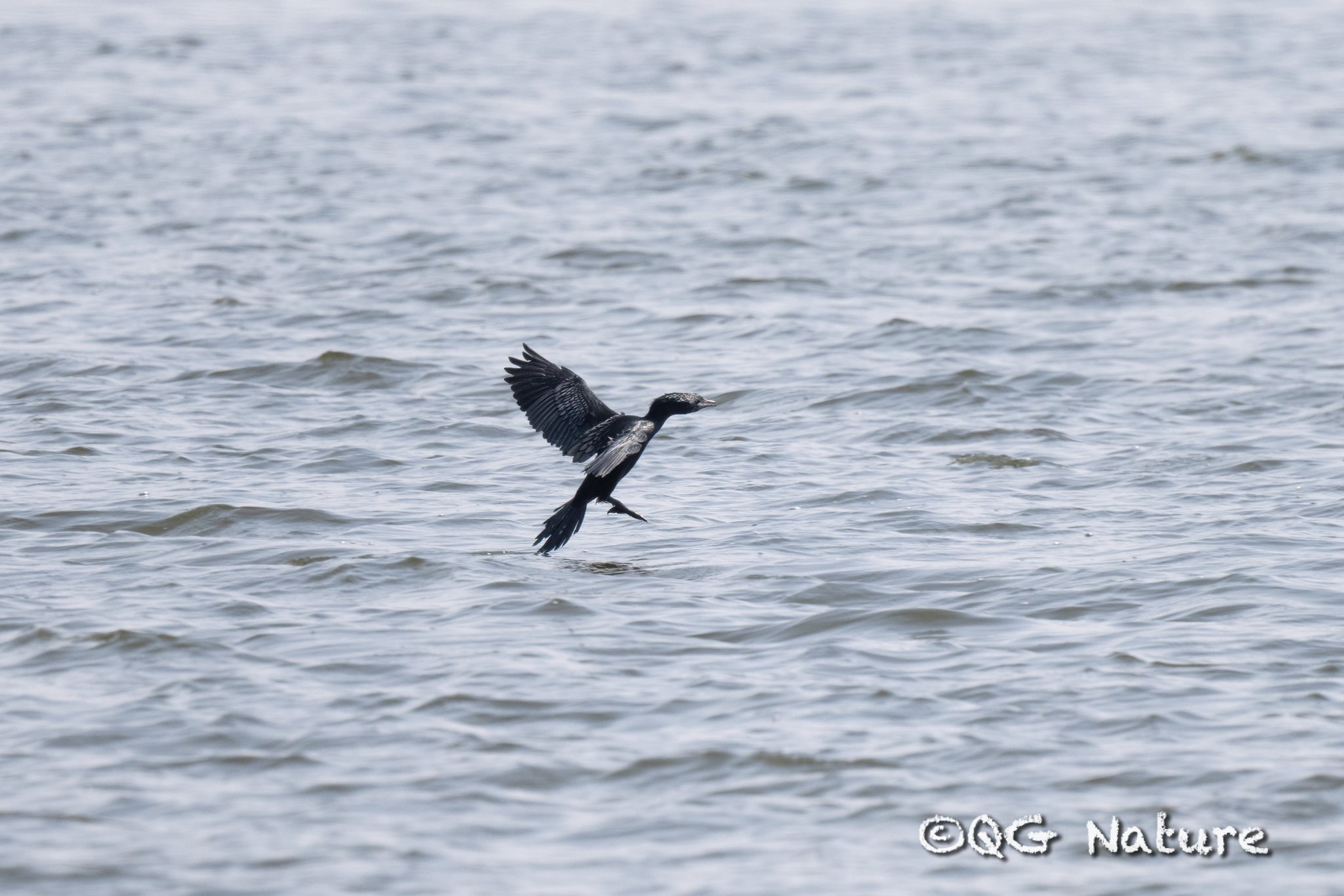
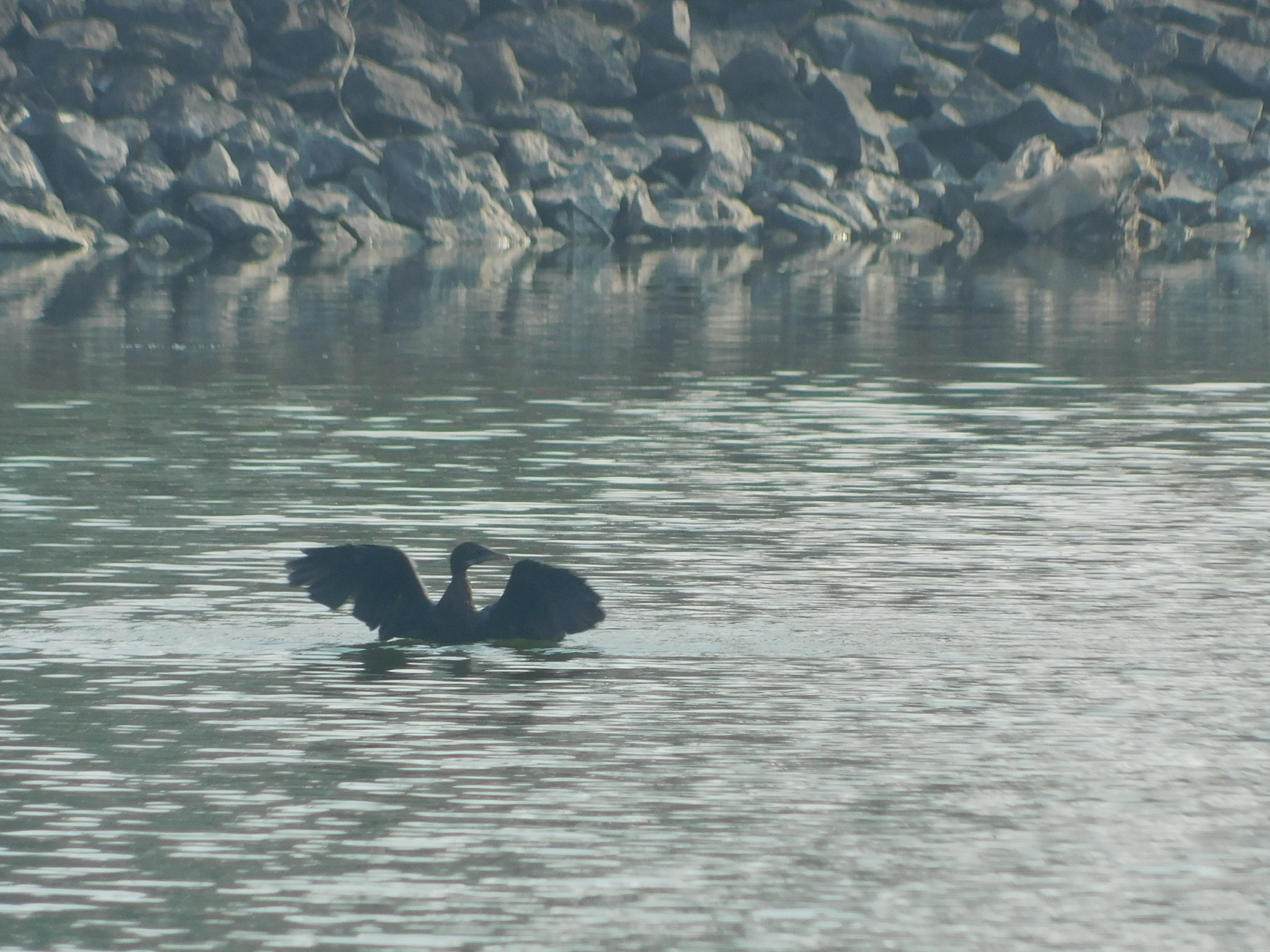
Little Cormorant
Microcarbo niger
黑颈鸬鹚
Introduction
A small waterbird in the cormorant family (Phalacrocoracidae), scientifically classified as Microcarbo niger. It ranges across the Indian subcontinent including India, Sri Lanka, Bangladesh, Pakistan, and lowland Nepal, extending eastward through Myanmar, Thailand, Laos, Cambodia, and Indonesia to Java. It occupies freshwater wetlands from small village ponds and large lakes to streams and occasionally coastal estuaries. The species is slightly smaller than the Indian cormorant and distinguished by its lack of a peaked head and shorter beak. It typically forages singly or in loose groups, swimming underwater to capture fish. Like other cormorants, it is frequently observed perched with wings spread after emerging from water, a behavior associated with wing-drying.
Description
A compact waterbird measuring approximately 50 centimeters in length. The breeding adult displays glistening entirely black plumage with scattered white spots and filoplumes on the face, complemented by a short crest on the back of the head. The eyes, gular skin, and face appear dark. Non-breeding adults and juveniles show brownish plumage with more fleshy-looking bill and gular skin; the crest becomes less prominent and a small well-defined white throat patch may be visible. Sexes appear identical in the field, though males typically achieve larger body size. Rare silvery-gray plumage variations have been documented in some populations.
Identification
Slightly smaller than the Indian cormorant, which can be distinguished by its narrower, longer bill ending in a prominent hooked tip, blue iris, and more pointed head profile. In the western Indus River valley, vagrant pygmy cormorants may overlap in range and prove difficult to differentiate, with some authorities historically considering them conspecific. The combination of smaller size, shorter bill lacking a prominent hook, and absence of a peaked head profile provides the best identification clues in the field.
Distribution & Habitat
Distributed across India, Sri Lanka, Bangladesh, Pakistan, and lowland Nepal, with range extension through Myanmar, Thailand, Laos, Cambodia, and Indonesia to Java. The species is absent from the Himalayas proper, though vagrant individuals have been recorded in Ladakh. It inhabits various freshwater wetland habitats including small village ponds, large lakes, streams, and occasionally tidal estuaries. The species does not typically migrate long distances, though some local movements may occur in response to water conditions.
Behavior & Ecology
Forages mainly in small loose groups or alone by swimming underwater to capture prey using webbed feet. A study in northern India documented fishing in waters less than one meter deep, capturing fish measuring 2-8 centimeters in length. Prey is typically brought to the surface for swallowing, where kleptoparasitism from painted storks, gulls, egrets, and other cormorants commonly occurs. The characteristic wing-spreading posture after foraging is believed to aid wing-drying, with duration inversely related to air temperature and dryness. Breeding season varies geographically: July-September in Pakistan and northern India, November-February in southern India, December-May in Sri Lanka, and May-October in Bangladesh. Males perform courtship displays with wing-fluttering while holding the head back and bill raised. Both parents construct stick platform nests in trees over approximately two weeks, often in mixed colonies with other waterbirds. Clutch size ranges from 2-6 eggs laid at two-day intervals, hatching asynchronously after 15-21 days of incubation. Chicks display bare red heads and fledge after about one month. Vocalizations near nests and roosts include low roaring sounds, grunts, groans, a low-pitched ah-ah-ah call, and kok-kok-kok sounds. Roosting occurs communally, often alongside other waterbird species.
Conservation
No IUCN assessment or conservation status mentioned in source material.
Culture
Sometimes called the Javanese cormorant when referring to populations in Java, Indonesia. No additional cultural significance, folklore, or traditional uses documented in source material.
Source: Wikipedia · CC BY-SA 3.0
Taxonomy
- Order
- Suliformes
- Family
- Phalacrocoracidae
- Genus
- Microcarbo
- eBird Code
- litcor1
Distribution
inland and coastal, from Indus Valley (central Pakistan) southward to Sri Lanka and eastward through sub-Himalayan India to southern China, Vietnam, and Java
Vocalizations
Data Sources
Species description from Wikipedia, licensed under CC BY-SA 3.0.
Bird images and sounds sourced from GBIF, contributed by citizen scientists worldwide under Creative Commons licenses.
Taxonomy data from AviList 2025.