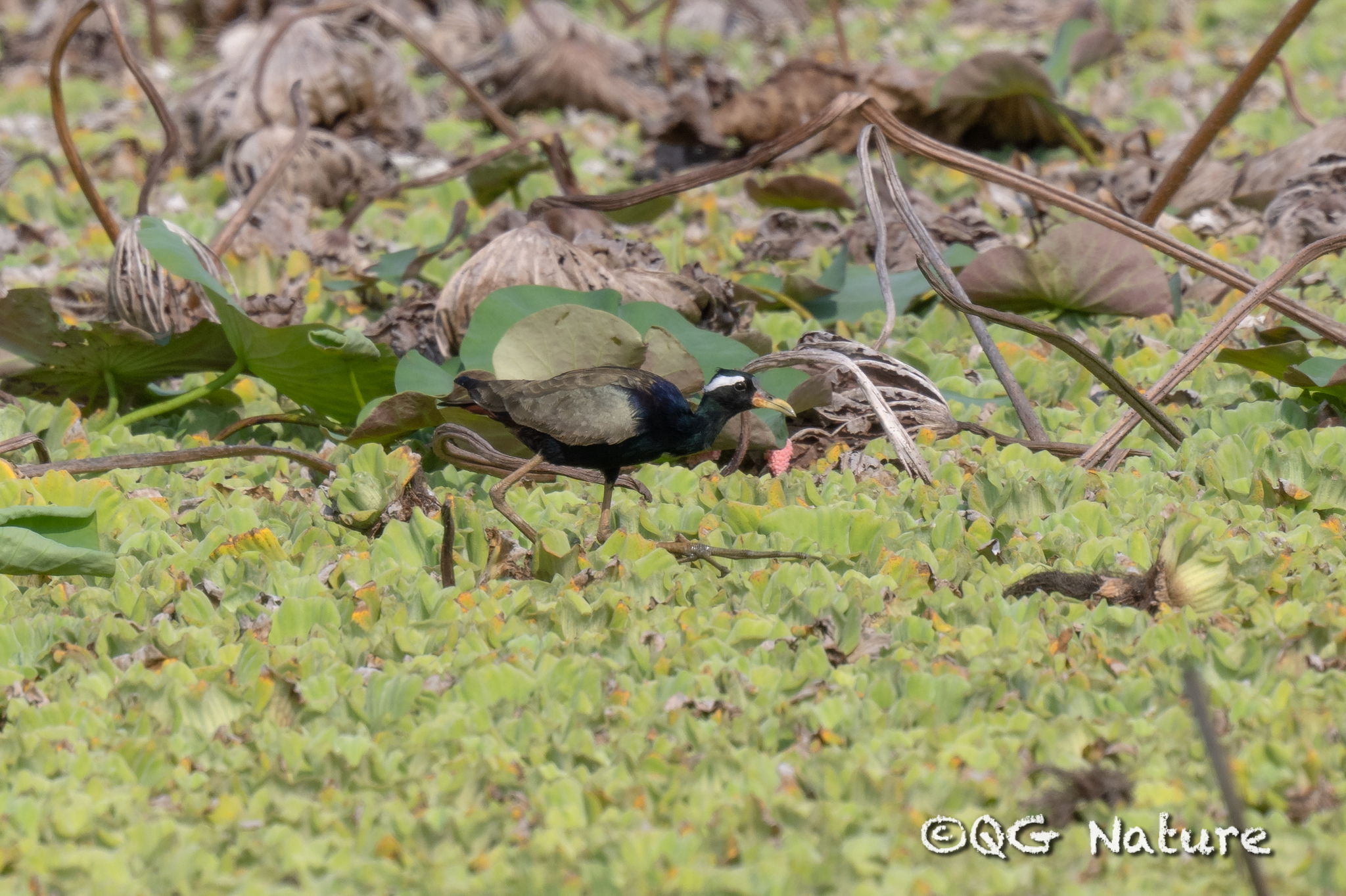
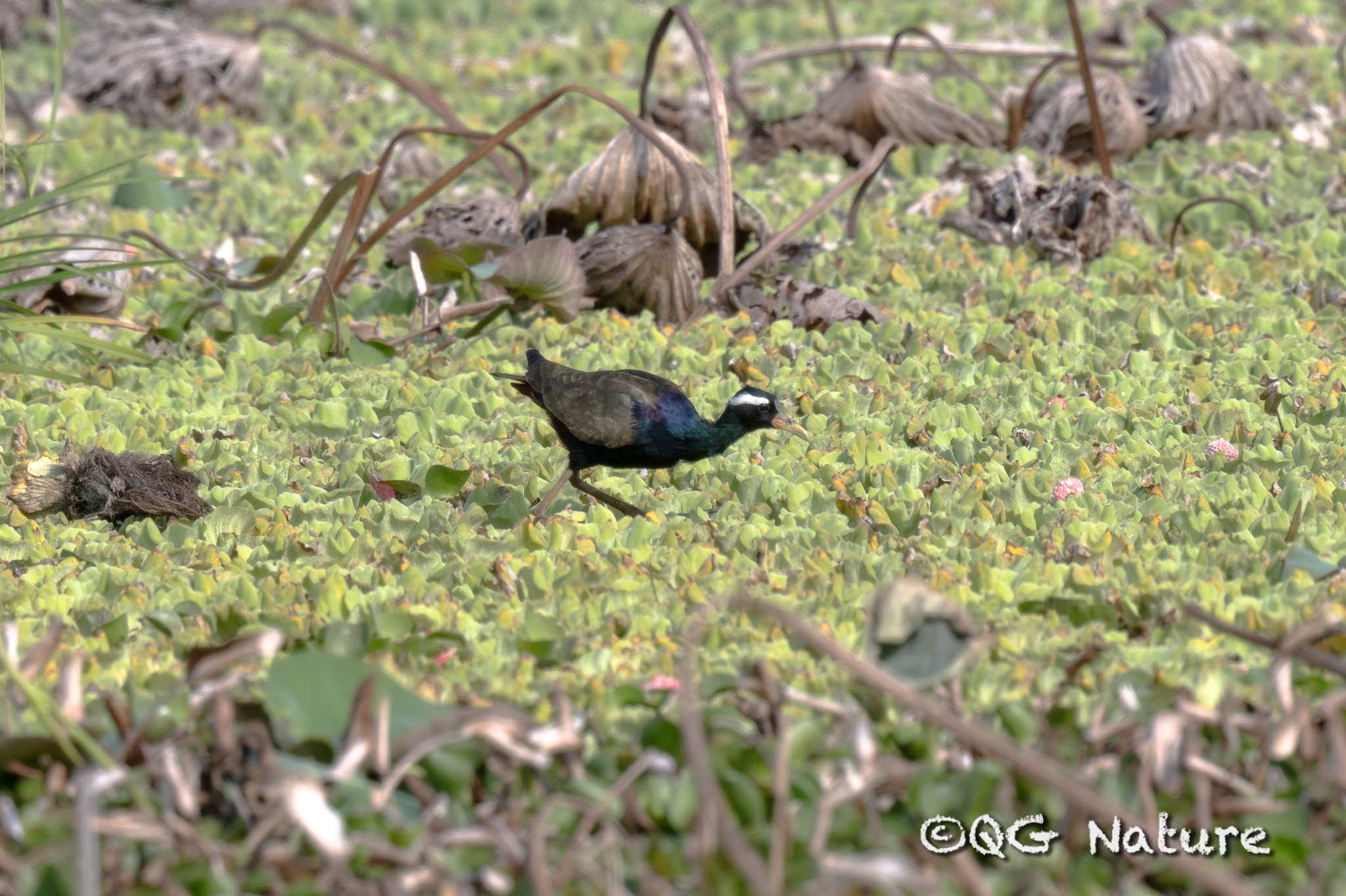
Bronze-winged Jacana
Metopidius indicus
铜翅水雉
Introduction
A wader in the family Jacanidae, found across South and Southeast Asia. It inhabits wetlands with floating aquatic vegetation and is the sole species in the genus Metopidius. This species forages on lilies and other floating vegetation using its long feet and legs for balance. Females are polyandrous, maintaining harems of males during the breeding season in monsoon rains.
Description
Rail-like, large, short-tailed birds appearing dark at distance except for the supercilium. Length is 29 cm. Females are slightly larger than males. Wings are bronzy brown with green sheen and have a reduced tubercular carpal spur. Head, neck, and breast are black, contrasting with a broad white supercilium extending from over the eye to the back of neck. Lower back and tail coverts are chestnut; the tail is stubby and reddish brown with a black terminal band. The bill is greenish yellow with a red base to the upper mandible. A reddish-purple frontal shield extends over the forehead. Legs are greenish with long toes; the elongated hind toe nail is longer than the toe. Downy chicks are light brown with a dark stripe down the nape.
Identification
Adults can be confused with common moorhen and watercock, which occupy similar habitats. Young birds resemble young pheasant-tailed jacanas but lack the black necklace characteristic of that species. The broad white supercilium and dark body plumage help distinguish adults in the field.
Distribution & Habitat
Widely distributed across the Indian subcontinent (excluding Sri Lanka and western Pakistan) and Southeast Asia, mainly at low elevations. Sedentary but shows seasonal dispersal in response to drought and rains. Found in wetlands including those dominated by introduced weeds such as water hyacinth. Uses cover provided by Ipomoea aquatica during breeding. Co-occurs with pheasant-tailed jacana in similar habitats.
Behavior & Ecology
Forages singly or in pairs on aquatic vegetation, balancing on long legs and toes. Diet consists of plant material, insects, and other invertebrates picked from floating vegetation. Gives a wheezy piping seek-seek-seek call, mainly in alarm; may hide by submerging when threatened. Breeding season coincides with rains (June to September in India). Males defend territories through open wing and neck-stretched displays that can escalate to pecking. Nests are small platforms of stems and leaves from Pistia, Nymphoides, Hydrilla, and Eichhornia placed on vegetation mats; eggs may also be laid directly on lotus leaves. Clutch is four conical, glossy brown eggs with black zig-zag markings. Incubation and chick care are entirely by males, lasting 29 days. Young become independent at about ten weeks old. Eggs face high predation rates, up to 94% in some studies. Males also give a yelling call to attract females, particularly in larger harems.
Conservation
No IUCN assessment or population trends mentioned in the article.
Culture
No cultural significance, folklore, or mythological references mentioned in the article.
Source: Wikipedia · CC BY-SA 3.0
Taxonomy
- Order
- Charadriiformes
- Family
- Jacanidae
- Genus
- Metopidius
- eBird Code
- brwjac1
Distribution
lowlands of India to southwestern China, southeastern Asia, Sumatra, and Java
Vocalizations
Data Sources
Species description from Wikipedia, licensed under CC BY-SA 3.0.
Bird images and sounds sourced from GBIF, contributed by citizen scientists worldwide under Creative Commons licenses.
Taxonomy data from AviList 2025.