American Wigeon
Mareca americana
绿眉鸭
Introduction
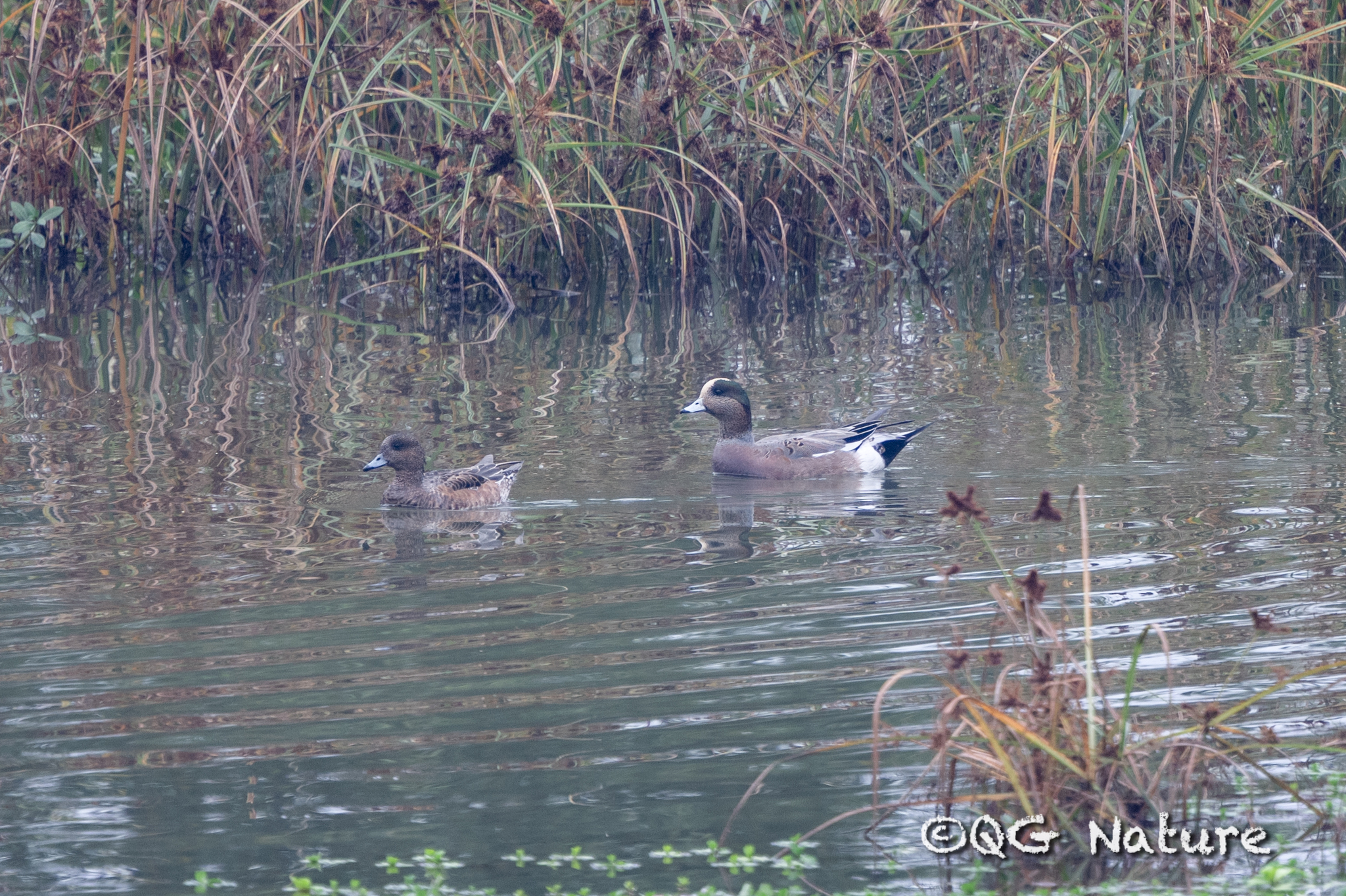
A dabbling duck (genus Mareca) found throughout North America. The New World counterpart to the Eurasian wigeon. Inhabits open wetlands including wet grasslands and marshes with taller vegetation. Notably vegetarian diet and known as 'poacher' or 'robber' ducks for stealing vegetation brought to the surface by diving water birds. Forms large flocks outside breeding season. Conservation status: least concern.
Description
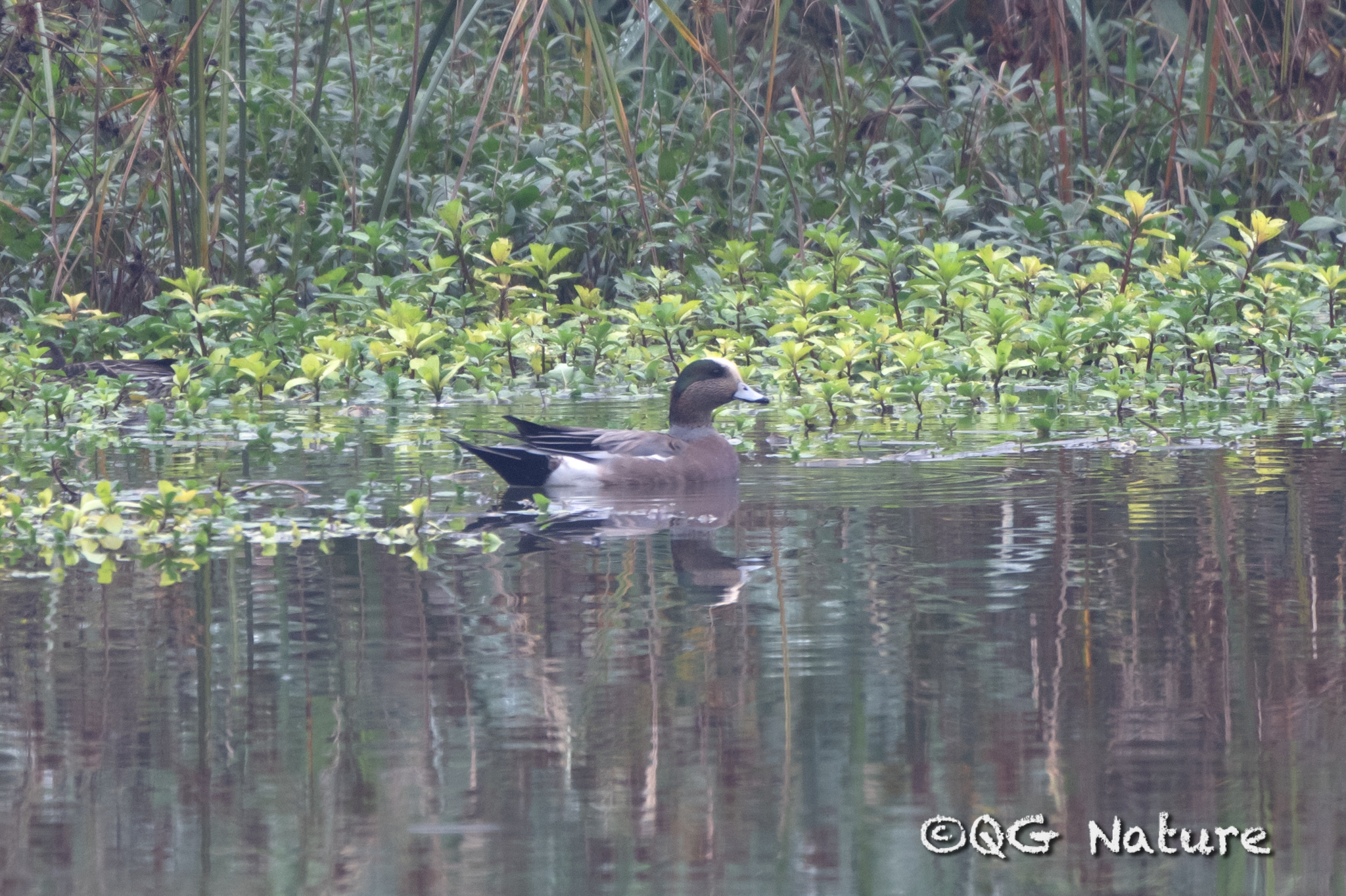
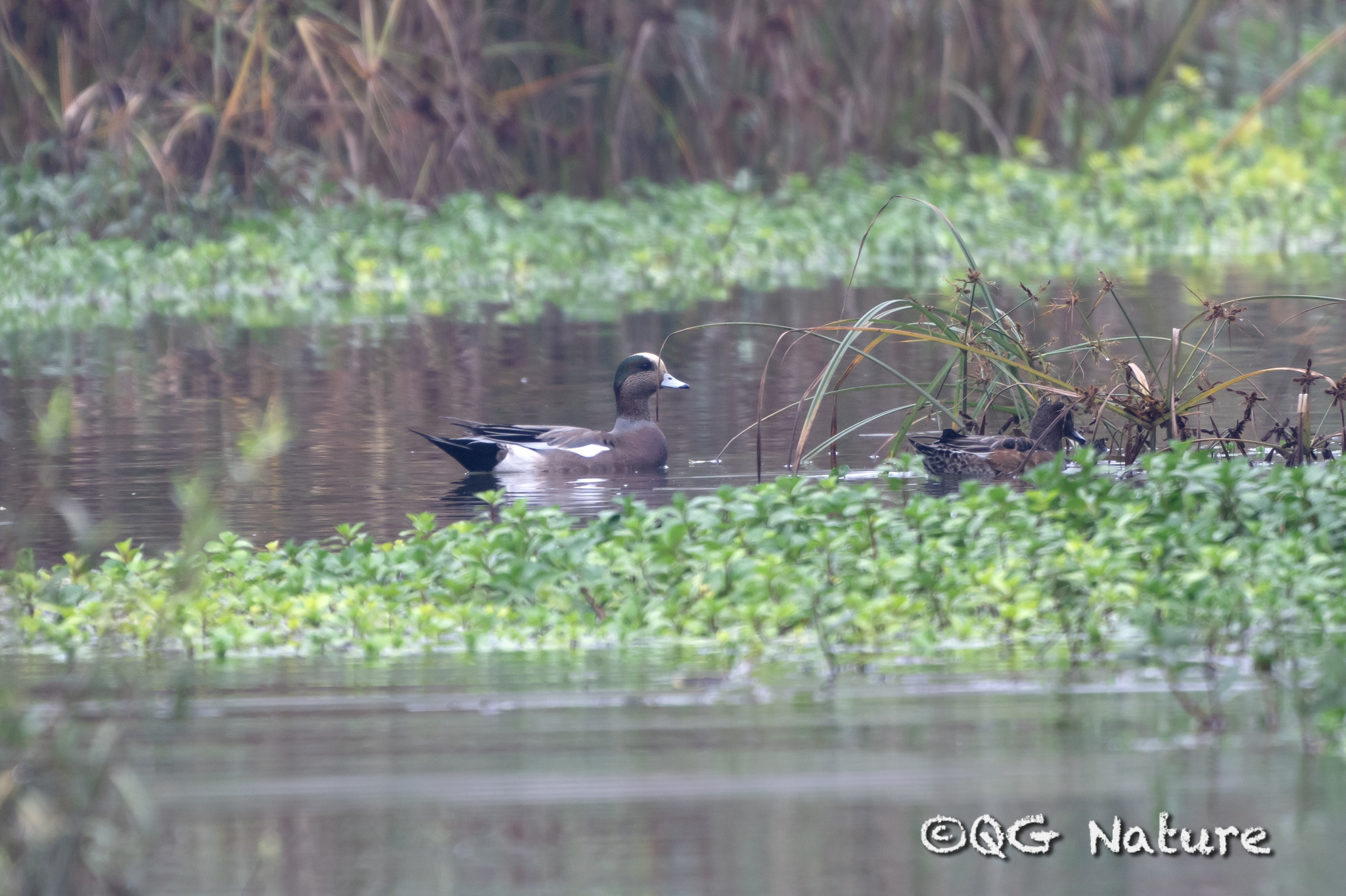
Medium-sized dabbling duck, larger than a teal but smaller than a pintail. Body length 42-59 cm (17-23 in), wingspan 76-91 cm (30-36 in), weight 512-1,330 g (1.129-2.932 lb). Round head, short neck, and small bill distinguish it in silhouette. Two adult molts per year plus a juvenile molt in the first year. Breeding male has green mask around eyes, cream-colored cap from crown to bill, white belly, and prominent white shoulder patch visible in flight. Female is brown and gray overall. Both sexes have pale blue bills with black tips, white bellies, gray legs and feet, and gray wing patches behind the speculum.
Identification
In silhouette, the round head, short neck, and small bill distinguish it from other dabblers. Males show large white shoulder patches in flight, visible as flashing white when banking. Female differs from Eurasian wigeon in head and neck coloring; Eurasian wigeon has darker head and all-grey underwing. The pale blue bill with black tip, combined with body shape, helps distinguish from similar species.
Distribution & Habitat
Breeds across all but the extreme north of Canada and Alaska, and in the Interior West through Idaho, Colorado, the Dakotas, Minnesota, and eastern Washington and Oregon. Most numerous in the Pacific Flyway. Winters in the southern half of the United States, Idaho, Washington, Oregon, the Mid-Atlantic coast, and south through Central America, the Caribbean, and northwestern South America. Key wintering areas include California's Central Valley, Puget Sound, the Texas Panhandle, and the Gulf Coast. A rare but regular vagrant to western Europe, particularly Britain and Ireland, since at least 1958.
Behavior & Ecology
Feeds primarily by dabbling for plant food or grazing on land. Diet is largely vegetarian, including waste grain in harvested fields, pasture grasses, winter wheat, clover, and lettuce. Known to steal vegetation brought to the surface by diving coots and divers, earning the nicknames 'poacher' or 'robber' ducks. Highly gregarious outside breeding season, forming large flocks. Vocalizations include a three-note wheezy whistle from males (whoee-whoe-whoe) and hoarse grunts and quacks from females. Breeding begins in April-May. Nests on dry ground in a grass-lined depression hidden in vegetation, typically near water but sometimes some distance away.
Conservation
IUCN assessment: least concern. The 2009 estimate was 2.5 million breeding wigeons in the traditional survey area, slightly below the 1955-2009 average. Population trends show declines in Canada's Prairie Pothole Region but increases in Alaska's interior and west coast. This species ranks as the fifth-most commonly harvested duck in the United States, after the mallard, green-winged teal, gadwall, and wood duck.
Culture
Also known as the 'baldpate' (pate meaning head), referring to the whitish crown and forehead of the male bird. The alternative common name is not used in all regions, with 'American wigeon' being more standard in field guides and among birders.
Source: Wikipedia · CC BY-SA 3.0
Taxonomy
- Order
- Anseriformes
- Family
- Anatidae
- Genus
- Mareca
- eBird Code
- amewig
Distribution
breeds Alaska to southern USA; winters through Central America and the Caribbean
Data Sources
Species description from Wikipedia, licensed under CC BY-SA 3.0.
Bird images and sounds sourced from GBIF, contributed by citizen scientists worldwide under Creative Commons licenses.
Taxonomy data from AviList 2025.