Chestnut Munia
Lonchura atricapilla
栗腹文鸟
Introduction
Lonchura atricapilla is a small passerine estrildid finch. Formerly considered conspecific with the tricoloured munia, it is now recognized as a separate species. It is a resident breeding bird across Bangladesh, Brunei, Cambodia, China, India, Indonesia, Laos, Malaysia, Burma, Nepal, the Philippines, Singapore, Taiwan, Thailand, Vietnam, and Hawaii. Introduced populations exist throughout the Greater Antilles and Martinique in the Caribbean. It was the national bird of the Philippines until 1995, known locally as 'mayang pula' ('red maya'). It inhabits open grassland and cultivation, feeding primarily on grain and seeds.
Description
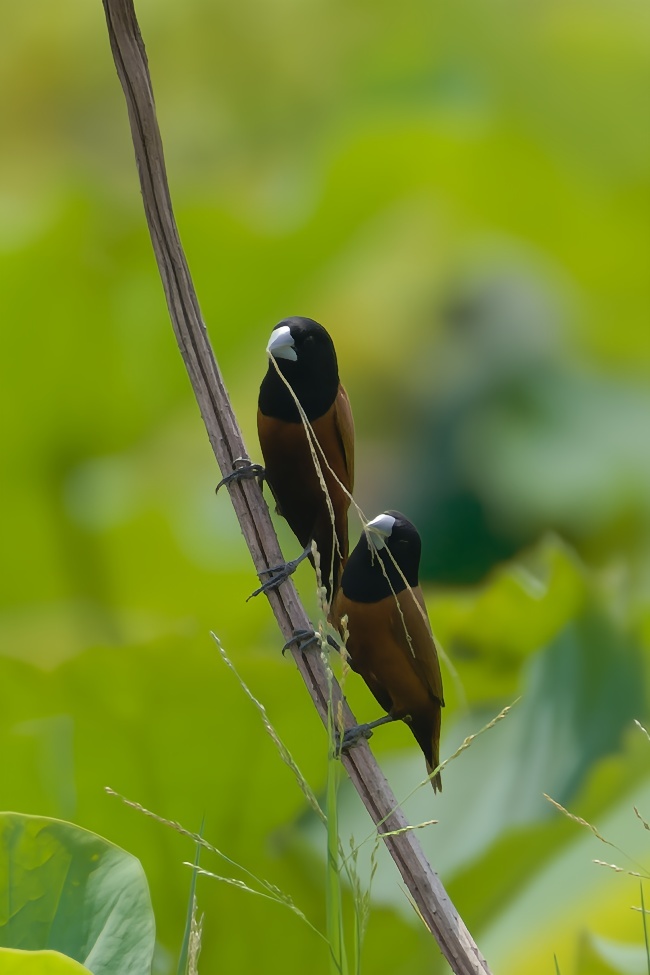
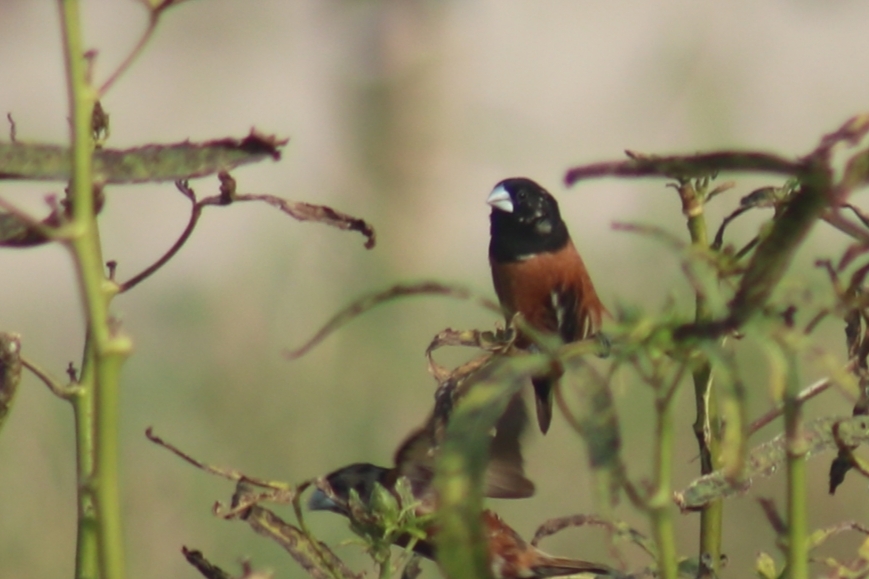
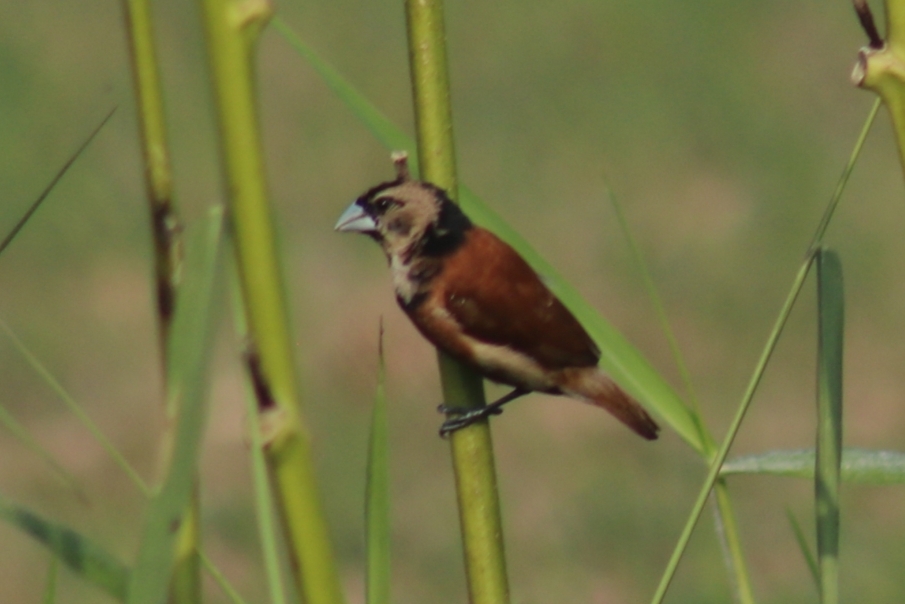
A small finch measuring 11-12 cm in length. The adult has a stubby pale grey-blue bill, black head, and brown body. A distinctive brick red patch on the lower back is visible only in flight. Some races display a black belly. The sexes are similar in appearance. Immature birds have uniform pale brown upperparts, lack the dark head, and show white to pale buff underparts. Subspecies vary slightly in the intensity of coloration.
Identification
The brick red lower back patch visible in flight distinguishes this species from other birds locally called 'maya' in the Philippines. It differs from the predominantly brownish Eurasian tree sparrow ('mayang simbahan'), which is more common in urban areas. Immature birds lack the adult's dark head and have pale brown upperparts rather than the black-headed appearance of adults.
Distribution & Habitat
Native range extends across South and Southeast Asia including Bangladesh, Brunei, Cambodia, China, India, Indonesia, Laos, Malaysia, Burma, Nepal, the Philippines, Singapore, Taiwan, Thailand, and Vietnam, plus Hawaii. Has been introduced to all the Greater Antilles and Martinique in the Caribbean. Inhabits open grassland and cultivation areas throughout its range.
Behavior & Ecology
Gregarious species that feeds mainly on grain and other seeds. Nests are large domed grass structures built in bushes or tall grass. Lays 4-7 white eggs per clutch. Forms flocks outside the breeding season.
Conservation
Omitted
Culture
Was the national bird of the Philippines until 1995, when that designation was transferred to the Philippine eagle. Known locally as 'mayang pula' ('red maya') due to its distinctive brick red lower back patch. Urbanization has led to decreased awareness of this species, and it is now often confused with the more common Eurasian tree sparrow, which is also locally called 'maya'.
Source: Wikipedia · CC BY-SA 3.0
Taxonomy
- Order
- Passeriformes
- Family
- Estrildidae
- Genus
- Lonchura
- eBird Code
- chemun
Subspecies (7)
-
Lonchura atricapilla atricapilla
southeastern Nepal and northeastern India to Myanmar and northwestern Yunnan
-
Lonchura atricapilla batakana
mountains of northern Sumatra
-
Lonchura atricapilla deignani
southwestern China (southwestern Yunnan) to Thailand, Laos, and Vietnam
-
Lonchura atricapilla formosana
Taiwan and northern Luzon (northern Philippines)
-
Lonchura atricapilla jagori
Philippines (except northern Luzon), Borneo, Sulawesi, and offshore islands (Togian Islands, Muna, and Buton)
-
Lonchura atricapilla rubronigra
northern India (Haryana to northern Bihar) and lowlands of Nepal
-
Lonchura atricapilla sinensis
peninsular Thailand, Malaya, Sumatra, Riau Archipelago, and Lingga Archipelago
Data Sources
Species description from Wikipedia, licensed under CC BY-SA 3.0.
Bird images and sounds sourced from GBIF, contributed by citizen scientists worldwide under Creative Commons licenses.
Taxonomy data from AviList 2025.