Lesser Adjutant
Leptoptilos javanicus
秃鹳
Introduction
A large wading bird in the stork family Ciconiidae. It has a bare neck and head like other members of its genus but is more closely associated with wetland habitats and is solitary. It is less likely to scavenge than the related greater adjutant. Found from India through Southeast Asia. Conservation status was changed from Vulnerable to Near Threatened in 2020 following new research that revealed higher population numbers than previously estimated.
Description
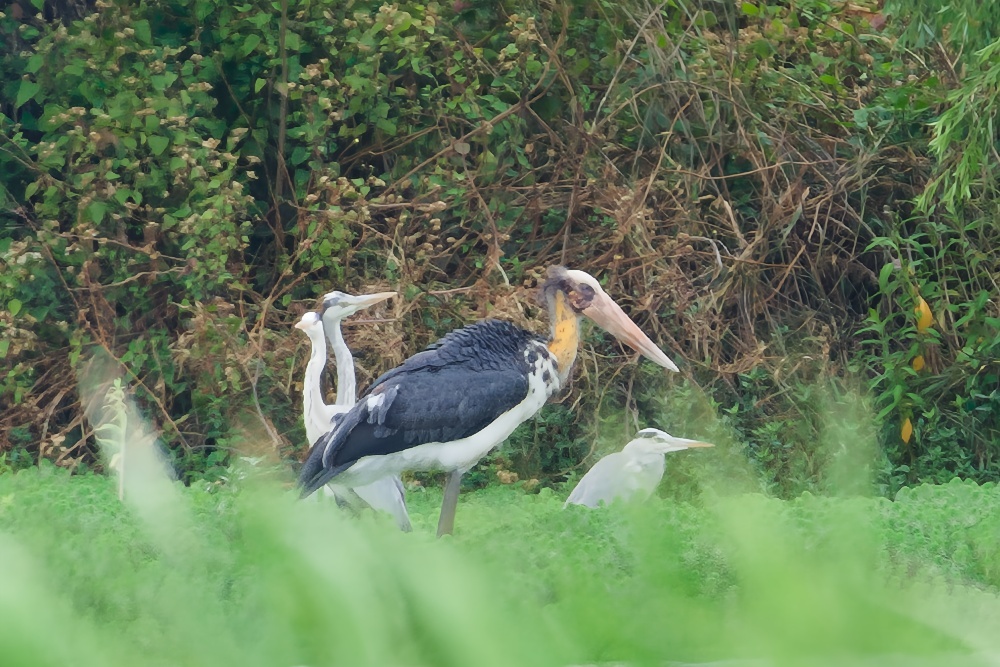
A large stork with an upright stance, standing 110-120 cm tall with a body length of 87-93 cm and weighing 4-5.71 kg. The head and neck are nearly naked with scattered hair-like feathers, lacking the pendant pouch of the greater adjutant. The upper plumage is uniformly dark, appearing almost all black, while the belly and undertail are white. The upper shank is grey rather than pink. During the breeding season, the face becomes reddish and the neck orange. The wing chord measures 57.5-66 cm and the tarsus is 22.5-26.8 cm. Juveniles are duller with more feathers on the nape.
Identification
The only confusable species is the greater adjutant. This species is generally smaller with a straight upper bill edge (culmen) measuring 25.8-30.8 cm with a paler base. It appears slightly trimmer and less hunch-backed than the greater adjutant. The skullcap is paler and the upper plumage is uniformly dark. Males and females appear similar in plumage but males tend to be larger and heavier billed.
Distribution & Habitat
Found across India, Nepal, Sri Lanka, Bangladesh, Myanmar, Thailand, Vietnam, Malaysia, Laos, Singapore, Indonesia and Cambodia. The largest population is in Cambodia; in India it is mainly distributed in Assam, West Bengal and Bihar. It occurs in large rivers and lakes within wooded regions, freshwater wetlands in agricultural areas, and coastal wetlands including mudflats and mangroves. It is extremely rare in southern India and may occur as a vagrant in southern Bhutan.
Behavior & Ecology
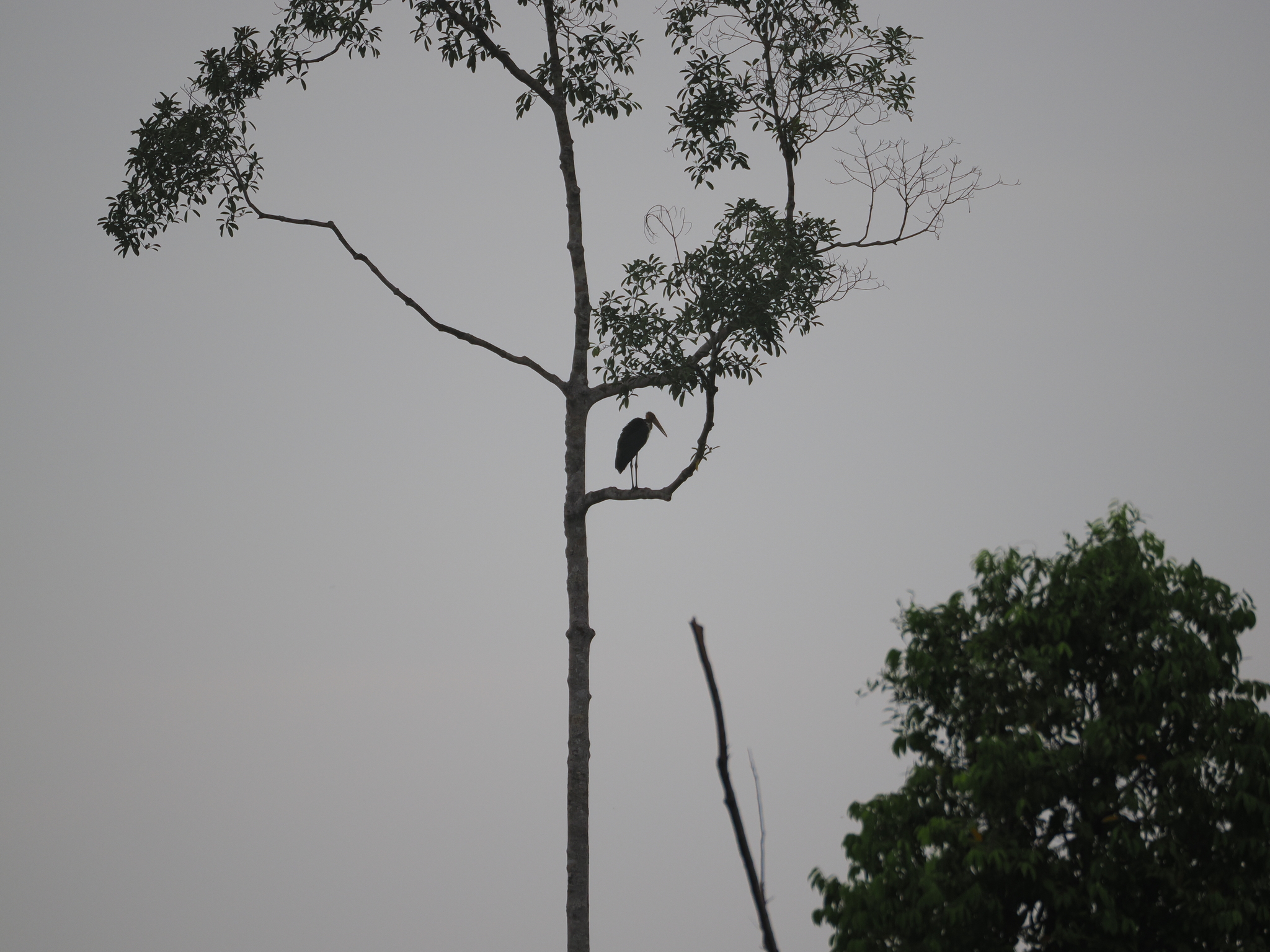
Feeds mainly on fish, frogs, reptiles, large invertebrates, rodents, small mammals and rarely carrion. Prey location is entirely visual. Largely silent but clatters bills, hisses and moans at the nest. During threat displays, adults extend their neck and give a hoarse wail. Solitary except during breeding season when forming loose colonies never exceeding 20 nests. Breeding season varies regionally: February to May in southern India, November to January in northeastern India, and July to November in Nepal. The nest is a large platform of sticks over a meter in diameter on tall trees, with clutch sizes of two to four white eggs and an incubation period of 28-30 days.
Conservation
IUCN assessment was changed from Vulnerable to Near Threatened in 2020 following detailed research that showed population sizes were much higher than previous estimates. The previous assessment was based largely on assumptions about forested areas and agricultural expansion impacts. Threats include hunting and habitat destruction. Research in Nepal documented 65 colonies with 206 nests and 280 chicks fledged, indicating high breeding success. Agricultural landscapes with flooded rice during monsoon followed by winter crops appear conducive to breeding success.
Culture
Hybridization with painted storks has been documented at Dehiwala Zoo in Sri Lanka and Kuala Lumpur Zoo in Malaysia.
Source: Wikipedia · CC BY-SA 3.0
Taxonomy
- Order
- Ciconiiformes
- Family
- Ciconiidae
- Genus
- Leptoptilos
- eBird Code
- lesadj1
Distribution
India and Sri Lanka to southern China, Indochina, and Indonesia
Data Sources
CBR Notes: IUCN红色名录等级由VU降为NT
Species description from Wikipedia, licensed under CC BY-SA 3.0.
Bird images and sounds sourced from GBIF, contributed by citizen scientists worldwide under Creative Commons licenses.
Taxonomy data from AviList 2025.