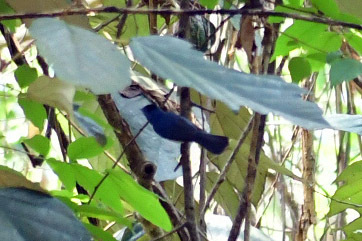
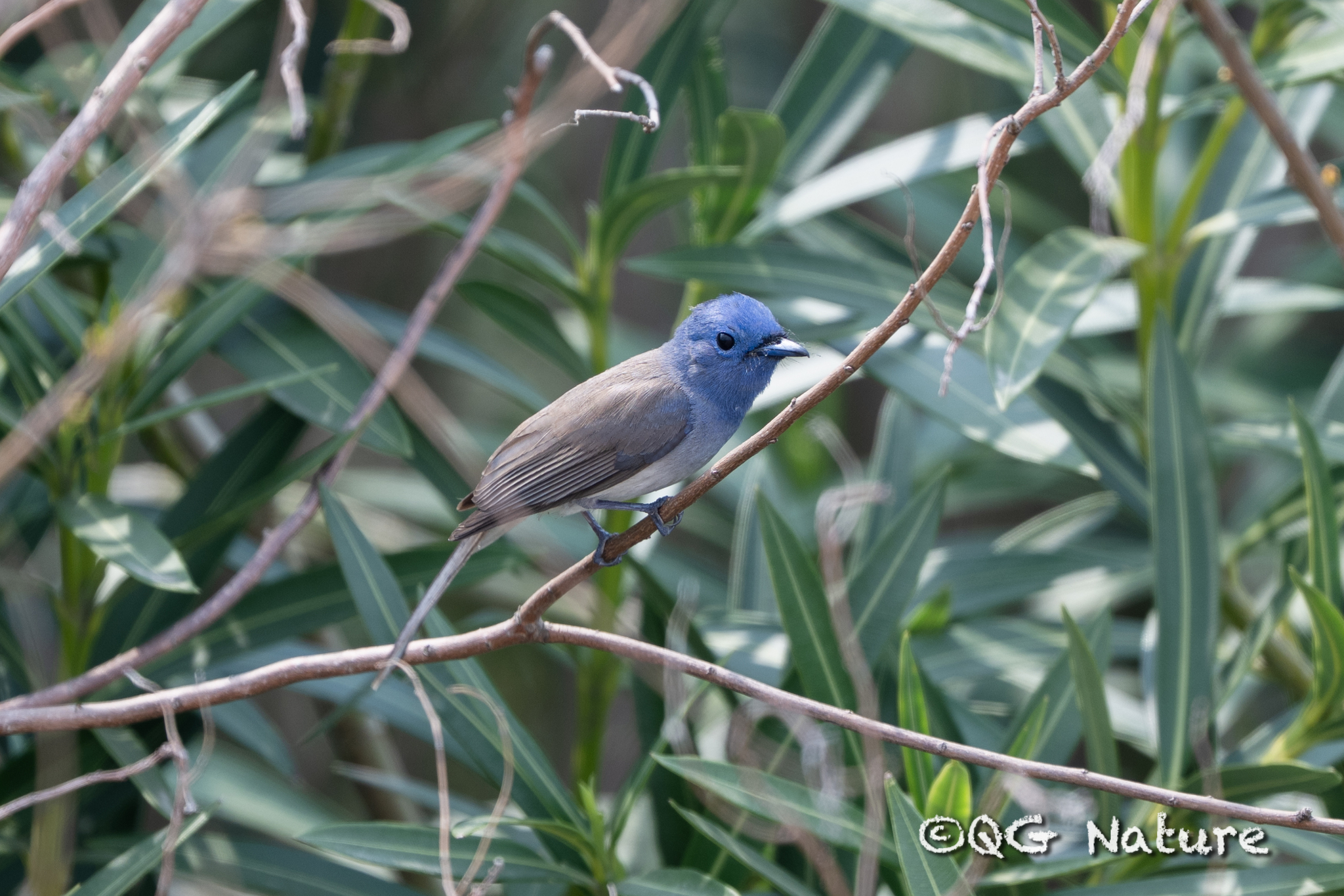
Black-naped Monarch
Hypothymis azurea
黑枕王鹟
Introduction
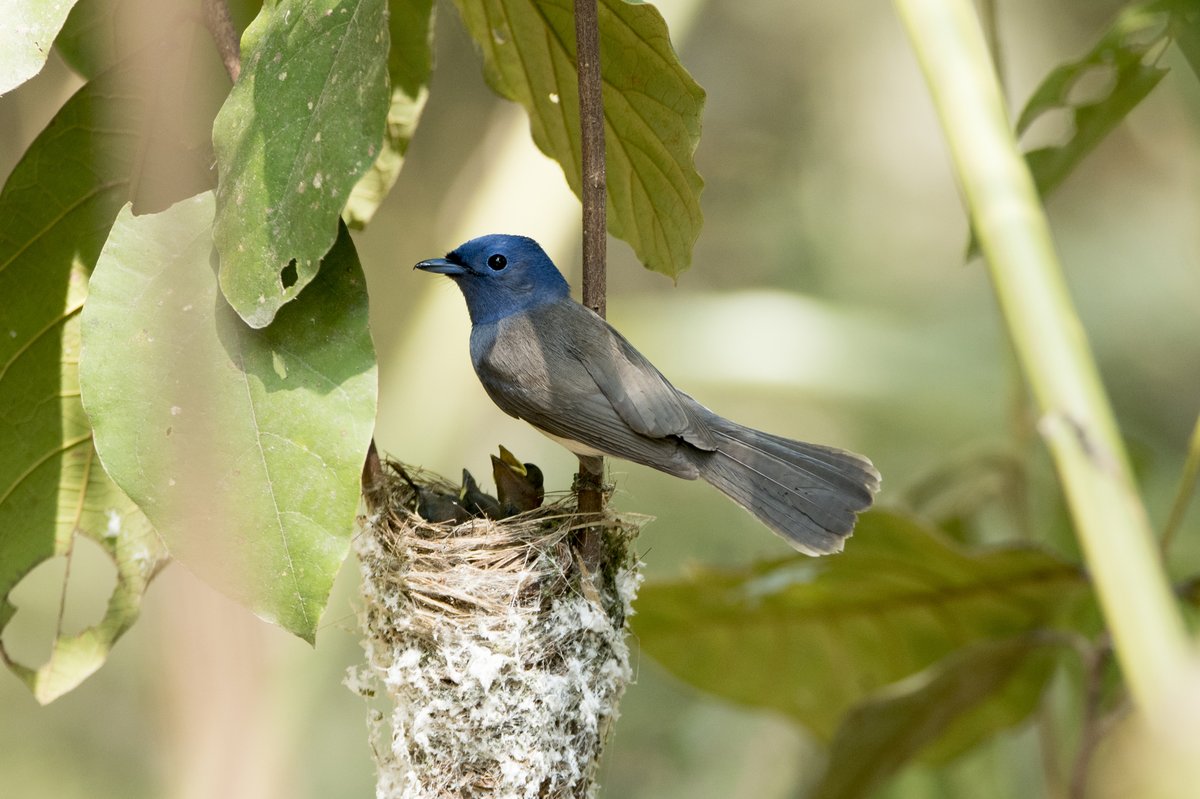
This small flycatcher occurs in the forests of southern and south-eastern Asia. It exhibits active, restless behavior, hawking insects from perches and returning to the same spot. The species forages in the middle to lower levels of dense forest canopies and frequently joins mixed-species foraging flocks. Strong sexual dimorphism exists: males have azure-blue upperparts and black markings on the head and neck, while females are olive-brown. Twenty-three subspecies are recognized across its geographic range.
Description
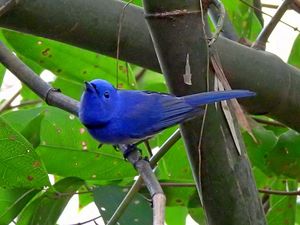
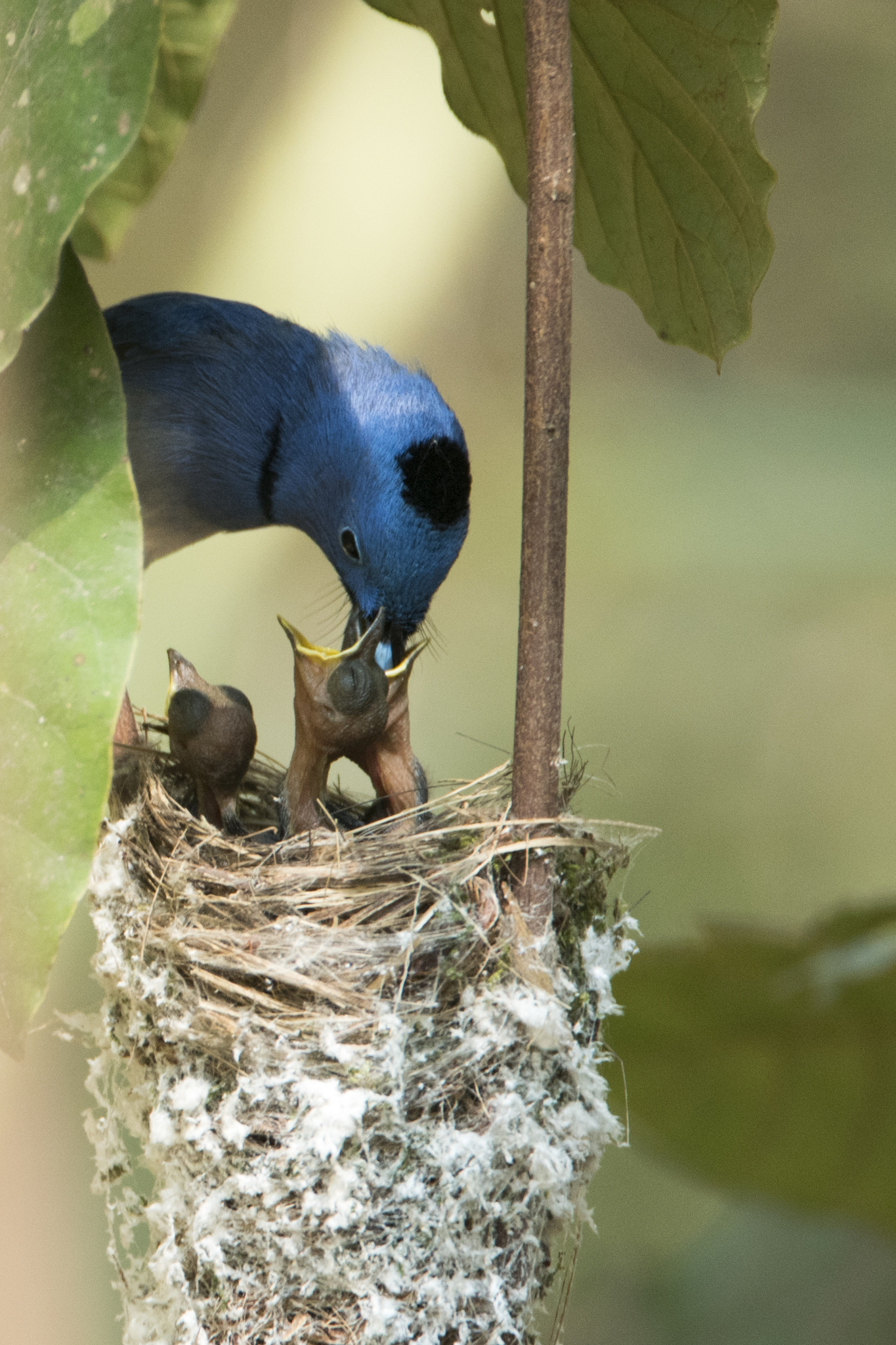
A small, slender flycatcher measuring approximately 16 cm in length. The adult male is predominantly pale azure-blue with a whitish lower belly, a black nape, and a distinctive narrow black gorget or 'necklace' around the throat. The female is considerably duller, lacking the black head and neck markings, with grey-brown wings and back that blend into forested backgrounds. The gape ranges from yellowish to green. Geographic variation is pronounced, with some populations showing deeper blue underparts while others display whitish or purplish tinges depending on the subspecies and region.
Identification
The male's combination of azure-blue plumage with a black nape and narrow black collar is distinctive within its range. When observing females, the grey-brown upperparts and lack of black head markings help distinguish them from similar species. The bird often sits very upright on perches, raising its nape feathers into a pointed crest when alert. Its call—a sharp, abrupt 'skrip'—resembles that of the Asian paradise flycatcher, though the black-naped monarch is smaller and lacks that species' long, ribbon-like tail feathers.
Distribution & Habitat
This species breeds across a broad swathe of tropical southern Asia, from Iran and Sri Lanka east through Bangladesh, India, and south-eastern Asia to Indonesia and the Philippines. Its preferred habitat consists of thick forests and well-wooded areas, including both primary and secondary growth. While largely resident throughout its range, some local seasonal movements do occur. It can be found from sea level up to moderate elevations, depending on the region and subspecies.
Behavior & Ecology
An active insectivore that primarily feeds by flycatching from perch, sallying out to capture airborne insects before returning to the same vantage point. It has short legs and characteristically sits very upright when perched, resembling a shrike in posture. During breeding season, which falls between March and August across its range, pairs build a neat cup-shaped nest in a tree fork. The nest is lined with spider webbing and fungi from the genus Marasmius, which may provide antibiotic benefits. Both parents share incubation duties, with eggs hatching after approximately 12 days. The species is highly social within mixed-species foraging flocks, particularly in the Western Ghats, where it plays a significant role as an understory participant.
Conservation
The black-naped monarch is currently assessed as Least Concern by the IUCN, reflecting its relatively stable population across its extensive range. However, like many forest-dependent species, it shows sensitivity to human disturbance. Research in Sri Lanka has demonstrated that populations retreat from disturbed habitat edges by approximately 75 meters, indicating potential localized压力的. Continued monitoring of habitat quality will be important for ensuring long-term population stability across its range.
Culture
The species holds little documented cultural significance in folklore or traditions. Its scientific nomenclature, however, carries historical weight—the specific epithet 'azurea' derives from Medieval Latin meaning azure-blue, reflecting the male's striking coloration. The species was first described scientifically in the late 18th century by European naturalists working from Philippine specimens, adding an early colonial chapter to its taxonomic history.
Source: Wikipedia · CC BY-SA 3.0
Taxonomy
- Order
- Passeriformes
- Family
- Monarchidae
- Genus
- Hypothymis
- eBird Code
- blnmon1
Vocalizations
Subspecies (23)
-
Hypothymis azurea abbotti
Babi and Lasia islands (west of Sumatra)
-
Hypothymis azurea aeria
Maratua Islands (off Borneo)
-
Hypothymis azurea azurea
Philippines
-
Hypothymis azurea catarmanensis
southern Philippines (Camiguin Sur)
-
Hypothymis azurea ceylonensis
Sri Lanka
-
Hypothymis azurea consobrina
Simeulue (off Sumatra)
-
Hypothymis azurea forrestia
Mergui Archipelago (southern Myanmar)
-
Hypothymis azurea galerita
peninsular Thailand
-
Hypothymis azurea gigantoptera
Natunas Islands (South China Sea)
-
Hypothymis azurea idiochroa
Car Nicobar Island
-
Hypothymis azurea javana
Java and Bali
-
Hypothymis azurea karimatensis
Karimata Island (off western Borneo)
-
Hypothymis azurea leucophila
Mentawai Archipelago (off Sumatra)
-
Hypothymis azurea montana
northern and central Thailand
-
Hypothymis azurea nicobarica
Nicobar Islands
-
Hypothymis azurea oberholseri
Taiwan
-
Hypothymis azurea opisthocyanea
Anambas Islands (South China Sea)
-
Hypothymis azurea penidae
Penida Island (Lesser Sundas)
-
Hypothymis azurea prophata
southern Thailand, Thai-Malay Peninsula, Sumatra, and Borneo
-
Hypothymis azurea richmondi
Enggano (Sumatra)
-
Hypothymis azurea styani
India and Nepal to southern China and Indochina; Hainan
-
Hypothymis azurea symmixta
Lesser Sundas
-
Hypothymis azurea tytleri
Andaman and Coco Islands (Bay of Bengal)
Data Sources
Species description from Wikipedia, licensed under CC BY-SA 3.0.
Bird images and sounds sourced from GBIF, contributed by citizen scientists worldwide under Creative Commons licenses.
Taxonomy data from AviList 2025.