Indian Pied Myna
Gracupica contra
斑椋鸟
Introduction
A starling species (family Sturnidae) found throughout the Indian subcontinent. Inhabits plains and low foothills up to approximately 700 meters elevation, typically in areas with access to open water. Usually occurs in small groups and is frequently seen near human habitation including cities, villages, sewage farms, and refuse tips, though less bold than the common myna. Produces varied vocalizations composed of liquid notes including whistles, trills, buzzes, clicks, and warbling calls. Two subspecies are recognized: G. c. contra (east Pakistan, northern and central India, Nepal, Bangladesh) and G. c. superciliaris (northeast India, Myanmar, southwest China). Range has been expanding westward in India and has established populations in Pakistan and the United Arab Emirates.
Description
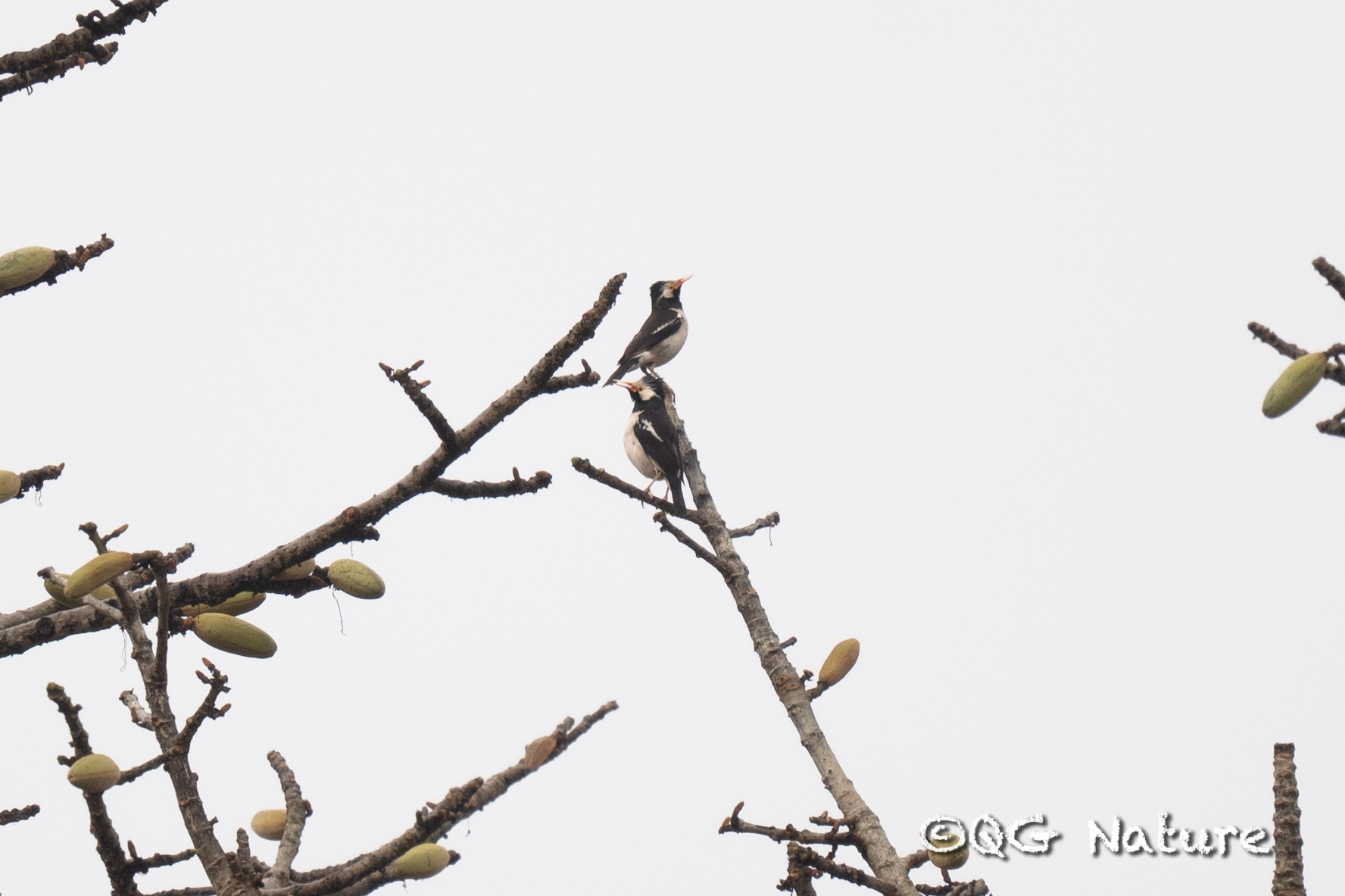
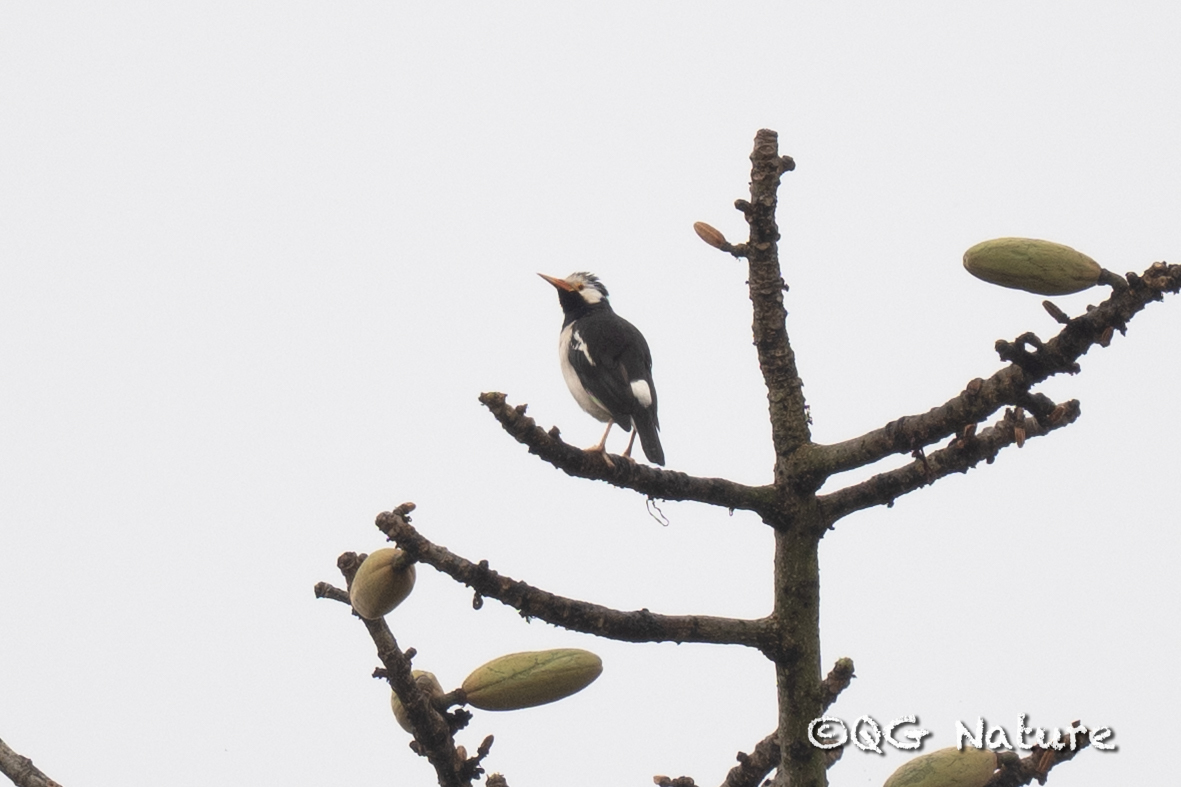
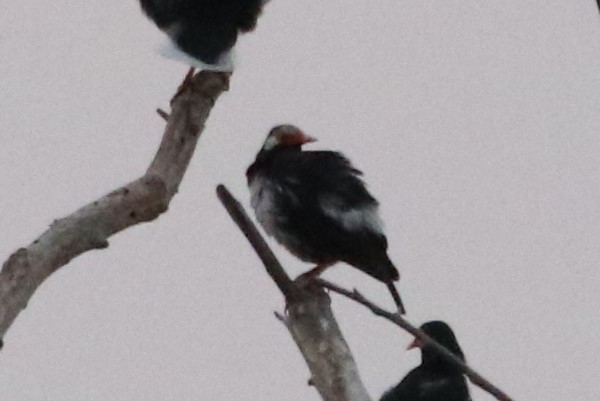
A strikingly marked bird with black and white plumage. The bill is yellowish with a reddish base, and bare skin surrounding the eye is reddish. The upper body, throat, and breast are black, while the cheek, lores, wing coverts, and rump are contrastingly white. The sexes appear similar, though juveniles have dark brown plumage replacing the black. Subspecies show slight variations in plumage, extent of feather streaking, and measurements. Flight is characteristically slow and butterfly-like on rounded wings. Leucistic individuals have been recorded in the wild.
Identification
Readily identified by its bold black and white plumage pattern. The combination of black upperparts, throat, and breast with white cheek, lores, and wing coverts distinguishes it from other mynas. The yellowish bill with reddish base and reddish eye patch are diagnostic features. Compared to the common myna (Acridotheres tristis), this species is more boldly patterned with white wing panels visible in flight. The Javan pied myna (G. jalla) is similar but has been separated as a distinct species potentially extinct in the wild.
Distribution & Habitat
Range extends primarily along the Gangetic plains in India, extending south to the Krishna River and east to Bangladesh. The western limit includes east Pakistan, with range expansion into Rajkot and Bombay (since 1953) and parts of Rajasthan. Has established self-sustaining populations in the United Arab Emirates. Found up to 700 meters elevation in foothills. Inhabits lowland open areas with scattered trees near water, including agricultural fields, lawns, and areas near human settlements. Expansion likely aided by caged bird trade, accidental escape, and changes in irrigation and farming practices.
Behavior & Ecology
Forages in small groups on the ground, feeding on grains, fruit, insects, earthworms, and molluscs. Uses a distinctive prying or gaping action to dislodge hidden food, with strong protractor muscles allowing the bird to part grass mats while binocular vision aids prey detection. Often feeds among grazing cattle. Breeding season spans March to September. Courtship involves calling, feather fluffing, and head bobbing. Nests are dome-shaped masses of straw placed in large trees or man-made structures near human habitation, with several pairs breeding in proximity. Clutch size is 4-6 glossy blue eggs, incubated for 14-15 days. Young fledge after approximately three weeks. Both parents feed chicks. Forms communal roosts and jointly defends nesting areas.
Conservation
Classified as Least Concern on the IUCN Red List (2017). No significant population declines have been reported, and the species' range has been expanding. No major threats identified, though the closely related Javan pied myna (G. jalla) has been driven to near extinction in the wild due to illegal songbird trade in Indonesia. The Indian pied myna may face similar pressures from trapping for the cagebird trade.
Culture
Popular as a cagebird due to its ability to mimic human voices and other bird songs. Young birds taken into captivity have been successfully trained to imitate tunes. The Sema Nagas of northeast India consider this species sacred and will not eat it, believing it represents the reincarnation of a human. Generally regarded as beneficial due to its consumption of insect pests in agricultural areas.
Source: Wikipedia · CC BY-SA 3.0
Taxonomy
- Order
- Passeriformes
- Family
- Sturnidae
- Genus
- Gracupica
- eBird Code
- aspsta2
Vocalizations
Subspecies (2)
-
Gracupica contra contra
eastern Pakistan eastward through northern and south-central India and southern Nepal to Bangladesh
-
Gracupica contra superciliaris
Manipur and Myanmar southward to Tenasserim
Data Sources
Species description from Wikipedia, licensed under CC BY-SA 3.0.
Bird images and sounds sourced from GBIF, contributed by citizen scientists worldwide under Creative Commons licenses.
Taxonomy data from AviList 2025.