Common Hill Myna
Gracula religiosa
鹩哥
Introduction
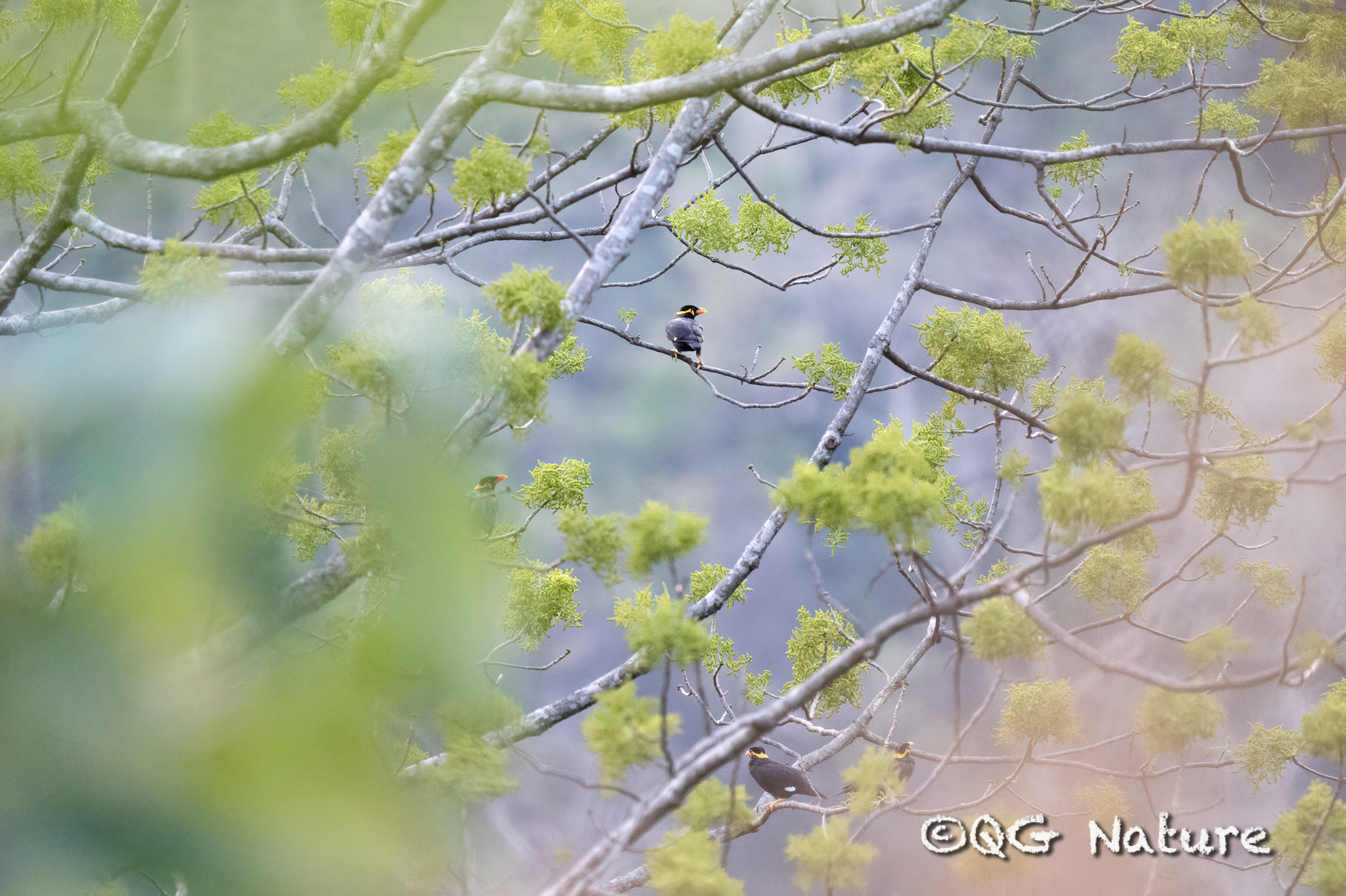
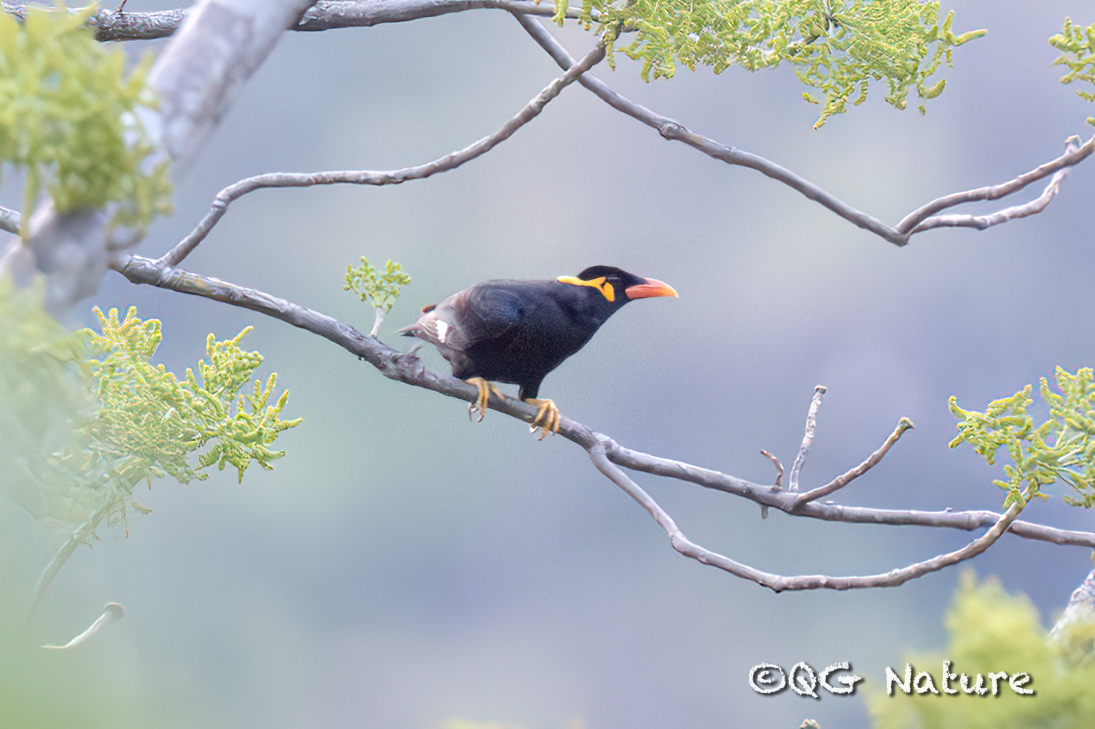
The common hill myna (Gracula religiosa) is a member of the starling family (Sturnidae) native to South and Southeast Asia. Its range extends from India and Sri Lanka through Bangladesh, Myanmar, Thailand, and Malaysia to Indonesia. This stocky, jet-black bird inhabits evergreen and semi-evergreen forest up to 2,000 meters elevation. It is characterized by a bright yellow bill, prominent orange-yellow wattles on the head and nape, and white wing patches visible in flight. Unlike most starlings, it is almost entirely arboreal, residing in the forest canopy where it moves in noisy groups. The species is most active and vocal at dawn and dusk, producing loud descending whistles and varied calls. It has been widely kept in aviculture for its vocal mimicry abilities. The IUCN lists the common hill myna as Near Threatened due to significant population declines from habitat destruction and trapping for the pet trade, particularly in northeastern India, Thailand, and Bangladesh.
Description
This stocky starling measures approximately 29 cm in length, making it noticeably larger than the common myna. Its plumage is predominantly jet-black with a distinctive green gloss throughout, particularly pronounced on the upperparts, while the head and neck show purple undertones. The most striking features are the bright orange-yellow patches of naked skin and fleshy wattles that adorn the sides of the head and nape. The bill is robust and bright yellow, matching the color of its strong legs. A large white wing patch is visible in flight but remains largely hidden when the bird is perched. The sexes are identical in appearance, though juveniles display duller coloring on the bill. Subspecies vary slightly in size, plumage glossiness, and the specific pattern of their facial wattles.
Identification
The hill myna can be distinguished from the common myna and bank myna by its distinctive wattles, which extend from beneath the eye to the nape and join there, rather than the single bare eye-patch seen in other myna species. The Sri Lanka hill myna differs in having a single continuous wattle across the nape that extends partially toward the eyes, while the southern hill myna displays separate wattles that curve toward the top of the head. The Nias hill myna is notably larger with a proportionally larger bill and subtle differences in wattle shape. In flight, the large white wing patches are distinctive, though these can be confused with other large starlings. The combination of size, wattle pattern, and bright yellow bill provides the best identification clues.
Distribution & Habitat
This species breeds across a vast range extending from the Kumaon division in India eastward through Nepal, Sikkim, Bhutan, and Arunachal Pradesh, inhabiting the lower Himalayas, terai, and foothills up to 2,000 meters elevation. Its range continues through Southeast Asia to southern China, Thailand, and across northern Indonesia to Palawan in the Philippines. It is virtually extinct in Bangladesh due to habitat destruction and overexploitation for the pet trade. Feral populations that once existed on Christmas Island have also disappeared. Introduced populations persist in Saint Helena, Puerto Rico, and possibly the mainland United States, though these require warm subtropical climates to survive. The species is resident throughout its range and does not undertake long-distance migrations.
Behavior & Ecology
Hill mynas are highly social birds that move in large, noisy groups of about six individuals in forest canopy clearings. They exhibit a distinctive sideways hopping motion along branches, unlike the characteristic walking gait of other myna species. Their diet is omnivorous, consisting of fruit, nectar, and insects. Breeding occurs in tree holes, with clutches typically containing two or three eggs. Both sexes produce an extraordinary range of vocalizations, including whistles, wails, screeches, and gurgles, with each individual possessing a repertoire of three to thirteen distinct call types. Dialects change rapidly with distance—birds more than 15 kilometers apart share no call types. Unlike some species, they do not typically imitate other birds in the wild, though captive individuals can learn human speech and everyday sounds with remarkable accuracy. They are most vocal at dawn and dusk.
Conservation
The IUCN currently lists the common hill myna as Least Concern on a global scale, reflecting its wide distribution and rapid generation time. However, significant regional declines have occurred, particularly in Thailand, where populations of the subspecies G. r. intermedia have decreased markedly due to intensive trapping for the pet trade. Nearly 20,000 wild-caught birds were entering the international pet trade annually during the 1990s. The species is listed on CITES Appendix II, with Thailand providing protection under Appendix III since 1992. The Andaman and Nicobar Islands subspecies has become increasingly rare, and the Simeulue subspecies G. r. miotera is likely extinct in the wild, driven to disappearance by unsustainable collecting. Populations in northeastern India, Bangladesh, the Philippines, and Laos have also declined substantially. In some regions, conservation efforts involving artificial nest boxes have helped maintain local populations while providing some control over numbers.
Culture
The common hill myna holds a special place in Asian culture due to its remarkable ability to imitate human speech and other sounds. This talent has made it one of the most popular cage birds throughout South and Southeast Asia, with a history dating back centuries. The specific epithet 'religiosa' may reference the tradition of teaching these birds to repeat sacred prayers, highlighting their long association with religious practices. Beyond their vocal abilities, hill mynas appear in various cultural contexts throughout their range, often valued as status symbols and companions. Their presence in traditional markets and homes reflects their importance in local avicultural traditions. However, the high demand for pet birds has also driven significant population declines, creating tension between cultural practices and conservation needs. In recent years, this tension has intensified as demand has increased despite legal protections in countries like India.
Source: Wikipedia · CC BY-SA 3.0
Taxonomy
- Order
- Passeriformes
- Family
- Sturnidae
- Genus
- Gracula
- eBird Code
- hilmyn
Subspecies (9)
-
Gracula religiosa andamanensis
Andaman and Nicobar islands
-
Gracula religiosa batuensis
Batu and Mentawai islands (off northwestern Sumatra)
-
Gracula religiosa enganensis
Enggano Island (off southern Sumatra)
-
Gracula religiosa intermedia
northern India to Myanmar, Thailand, Indochina, and southern China
-
Gracula religiosa miotera
Simeulue (off the western coast of Sumatra); on the brink of becoming extinct in the wild
-
Gracula religiosa palawanensis
Palawan (southwestern Philippines)
-
Gracula religiosa peninsularis
northeastern peninsular India
-
Gracula religiosa religiosa
Thai-Malay Peninsula, Sumatra, Bangka Island, Java, Bali, and Borneo
-
Gracula religiosa robusta
Nias, Pulan, Babi, Tuangku, and Bangkaru islands (off Sumatra)
Data Sources
Species description from Wikipedia, licensed under CC BY-SA 3.0.
Bird images and sounds sourced from GBIF, contributed by citizen scientists worldwide under Creative Commons licenses.
Taxonomy data from AviList 2025.