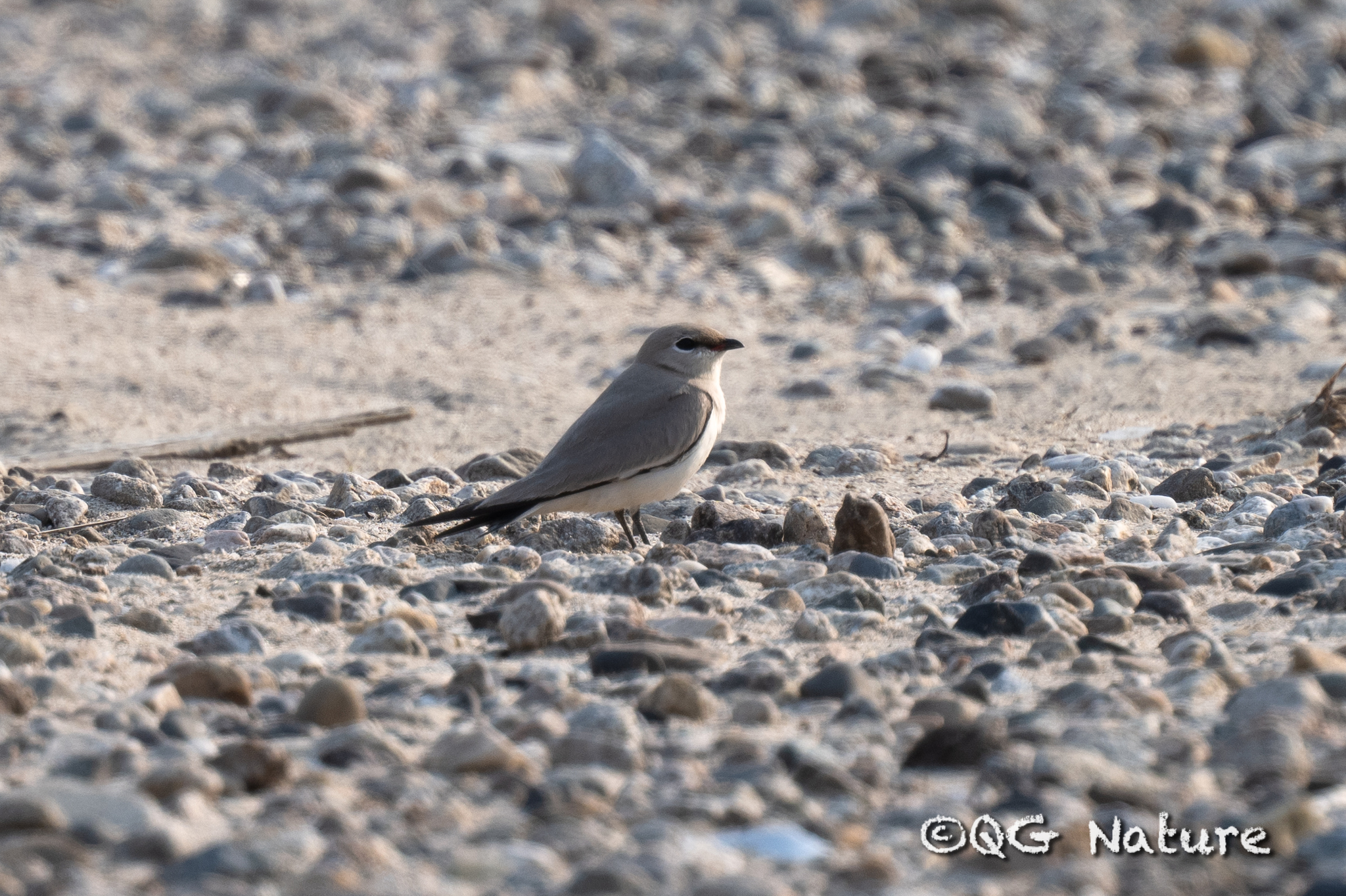
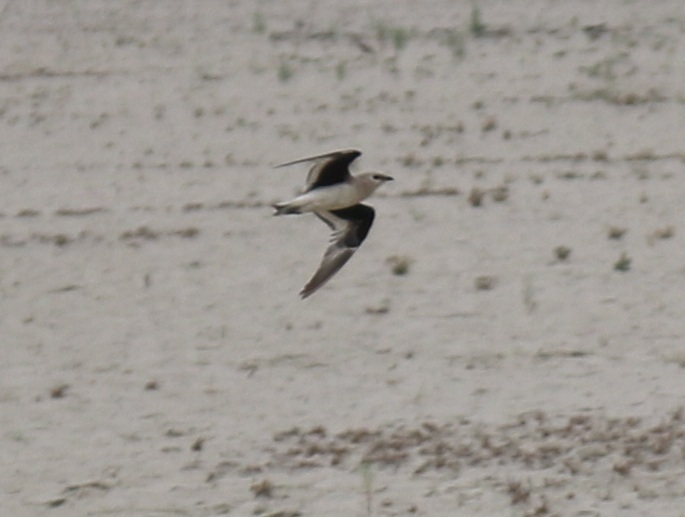
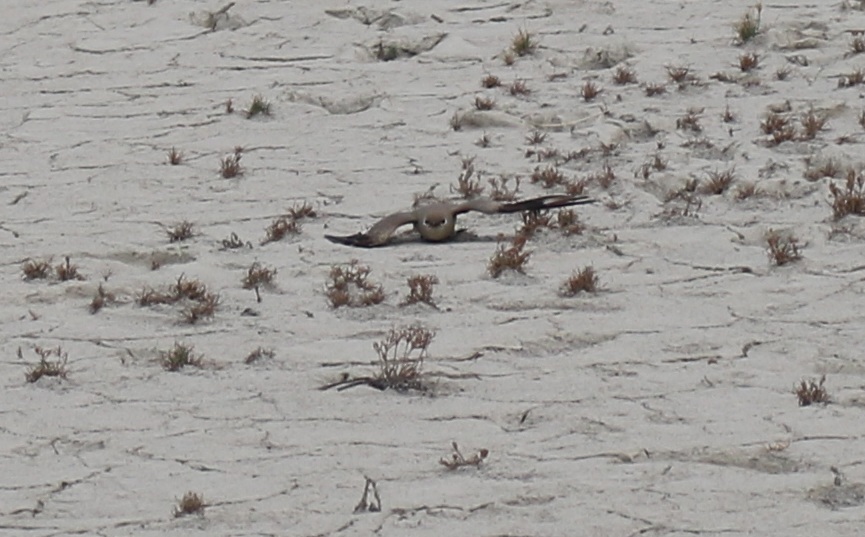
Small Pratincole
Glareola lactea
灰燕鸻
Introduction
A small wader in the pratincole family (Glareolidae). Resident breeder across India, Western Pakistan, Bangladesh, Burma, Laos, Cambodia, Sri Lanka and Thailand. Inhabits open country near water bodies. The most distinctive trait is that despite being classified as waders, pratincoles hunt insect prey on the wing like swallows, though they can also feed on the ground. Breeds December to March on gravel or sand banks near rivers and lakes, laying 2-4 eggs in a ground scrape.
Description
A compact bird measuring 16.5-18.5 cm in length with a 42-48 cm wingspan. It has short legs, long pointed wings, and a short tail adapted for aerial feeding. The plumage is mainly pale grey (lactea meaning milky) with a brown crown. The upper wings are grey with black primaries and distinctive black and white bars on the rear edge of the inner flight feathers. Underwings are predominantly black. The tail is white with a black terminal triangle, and the belly is white.
Identification
Due to its small size, this species can be briefly confused in flight with swifts or swallows. The combination of short legs and pale grey plumage distinguishes it from typical waders. The black underwings and black terminal triangle on the white tail are key识别 marks in flight.
Distribution & Habitat
Resident across the Indian subcontinent: India, Western Pakistan, Bangladesh, Burma, Laos, Cambodia, Sri Lanka and Thailand. Inhabits open country near water bodies. Breeding occurs December to March on gravel or sand banks along rivers and lakes. Known breeding areas include northern Karnataka (Manvi district, Raichur, and along the Hemavathi River) and northern Kerala near Kannur.
Behavior & Ecology
Feeds primarily on insects, employing two distinct hunting strategies: aerial hawking on the wing like swallows, and ground foraging. Often observed near water in the evening actively hunting insects. Social behavior and vocalizations not described in detail. Breeding takes place in ground scrapes with 2-4 eggs laid between December and March.
Conservation
No IUCN assessment or specific conservation status mentioned in the available information.
Culture
No cultural significance, folklore, or mythological associations documented in the provided source.
Source: Wikipedia · CC BY-SA 3.0
Taxonomy
- Order
- Charadriiformes
- Family
- Glareolidae
- Genus
- Glareola
- eBird Code
- smapra1
Distribution
eastern Afghanistan and Pakistan to India and Indochina
Data Sources
Species description from Wikipedia, licensed under CC BY-SA 3.0.
Bird images and sounds sourced from GBIF, contributed by citizen scientists worldwide under Creative Commons licenses.
Taxonomy data from AviList 2025.