Black-throated Loon
Gavia arctica
黑喉潜鸟
Introduction
A migratory aquatic bird in the family Gaviidae. Taxonomically placed in the genus Gavia, it is currently considered sister to a clade containing the Pacific loon (Gavia pacifica), common loon (Gavia immer), and yellow-billed loon (Gavia adamsii), though this phylogenetic placement is debated. Two subspecies are recognized: G. a. arctica and G. a. viridigularis. Breeds across northern Europe and Asia on isolated, deep freshwater lakes larger than 0.1 km², particularly those with inlets. Winters along sheltered, ice-free coasts of the north-east Atlantic Ocean and both the eastern and western Pacific Ocean. Forages primarily by diving, with most dives successful and reaching depths no greater than 5 meters. The species is protected under the Migratory Bird Treaty Act of 1918 and the Agreement on the Conservation of African-Eurasian Migratory Waterbirds. The IUCN lists it as Least Concern due to its large population and extensive range, despite a ongoing population decline that is not considered rapid.
Description
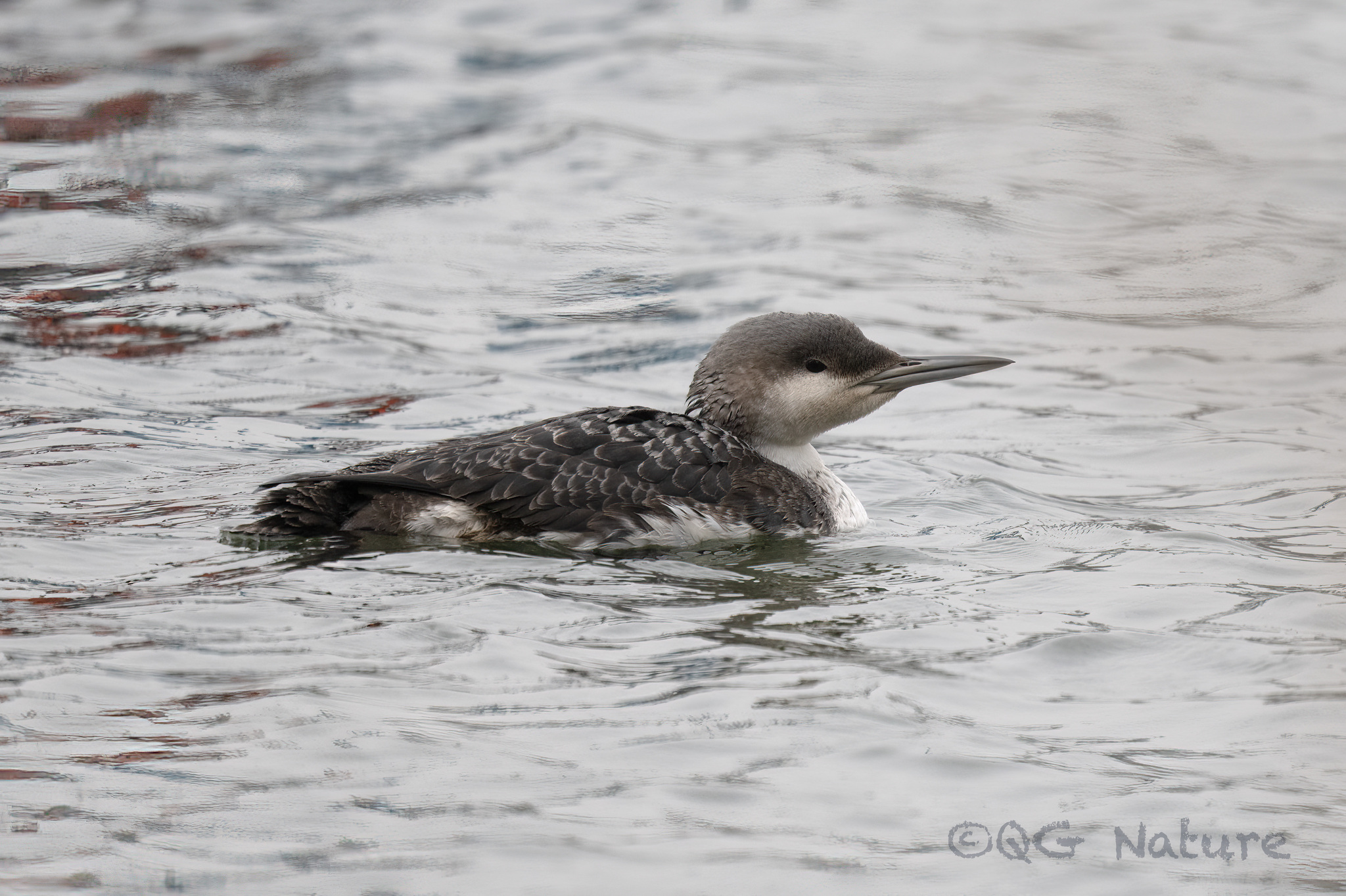
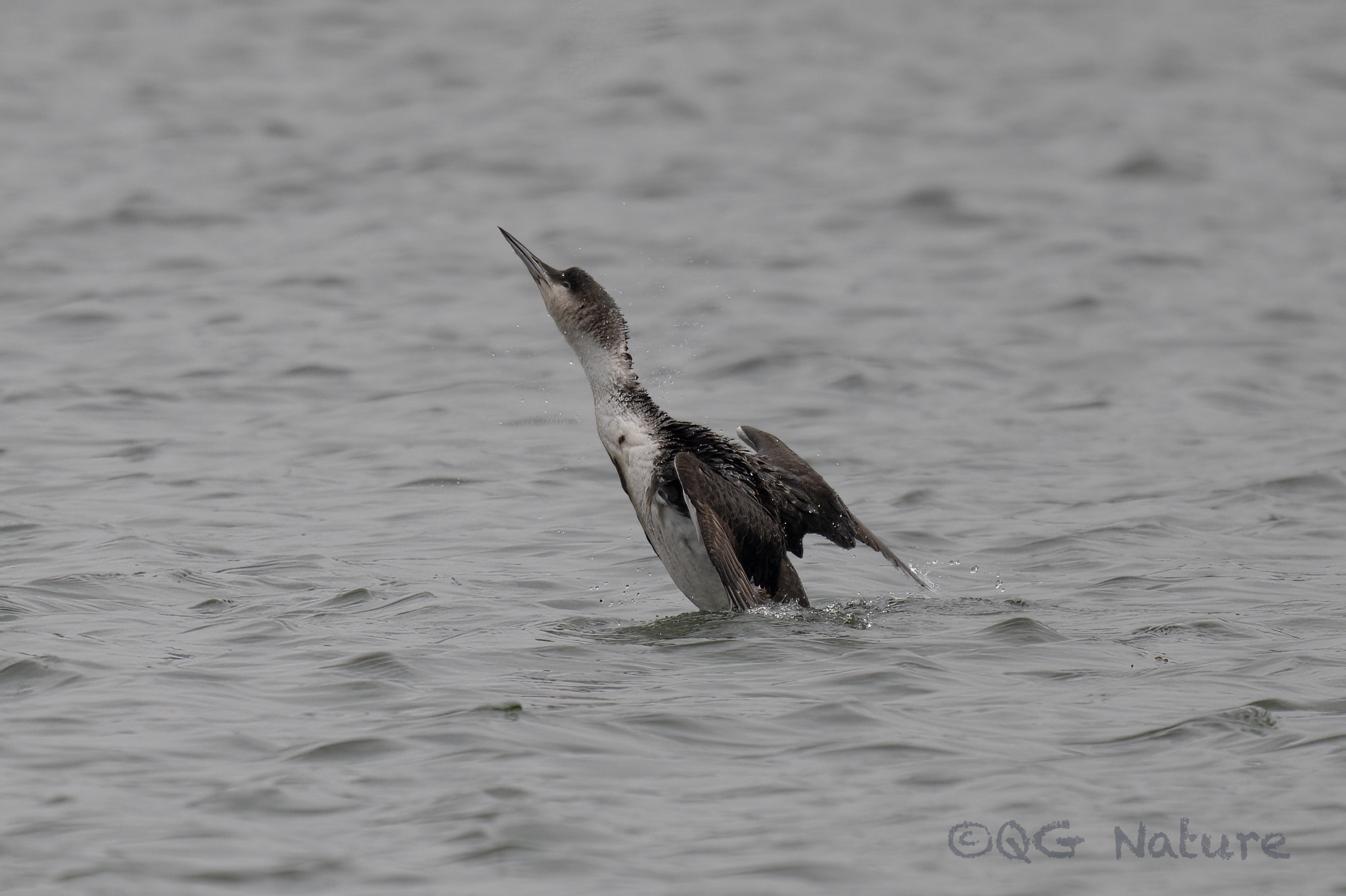
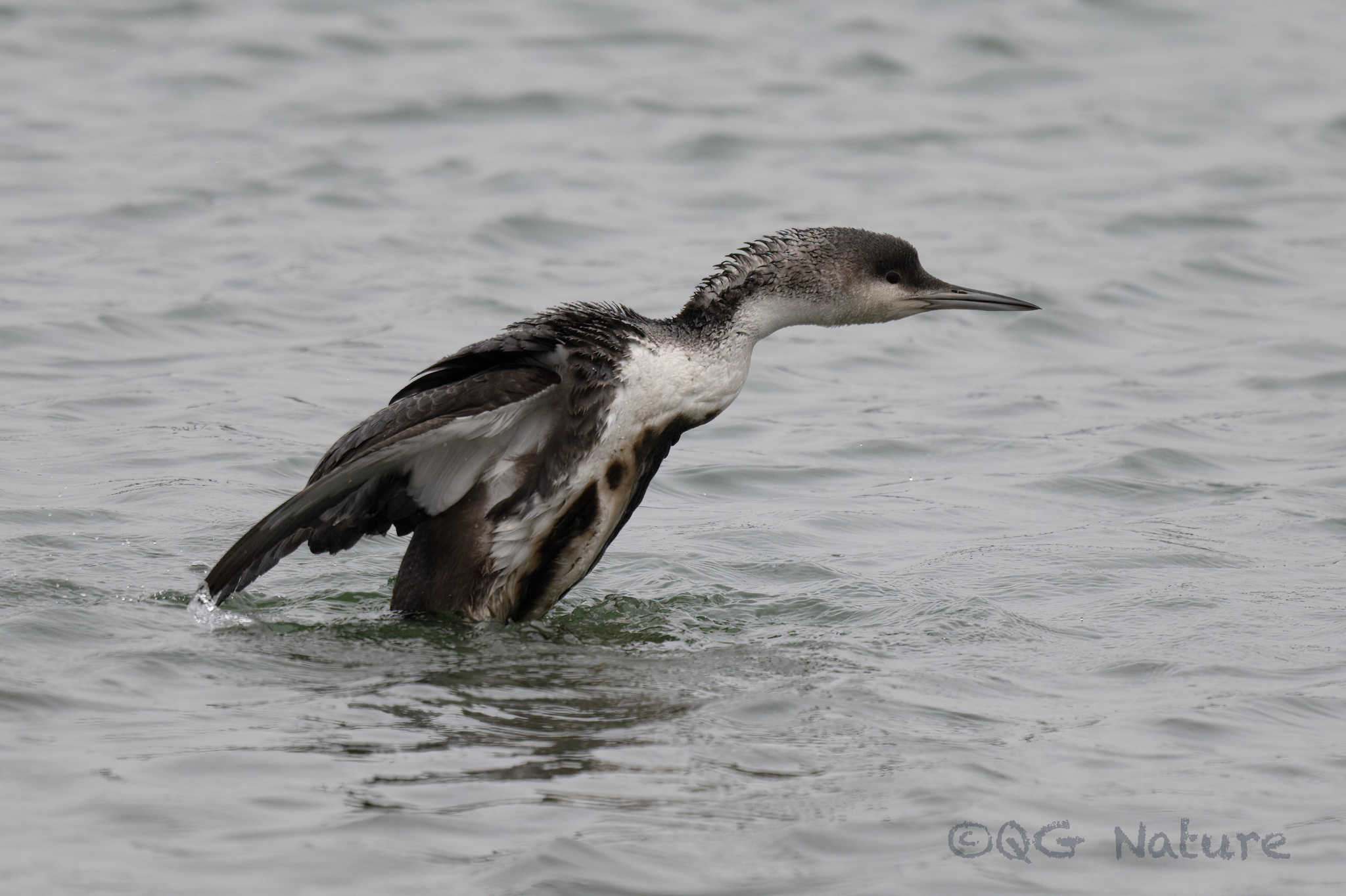
A large diving bird measuring 58 to 73 cm in length with a 100 to 130 cm wingspan, weighing 1.3 to 3.4 kg. The nominate subspecies in breeding plumage has a grey head and hindneck with a black throat and foreneck patch showing soft purple gloss. The lower throat features a necklace of short parallel white lines, while about five long parallel white lines extend from the lower throat down the sides of the chest. Underparts are pure white except for the patterned chest. Upperparts are blackish with high-contrast white squares covering the mantle and scapulars, plus small white spots on the lesser and median coverts. The bill, legs, and toes are black; irides are deep brown-red. The subspecies viridigularis is identical except for a green throat patch. Non-breeding adults lack the patterned upperparts, showing brownish tones on the cap and hindneck with unpatterned blackish upperparts. Juveniles are browner overall with buffy scaling on the upperparts.
Identification
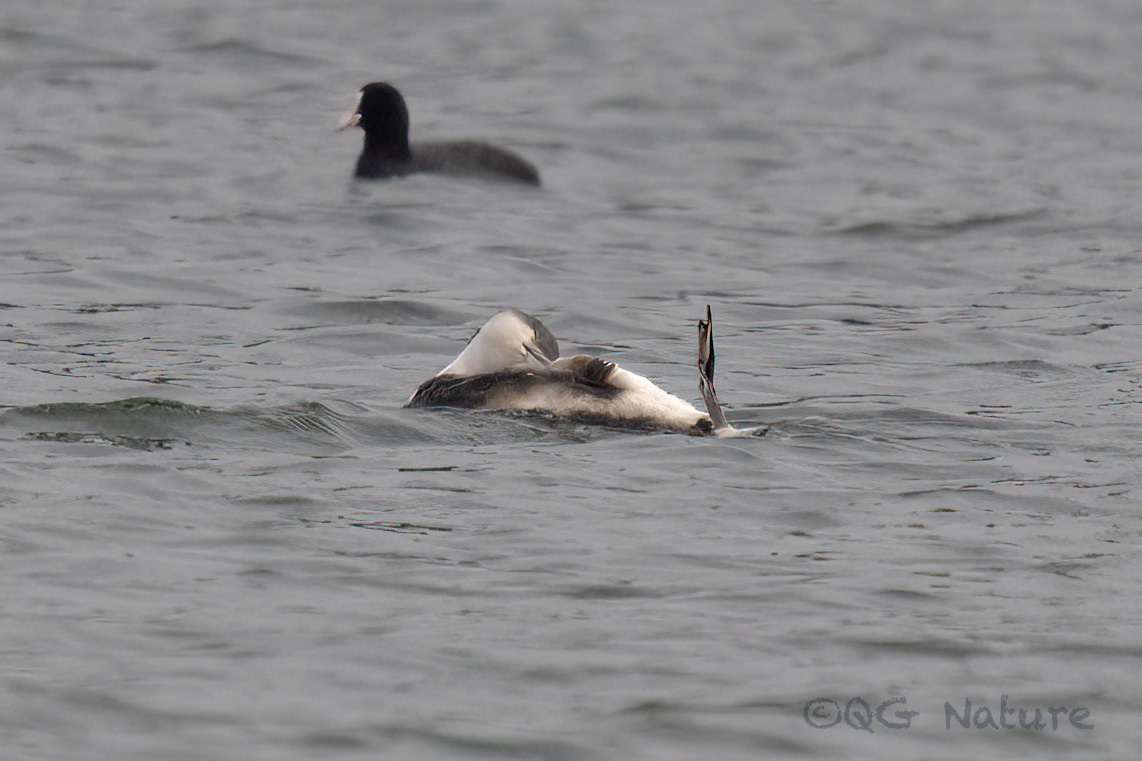
Distinguished from the Pacific loon by the white flanks, a key field mark. The green throat patch identifies the subspecies viridigularis versus the black throat of the nominate. In breeding plumage, the combination of grey head, black throat, and white-spotted blackish upperparts is distinctive. Non-breeding birds show a brownish cap and hindneck with a thin dark necklace separating the darker throat sides from the white front. The steel-grey bill with blackish tip and white sides of the head below the eye aid identification. The white flank patch distinguishes it from the Pacific loon in all plumages.
Distribution & Habitat
Breeds across northern Europe and Asia from Scandinavia east to Chukotka and Kamchatka, with populations reaching the Seward Peninsula in Alaska. The nominate subspecies breeds from northern Europe east to the Lena River and Transbaikal, wintering on coasts of northwestern Europe and the Mediterranean, Black, and Caspian Seas. Subspecies viridigularis breeds from the Lena River east to Chukotka, Kamchatka, and northern Sakhalin, wintering on northwestern Pacific coasts. Breeding habitat consists of isolated, deep freshwater lakes larger than 0.1 km² with small stretches of open water. Winter habitat includes inshore waters along sheltered coasts, occasionally found inland on seas such as the Mediterranean and Black.
Behavior & Ecology
Forages alone or in pairs, rarely in groups, diving from the water to depths no greater than 5 meters. Dives average 1.6 per minute with about 80% success rate; successful dives average 17 seconds while unsuccessful ones average 27 seconds. Preys mainly on fish, but also takes insects, molluscs, crustaceans, and plant matter. Breeding begins in April in southern range areas or after spring thaw in northern areas. Nests on the ground within 1 meter of the breeding lake or on emergent vegetation, constructing an oval nest about 23 cm across from plant material. Lays a clutch of two (rarely one or three) brown-green speckled eggs measuring 76 by 47 mm, incubated by both parents for 27 to 29 days. Chicks fledge after 60 to 65 days. Vocalizations include a rhythmic male breeding song described as 'oooéé-cu-cloooéé-cu-cloooéé-cu-cluuéé', a 'áááh-oo' wail, a growling 'knarr-knor' call given at night, and a rising 'uweek' alarm call. Flight call is a barking 'kwow'.
Conservation
IUCN Red List status: Least Concern. Population is declining but not rapidly enough to warrant a higher threat category due to large population size and extensive range. Protected under the Migratory Bird Treaty Act of 1918 (United States) and the Agreement on the Conservation of African-Eurasian Migratory Waterbirds (Europe and Africa). Primary threats include acidification and heavy-metal pollution of breeding lakes, oil pollution near fishing grounds, mortality in fishing nets, and coastal windfarm development. Nesting success ranges from under 30% to over 90% annually, influenced primarily by predation and flooding. Annual adult mortality rate is approximately 10%. Mammalian predators such as red foxes and pine martens account for about 40% of clutch losses, while avian predators including hooded crows also take eggs.
Source: Wikipedia · CC BY-SA 3.0
Taxonomy
- Order
- Gaviiformes
- Family
- Gaviidae
- Genus
- Gavia
- eBird Code
- arcloo
Subspecies (2)
-
Gavia arctica arctica
breeds Western Palearctic from Scotland eastward to Lena River (northeastern Siberia, including Novaya Zemlya and Franz Josef Land), and southward through northern Kazakhstan; winters to northwestern and southern Europe
-
Gavia arctica viridigularis
breeds northeastern Siberia and far western mainland Alaska; winters from the Kuril Islands to the Yellow Sea
Data Sources
Species description from Wikipedia, licensed under CC BY-SA 3.0.
Bird images and sounds sourced from GBIF, contributed by citizen scientists worldwide under Creative Commons licenses.
Taxonomy data from AviList 2025.