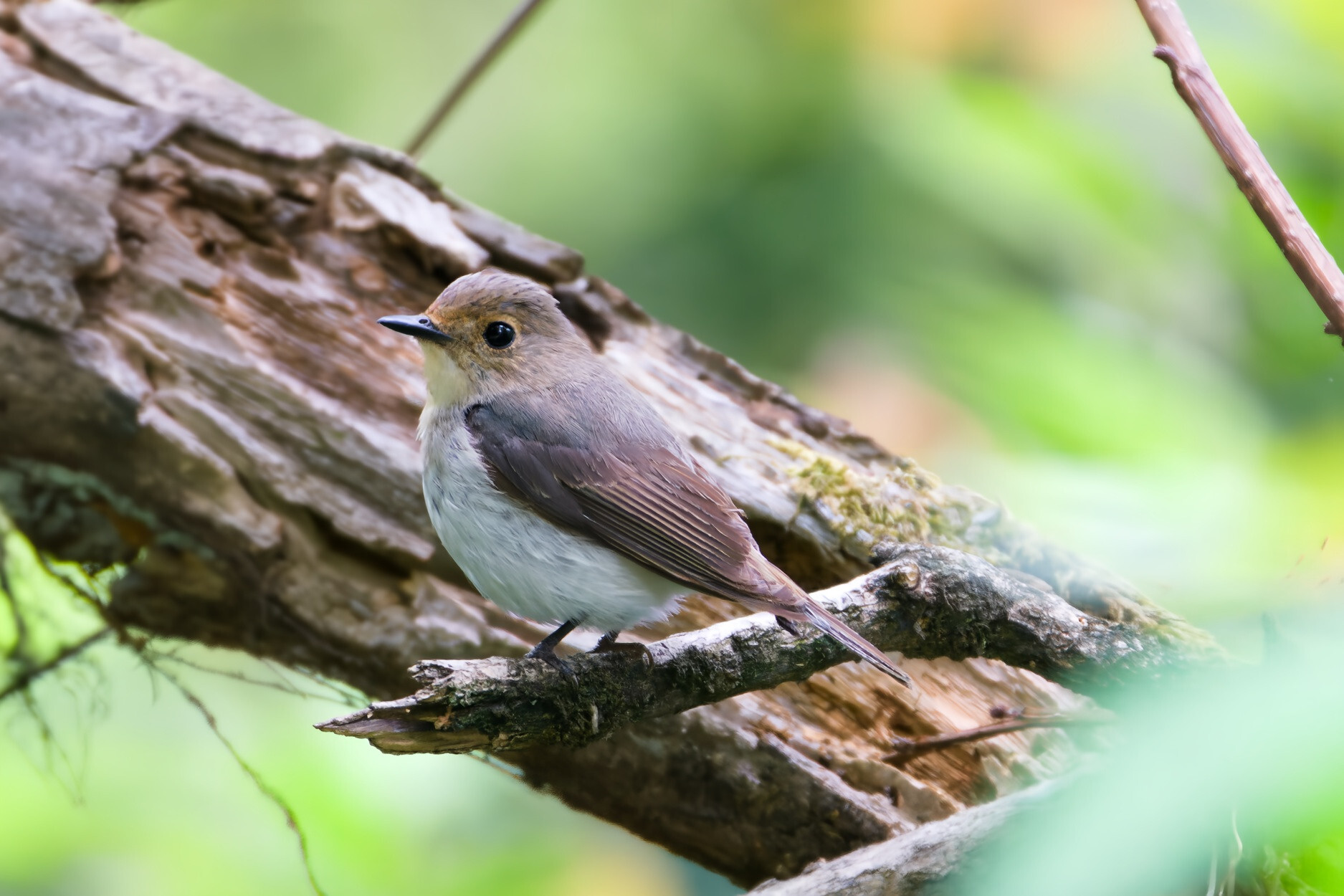
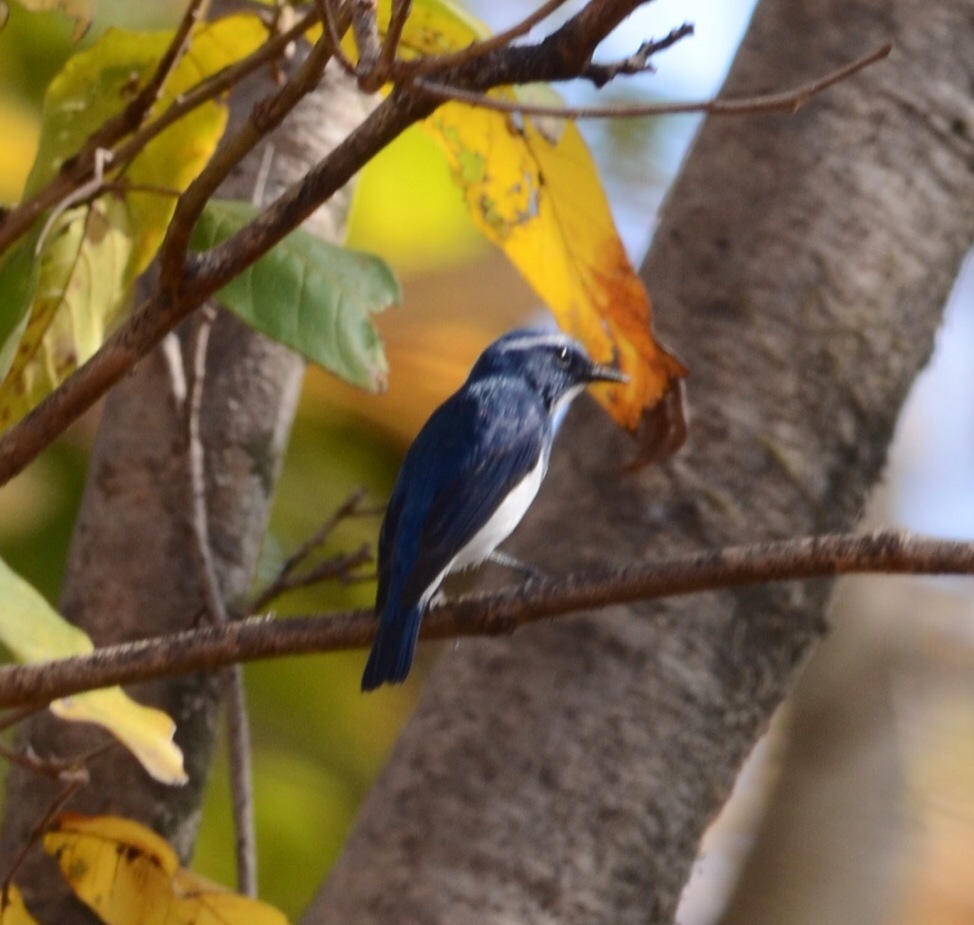
Ultramarine Flycatcher
Ficedula superciliaris
白眉蓝姬鹟
Introduction
Small arboreal Old World flycatcher (Ficedula genus). Breeding range extends from eastern Afghanistan to the Hengduan Mountains; winters in India and northwestern Indochina. Inhabits open, mixed forests of oak, rhododendron, pine, and fir, occasionally orchards. Breeding occurs between 2000 and 2700 meters elevation. Characterized by constant tail-jerking behavior and clinal variation in plumage patterns across its range.
Description
Small, stocky flycatcher approximately 10 cm in length, slightly smaller than a sparrow. Males are deep blue above with deep blue sides to the head and neck. A prominent white patch extends from the center of the throat through the breast to the belly. Western subspecies display a distinctive white supercilium and white bases to the outer tail feathers, while eastern subspecies lack distinct white patches. The population from south Assam hills completely lacks any supercilium. Clinal variation exists from west to east along the Himalayan foothills.
Identification
Compact flycatcher about 10 cm long with stocky build. Males are unmistakable with deep blue upperparts and white underparts from throat to belly. Key identification features include the presence or absence of white supercilium and tail markings, which vary geographically: western birds show white eyebrow and tail base markings, eastern birds lack these, and south Assam populations have no supercilium at all. Constant tail-jerking movement is characteristic.
Distribution & Habitat
Breeds in the western Himalayas from Jammu and Kashmir through Himachal Pradesh to Uttarakhand (western race), intergrading with the eastern race in Nepal. Eastern race extends through Bhutan to Arunachal Pradesh. Also found in the lower hills of Meghalaya and Nagaland (Khasi and Cachar hills). Breeding elevations range from 2000 to 2700 meters, occasionally 1800 to 3200 meters. Winters in central India from Delhi south to northern Maharashtra, Goa, and eastward to Andhra Pradesh and Odisha. Occurs as a vagrant in northern Bangladesh.
Behavior & Ecology
Mainly insectivorous. Typically found singly, though sometimes joins mixed hunting parties in winter. Keeps to low trees and bushes within the foliage canopy, rarely venturing into open areas. Characterized by constant tail-jerking, often accompanied by fluffing of head feathers and a trrr note, especially near the nest. Foraging strategy relies more on indirect cues than direct cues for risk management. Breeding season runs from mid-April to early July. Nests are soft structures of fine moss, bark strips, and grass, lined with hair and rootlets, placed in tree holes or depressions in steep banks up to seven meters high, or in nest boxes. Lays 3 to 5 eggs, usually 4, measuring 16x12.2 mm on average, olive greenish to dull stone-buff with reddish brown freckling.
Conservation
Not assessed.
Culture
Not mentioned in source material.
Source: Wikipedia · CC BY-SA 3.0
Taxonomy
- Order
- Passeriformes
- Family
- Muscicapidae
- Genus
- Ficedula
- eBird Code
- ultfly1
Subspecies (2)
-
Ficedula superciliaris aestigma
Himalayas (Bhutan to southeastern Tibet, southwestern China, Myanmar, and northern India)
-
Ficedula superciliaris superciliaris
breeds Himalayas (northern Pakistan to Nepal and Sikkim); winters to central India
Data Sources
Species description from Wikipedia, licensed under CC BY-SA 3.0.
Bird images and sounds sourced from GBIF, contributed by citizen scientists worldwide under Creative Commons licenses.
Taxonomy data from AviList 2025.