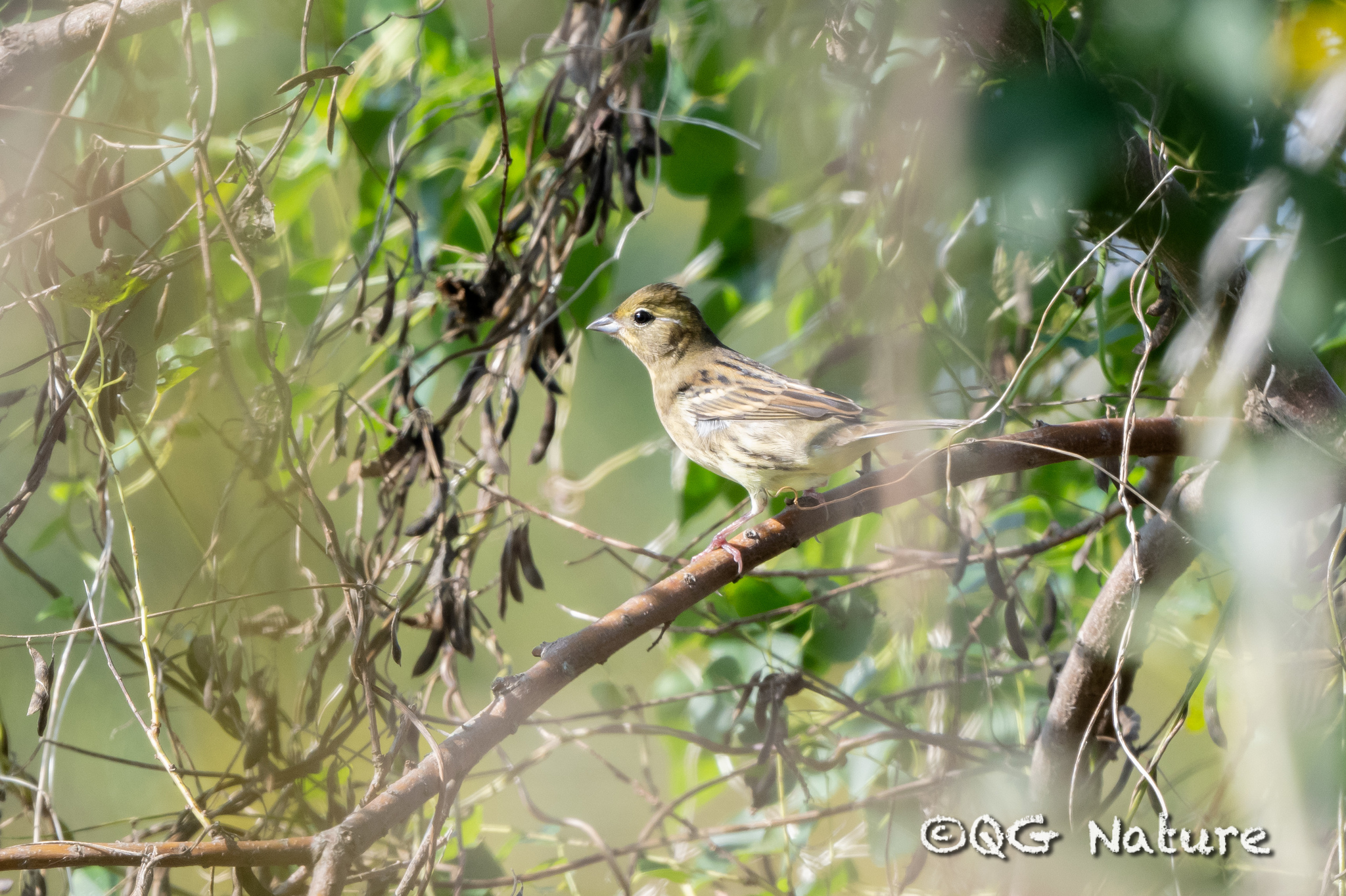
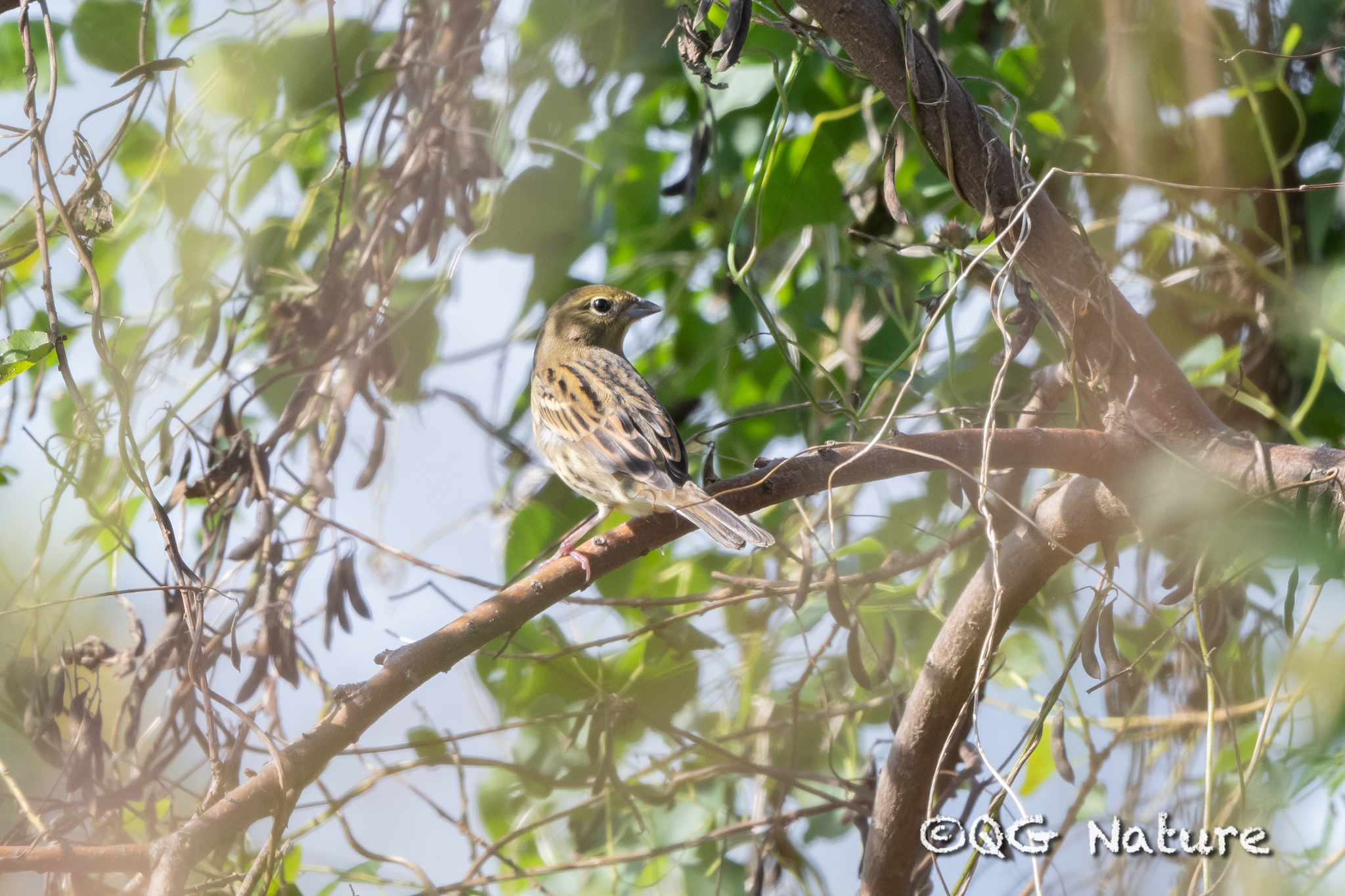
Yellow Bunting
Emberiza sulphurata
硫黄鹀
Introduction
This small passerine bunting inhabits the forested mountains of eastern Asia, primarily in Japan. It occupies temperate woodlands of central and northern Honshu during breeding season, at mid-elevations between 600 and 1,500 meters. The species has shown population stability or possible increase in recent years, contradicting earlier concerns about severe declines. Conservation status is IUCN Least Concern. Detailed population estimates remain elusive.
Description
A compact bunting measuring 14 cm in length with the characteristic conical bill shape of the family, though this individual's bill appears distinctly grey rather than the more typical horn color. The pinkish-brown legs and brown eyes provide additional identifying features. Adult males display a grey-green upperparts with fine black streaking on the mantle and back, while the underparts show a yellow-green wash most intense on the throat and belly, with streaking confined to the flanks. The face pattern includes black lores, a narrow black chin, and a pale eye ring, with white outer tail feathers conspicuous in flight. Two pale wing bars are formed by the tips of the median and greater wing coverts. Females resemble males but appear overall paler and lack the black facial and chin markings.
Identification
Males are most readily identified by the combination of yellow-green underparts with black lores and chin. The yellow underparts help distinguish this species from many other Emberiza buntings in the region, though females can be more challenging and may be confused with other species lacking the bold face pattern. The white outer tail feathers are visible in flight and can assist with identification when other features are difficult to observe. The species' size and wing bar pattern provide additional clues, though consultation with regional guides is recommended for confident identification of females in poor lighting conditions.
Distribution & Habitat
This species breeds exclusively in Japan, where it remains uncommon across its range. The core population occurs on Honshu, particularly in the central and northern portions of the island, with possible breeding on Kyushu and historical breeding on Hokkaido. During the non-breeding season, most individuals migrate south, with winter records from the Philippines, Taiwan, Hong Kong, and southeastern China, though the species remains scarce throughout this range. A few birds winter in the warmer regions of Japan. Small numbers pass through Korea during both spring and autumn migrations. The species inhabits forest and woodland during breeding season, transitioning to woodland, scrub, grassland, and farmland in winter.
Behavior & Ecology
The breeding season extends from mid-May through early July, with nesting activity commencing in late spring. The cup-shaped nest is constructed low in bushes, typically within dense vegetation that provides concealment from predators. Clutches consist of three to five eggs, though detailed incubation and fledging periods are not documented in available sources. The species produces a twittering song described as musical and relatively pleasant, accompanied by a soft tsip contact call. Social behavior outside the breeding season is not well documented, though like many buntings it is likely to occur in small flocks or loose associations during migration and winter.
Conservation
The IUCN classifies this species as Least Concern as of the current assessment, reflecting a reassessment of its population status. While earlier estimates suggested more severe declines, current evidence indicates the population is stable or possibly increasing, and likely substantially larger than previously thought. Despite this improved outlook, significant threats persist. Habitat loss through deforestation and land conversion affects both breeding and wintering grounds. Pesticide use impacts food availability and may cause direct mortality. Perhaps most concerningly, trapping for the cagebird industry continues to remove individuals from the wild, though the scale of this pressure is difficult to quantify. The total global population remains unknown as of 2021.
Culture
No specific cultural significance, folklore, or traditional uses are documented for this species in available sources. While other Emberiza species feature in various cultural contexts across their ranges, this particular species does not appear to have notable cultural associations.
Source: Wikipedia · CC BY-SA 3.0
Taxonomy
- Order
- Passeriformes
- Family
- Emberizidae
- Genus
- Emberiza
- eBird Code
- yelbun1
Distribution
breeds in montane forest edge of central Honshu (central Japan); winters to southeastern China, Taiwan and (mainly) northern Philippines
Data Sources
CBR Notes: 中文名由硫磺鹀恢复为硫黄鹀,IUCN红色名录等级由VU降为LC
Species description from Wikipedia, licensed under CC BY-SA 3.0.
Bird images and sounds sourced from GBIF, contributed by citizen scientists worldwide under Creative Commons licenses.
Taxonomy data from AviList 2025.