White-bellied Woodpecker
Dryocopus javensis
白腹黑啄木鸟
Introduction
This large woodpecker occurs across the tropical forests of the Indian subcontinent and Southeast Asia. It inhabits intact evergreen forests, particularly areas with large dead trees standing near rivers. The species reaches 40-48 cm in length. Fourteen subspecies have been described. Cebu Island's form hasn't been observed since the 1950s, and Tristram's woodpecker is extinct in South Korea and Japan. The species is typically encountered singly or in pairs, though occasionally a third bird accompanies a pair. It sometimes nests close to well-used trails through forest. The calls and drumming are notably loud and carry through the forest canopy.
Description
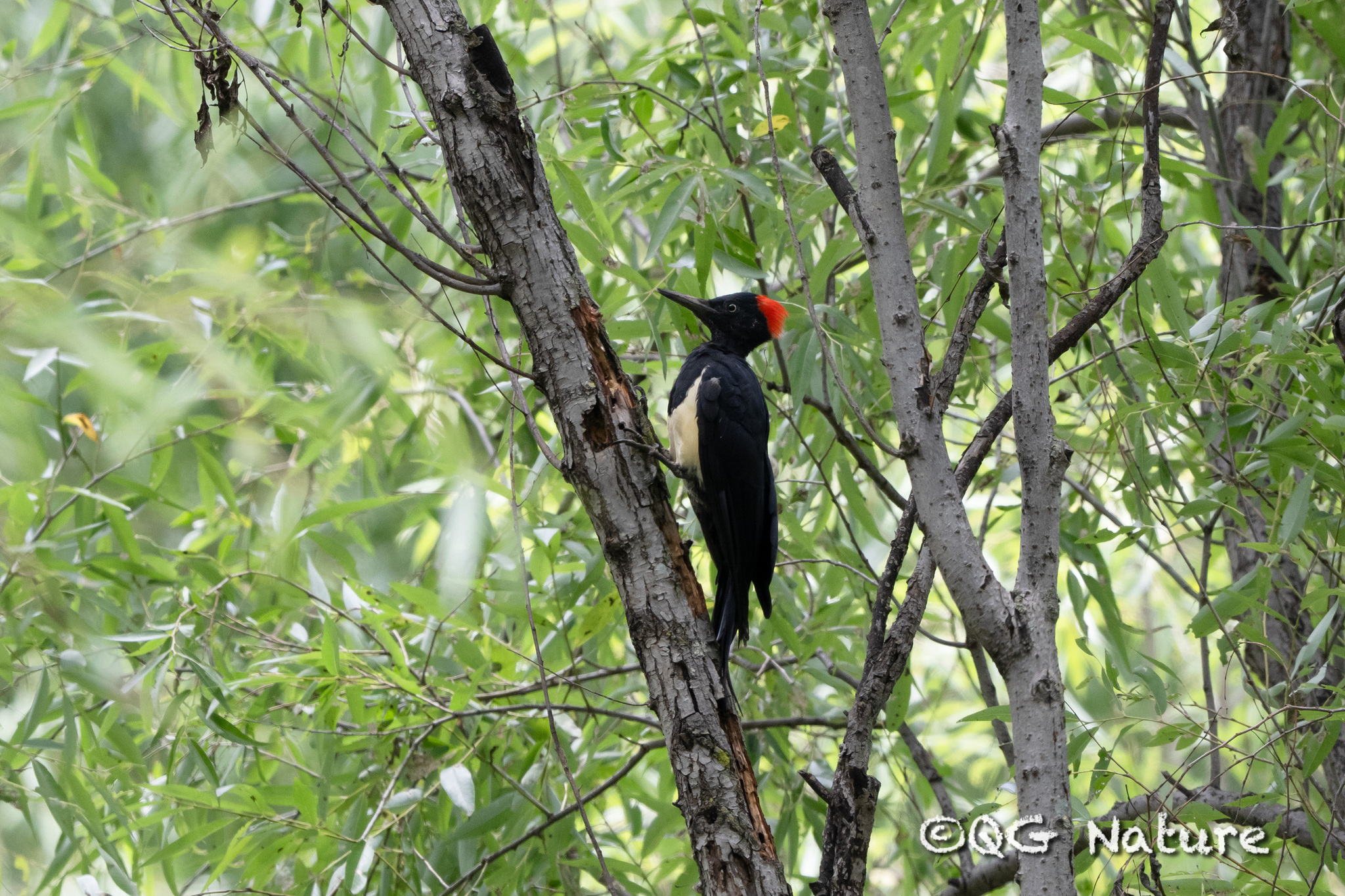
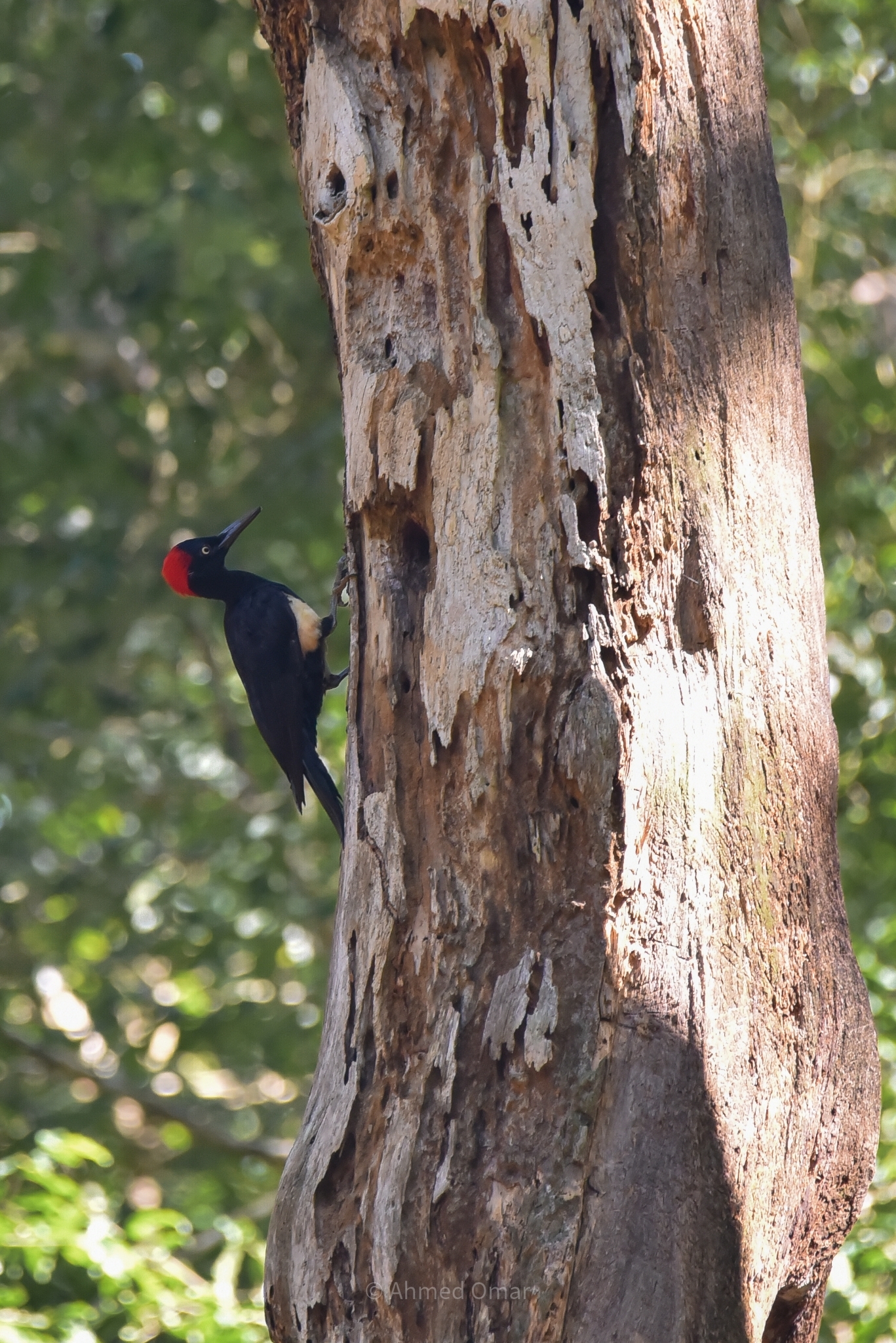
This is a substantially large woodpecker, measuring 40-48 cm in length with a body mass of 197-350 grams. The plumage is predominantly black, with the species ranking as the third-largest Asian woodpecker behind the great slaty woodpecker and black woodpecker. Standard measurements include a wing chord of 20.5-25.2 cm, tail length of 14.3-18.9 cm, a robust bill measuring 4.6-6 cm, and tarsus of 3.2-4.3 cm. Geographic variation exists in white plumage distribution—subspecies hodgsonii in India shows whitish underwing coverts and a white rump, though the face typically lacks white. Juveniles of the nominate race may display white streaks on the throat. The species bears close resemblance to its northern relative the black woodpecker and the North American pileated woodpecker, being similar in size and overall black plumage.
Identification
The white-bellied woodpecker's large size and predominantly black plumage distinguish it from smaller sympatric woodpeckers throughout its range. It most closely resembles the black woodpecker of more northern latitudes, though geographic separation generally prevents confusion. Among Asian woodpeckers, only the great slaty woodpecker exceeds it in size. The extent of white marking varies by subspecies, with Indian populations (hodgsonii) showing the most white on underwing coverts and rump. The combination of very large size, all-black appearance except for variable white patches, and preference for tall evergreen forest with large dead trees provides the best field identification clues. Vocalizations are notably louder and deeper than those of smaller woodpecker species.
Distribution & Habitat
This species inhabits evergreen forests across the tropical Indian subcontinent and Southeast Asia, from India and Sri Lanka through mainland Southeast Asia to the Sunda Islands and the Philippines. Fourteen subspecies are distributed across this vast range, with island populations showing significant geographic isolation. The species shows a strong association with large dead trees for nesting, often choosing specimens standing near rivers. While primarily sedentary, some seasonal movements may occur in response to resource availability. Different subspecies occupy distinct geographic areas—from the Western Ghats population in India through various island forms in the Philippine archipelago to populations in Borneo, Sumatra, and surrounding islands.
Behavior & Ecology
These woodpeckers are typically encountered alone or in pairs, though trios sometimes form. Adults may spend extended periods—up to an hour—foraging at single suitable trees, methodically investigating bark for prey. The diet consists primarily of insects, especially ants and grubs extracted from beneath bark, though fruit is occasionally consumed. Breeding occurs mainly from January to March, with the Indian subspecies hodgsonii breeding from January to May. Nests are excavated in large dead trees, often reused in successive years. The species roosts within tree cavities. Vocalizations range from short, sharp 'kuk' notes to more drawn-out 'kyuk,' 'kew,' and 'kee-yow' calls, with longer calls typically given before taking flight. Loud drumming occurs year-round but intensifies during the breeding season.
Conservation
The white-bellied woodpecker has fourteen subspecies, several of which face critical threats. Cebu Island's endemic form (D. j. cebuensis) hasn't been recorded since the 1950s and is considered likely extinct. Tristram's woodpecker (D. j. richardsi) survives only in North Korea after vanishing from South Korea and Tsushima, Japan. Habitat loss through deforestation represents the primary threat to this species, particularly affecting island populations with restricted ranges. In central India's Bastar region, collection of squabs by tribal peoples has contributed to local rarity. Many island subspecies are endangered, reflecting their limited distributions and ongoing habitat pressures. Conservation attention is focused on protecting remaining forest habitats and the large dead trees this species requires for nesting.
Culture
Information on cultural significance is not provided in the source material.
Source: Wikipedia · CC BY-SA 3.0
Taxonomy
- Order
- Piciformes
- Family
- Picidae
- Genus
- Dryocopus
- eBird Code
- whbwoo2
Vocalizations
Subspecies (15)
-
Dryocopus javensis cebuensis
formerly Cebu (central Philippines); extinct
-
Dryocopus javensis confusus
central and southern Luzon (northern Philippines)
-
Dryocopus javensis esthloterus
northern Luzon (northern Philippines)
-
Dryocopus javensis feddeni
Thailand, Myanmar, and Indochina
-
Dryocopus javensis forresti
montane forest of northern Myanmar and adjacent southwestern China
-
Dryocopus javensis hargitti
Palawan (southwestern Philippines)
-
Dryocopus javensis hodgsonii
peninsular India
-
Dryocopus javensis javensis
southern Thailand and Malay Peninsula to Greater Sundas and offshore islands
-
Dryocopus javensis mindorensis
Mindoro (Philippines)
-
Dryocopus javensis multilunatus
southern Philippines (Basilan, Dinagat, and Mindanao)
-
Dryocopus javensis parvus
Simeulue (off northwestern Sumatra)
-
Dryocopus javensis pectoralis
east-central Philippines (Leyte, Samar, Panaon, Calicoan, and Bohol)
-
Dryocopus javensis philippinensis
Philippines (Panay, Negros, Masbate, and Guimaras)
-
Dryocopus javensis richardsi
Korea; extirpated from Tsushima Island (Japan)
-
Dryocopus javensis suluensis
Sulu Archipelago
Data Sources
Species description from Wikipedia, licensed under CC BY-SA 3.0.
Bird images and sounds sourced from GBIF, contributed by citizen scientists worldwide under Creative Commons licenses.
Taxonomy data from AviList 2025.