Lesser Spotted Woodpecker
Dryobates minor
小斑啄木鸟
Introduction
The lesser spotted woodpecker is the smallest woodpecker species in Europe, measuring 14 to 16.5 centimeters in length. It occurs across the Palearctic region and inhabits the canopy of tall trees, favouring upper branches. Identification features include barring on the wings and lower back, a stumpy triangular silhouette, and bounding flight. It exhibits similar habits to the great spotted woodpecker. Populations are somewhat nomadic, causing annual fluctuations in local abundance. The species has declined significantly, particularly in Britain, where it has become increasingly scarce.
Description
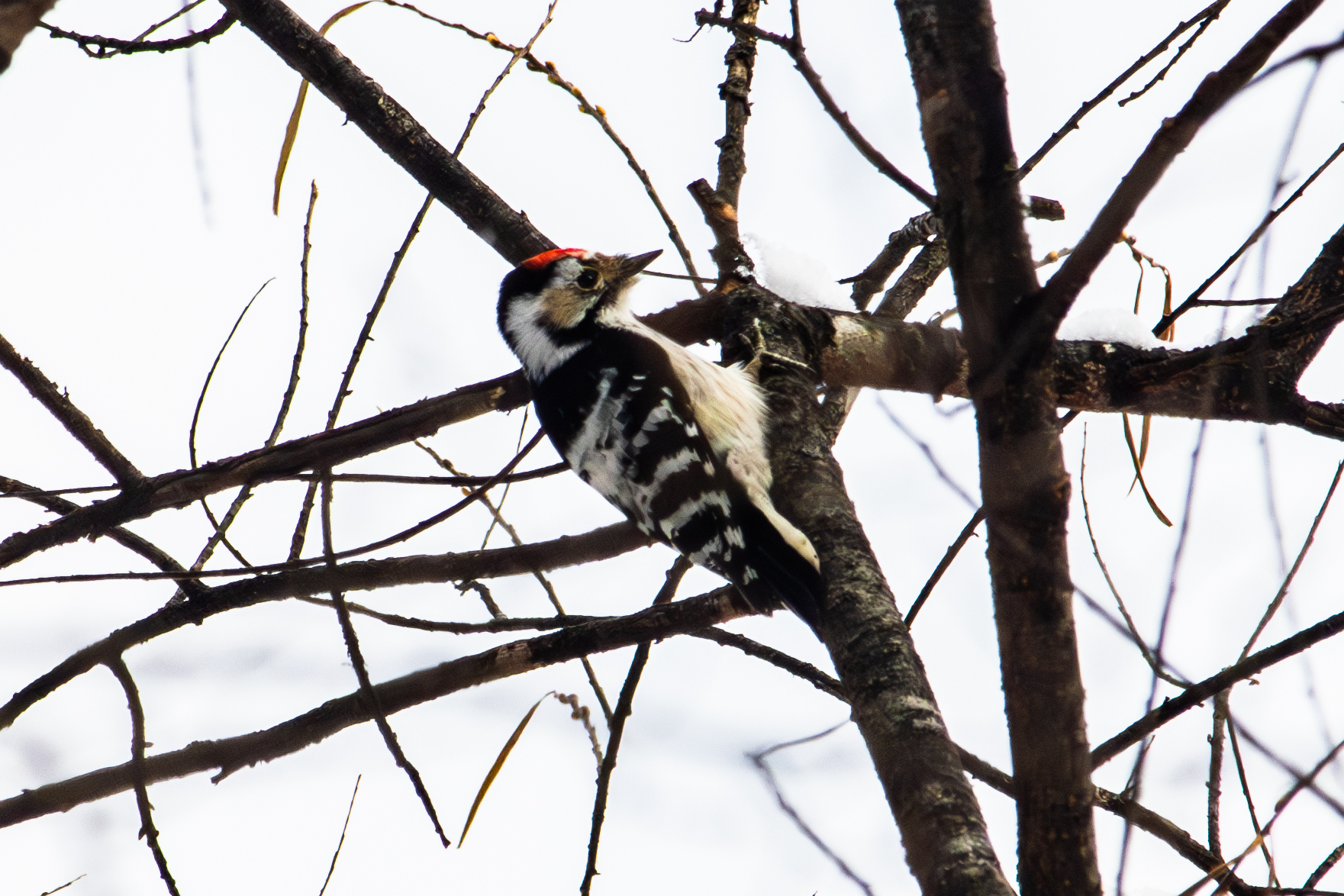
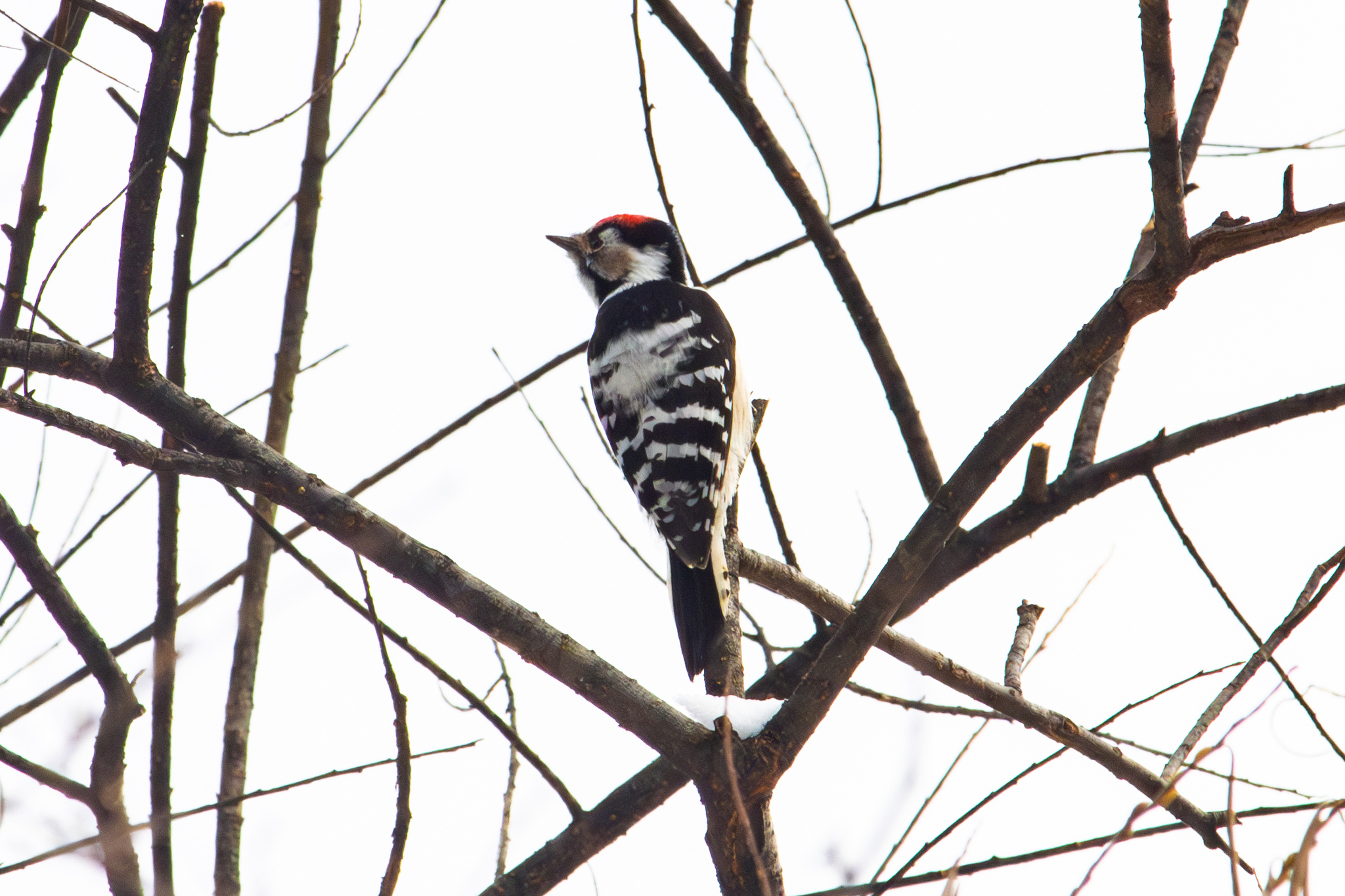
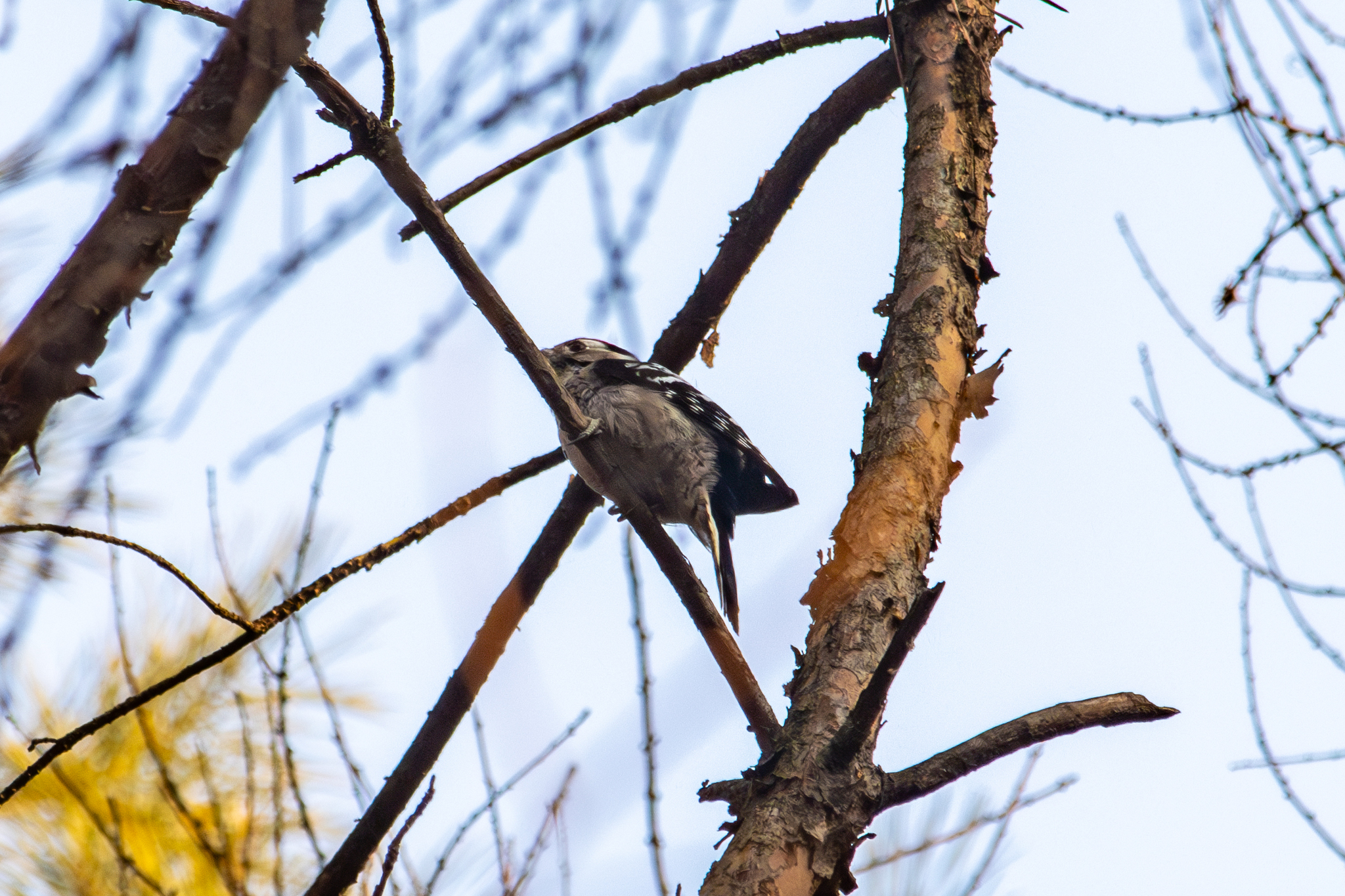
As the smallest European woodpecker, this species measures 14 to 16.5 centimetres in length with a wingspan of 24 to 29 centimetres and weighs between 17 and 25 grams. The plumage is predominantly black and white, with the upperparts displaying a distinctive barring pattern. Males possess a crimson crown contrasting with a brown forehead and black superciliary stripe, while females have a completely white crown. Juveniles of both sexes show varying amounts of crimson on the head. The underparts are white with fine streaks on the flanks. The wings feature broad black bars, the lower back has narrower barring, and the outer tail feathers are also barred. The bill and legs are slate-grey. There are no marked seasonal changes in plumage throughout the year.
Identification
The small size and distinctive wing pattern are the key identification features. When seen on a trunk, the broad black bars on the wings combined with narrower bars on the lower back distinguish this species from other European woodpeckers. The great spotted woodpecker is significantly larger and lacks the extensive barring on the back. The call is a repeated, loud 'keek' note, surprisingly powerful for such a small bird, and a vibrating rattle that can be distinguished with experience from the similar call of the larger great spotted woodpecker. The bounding, almost triangular flight silhouette is characteristic of the genus.
Distribution & Habitat
This species occurs throughout the Palearctic region, from Britain and Iberia across Europe and Siberia to the Sea of Okhotsk, Korea, Japan and northern Mongolia. It also extends into northwest Africa and Iran. Thirteen subspecies are recognised, showing considerable geographic variation in plumage details, particularly in the development of the postauricular stripe. The species inhabits deciduous and mixed woodland, parks, and mature gardens, favouring areas with standing dead wood. Populations are largely resident but can be nomadic, with annual fluctuations common across its range.
Behavior & Ecology
This species forages primarily on wood-boring insect larvae, chipping away at rotten wood to extract prey. From autumn through spring, it concentrates on thin dead branches in living trees, while during the breeding season it takes more surface insects from foliage and bark. Nestlings are fed mainly with aphids and larval insects. The nesting cavity is excavated at considerable height, typically 10 to 20 metres above ground, with an entrance diameter of 2.5 to 5 centimetres and a shaft extending 30 centimetres or more below. Five to eight white eggs are laid in late May, with a single brood per season and both parents sharing incubation duties. The loud 'keek' call serves as a territorial signal and courtship display throughout the year.
Conservation
The species is currently listed as Least Concern globally, though populations in parts of its range have shown concerning declines. In Britain, the population almost halved between 2009 and 2017, with approximately 2,000 birds remaining. The British Ornithology Trust attributes this decline to modern forestry and park management practices that rapidly remove dead and decaying trees, depriving the species of its essential nesting habitat. The species depends on standing dead wood for both foraging opportunities and nesting sites, making habitat retention crucial for its survival. Winter temperatures can directly affect survival through heat loss, while spring weather indirectly influences breeding success by affecting food availability.
Source: Wikipedia · CC BY-SA 3.0
Taxonomy
- Order
- Piciformes
- Family
- Picidae
- Genus
- Dryobates
- eBird Code
- leswoo1
Subspecies (13)
-
Dryobates minor amurensis
lower Amur River and Sakhalin to northeastern Korea and northern Japan
-
Dryobates minor buturlini
Iberia, southern France and Italy to Romania, Bulgaria, and northern Greece
-
Dryobates minor colchicus
Caucasus and Transcaucasia
-
Dryobates minor comminutus
England and Wales
-
Dryobates minor danfordi
Greece and Türkiye
-
Dryobates minor hortorum
France to Poland, Switzerland, Hungary, and northern Romania
-
Dryobates minor hyrcanus
northern Iran
-
Dryobates minor immaculatus
Anadyr Basin and Kamchatka (eastern Siberia)
-
Dryobates minor kamtschatkensis
Ural Mountains eastward to the Sea of Okhotsk and southward to northern Mongolia
-
Dryobates minor ledouci
northwestern Africa (northeastern Algeria and northwestern Tunisia)
-
Dryobates minor minor
northern Europe (Scandinavia to Ural Mountains)
-
Dryobates minor morgani
southwestern Iran
-
Dryobates minor quadrifasciatus
Lenkoran region of southeastern Azerbaijan
Data Sources
Species description from Wikipedia, licensed under CC BY-SA 3.0.
Bird images and sounds sourced from GBIF, contributed by citizen scientists worldwide under Creative Commons licenses.
Taxonomy data from AviList 2025.