Stripe-breasted Woodpecker
Dendrocopos atratus
纹胸啄木鸟
Introduction
This woodpecker inhabits the montane forests of Southeast Asia, ranging from northeastern India through Myanmar and Thailand to Vietnam and southwestern China. It occupies a variety of forest types, including pine and oak woodlands, forest edges, and scattered tree habitats. The species occurs at elevations above 2,000 meters, where it forages in the mid to upper canopy levels. It forms a close species-pair with the fulvous-breasted woodpecker, requiring attention to breast coloration and marking patterns for accurate identification. The population is considered uncommon throughout its range but appears stable. Body length is 22-24 cm.
Description
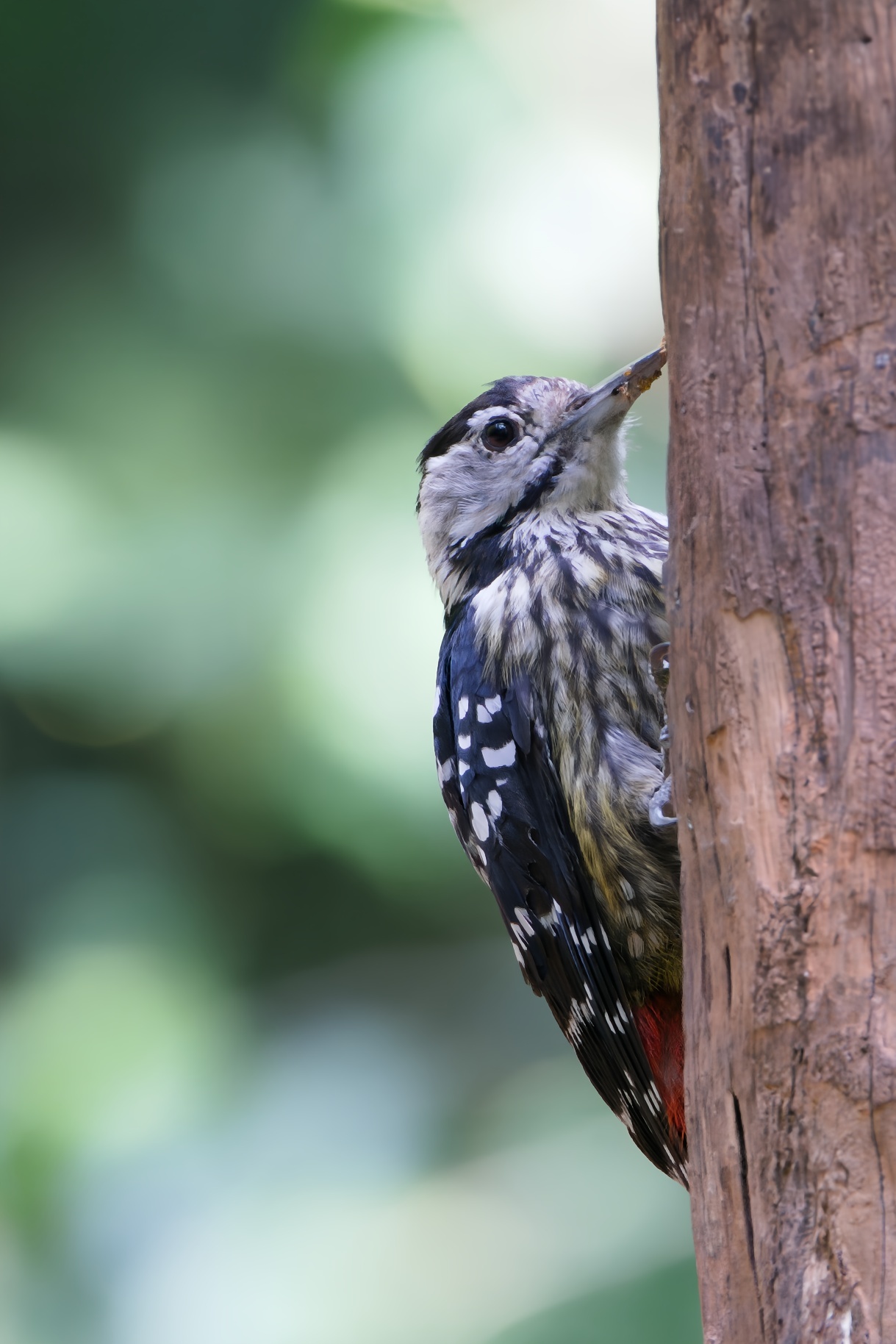
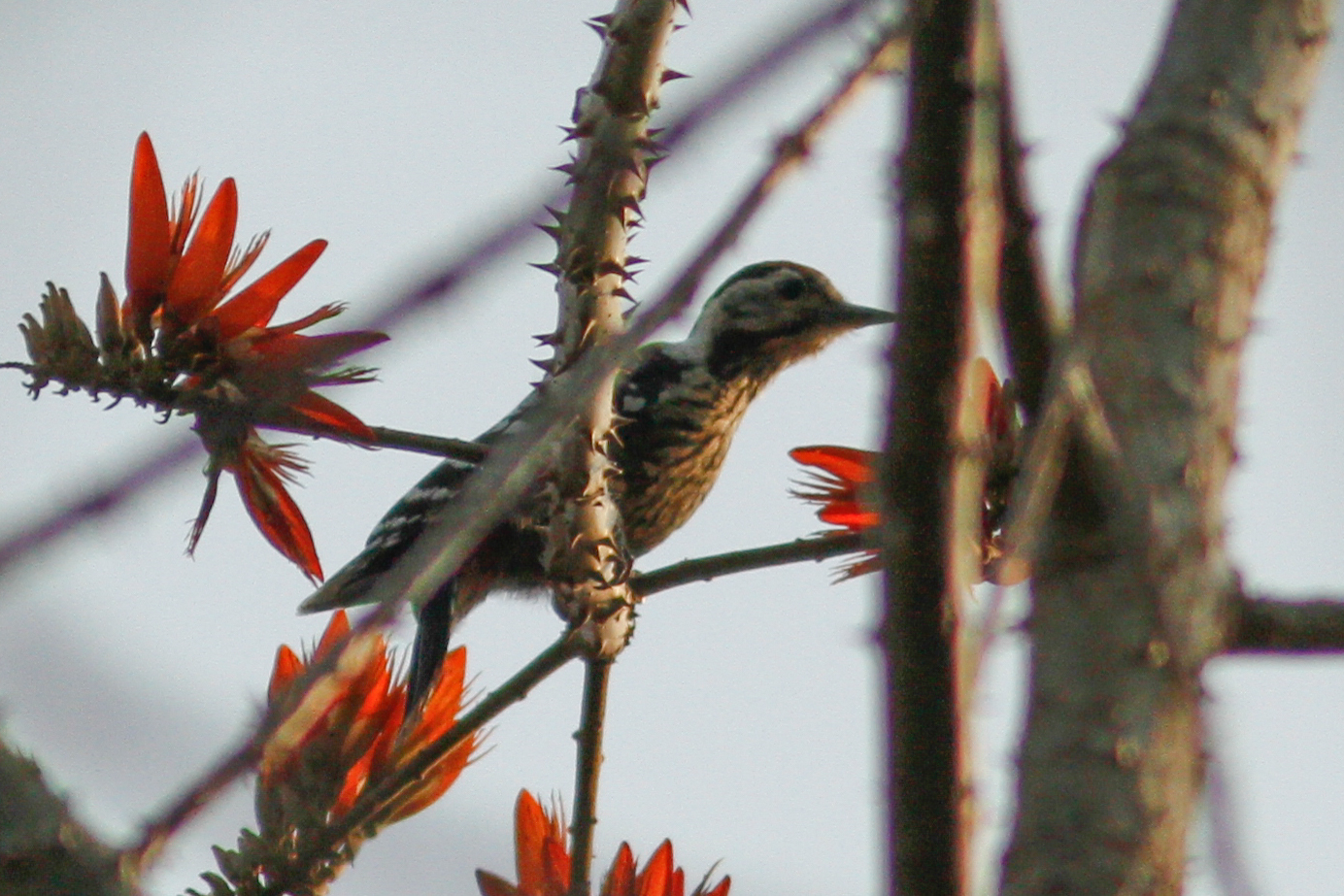
A small to medium-sized woodpecker measuring 21-22 cm in length. The upperparts are black with heavy white barring, though the mantle remains unbarred. The tail is black with white markings on the outer feathers. The face appears whitish with a prominent black moustache stripe that connects to a streak along the breast edge. Underparts range from greyish-yellow to greyish-buff and are boldly streaked with black, while the under tail coverts are red. Sexual dimorphism is pronounced: males display a red crown and nape, while females have black in these areas. The chestnut iris, grey sharply pointed beak, and bluish-grey legs and feet complete the plumage. Juveniles are greyer below with pink or orange under-tail coverts and duller red crown coloration in young males.
Distribution & Habitat
This species occurs across southeastern Asia, with its range extending from northeastern India through Myanmar, Thailand, Laos, and Vietnam to Yunnan Province in southwestern China. It inhabits montane evergreen forests, showing particular preference for pine and oak woodlands, though it also utilizes deciduous forest edges and more open areas with scattered trees. The species occurs at elevations from 800 to 2,800 meters but is most frequently encountered above 2,000 meters. No migratory movements are reported, as the species appears to be resident throughout its range.
Behavior & Ecology
Foraging occurs in the mid to upper canopy levels, where this woodpecker feeds primarily on insects, especially ants and beetle larvae. Birds typically forage in pairs or small family groups. Breeding season varies by region, beginning as early as February in some areas, March to May in India, and April to May in Myanmar. Nests are excavated in rotten stumps or tree cavities, positioned well above ground level. Clutch size typically consists of four or five eggs. Both parents share incubation duties, with observations of both adult male and female birds incubating simultaneously.
Conservation
The IUCN Red List assesses this species as Least Concern. Although described as fairly uncommon throughout its range, the population appears stable with no significant decline noted. The species' dependence on montane forest habitats provides some protection, though ongoing forest clearance for agriculture and logging within its range warrants continued monitoring.
Source: Wikipedia · CC BY-SA 3.0
Taxonomy
- Order
- Piciformes
- Family
- Picidae
- Genus
- Dendrocopos
- eBird Code
- stbwoo4
Subspecies (2)
-
Dendrocopos atratus atratus
Himalayas from Bhutan through southwestern China and eastward to northern Laos
-
Dendrocopos atratus vietnamensis
Vietnam; probably also southeastern Laos
Data Sources
Species description from Wikipedia, licensed under CC BY-SA 3.0.
Bird images and sounds sourced from GBIF, contributed by citizen scientists worldwide under Creative Commons licenses.
Taxonomy data from AviList 2025.