Nepal House Martin
Delichon nipalense
黑喉毛脚燕
Introduction
Hirundinidae family. Resident species endemic to the Himalayas and Southeast Asia, ranging through Nepal, northeastern India, and Myanmar. Inhabits rugged river valleys and forested mountain ridges between 1,000-4,000 meters elevation. Colonial breeder, constructing nests beneath cliff overhangs. Descends to lower elevations during non-breeding season; occasional vagrant in northern Thailand.
Description
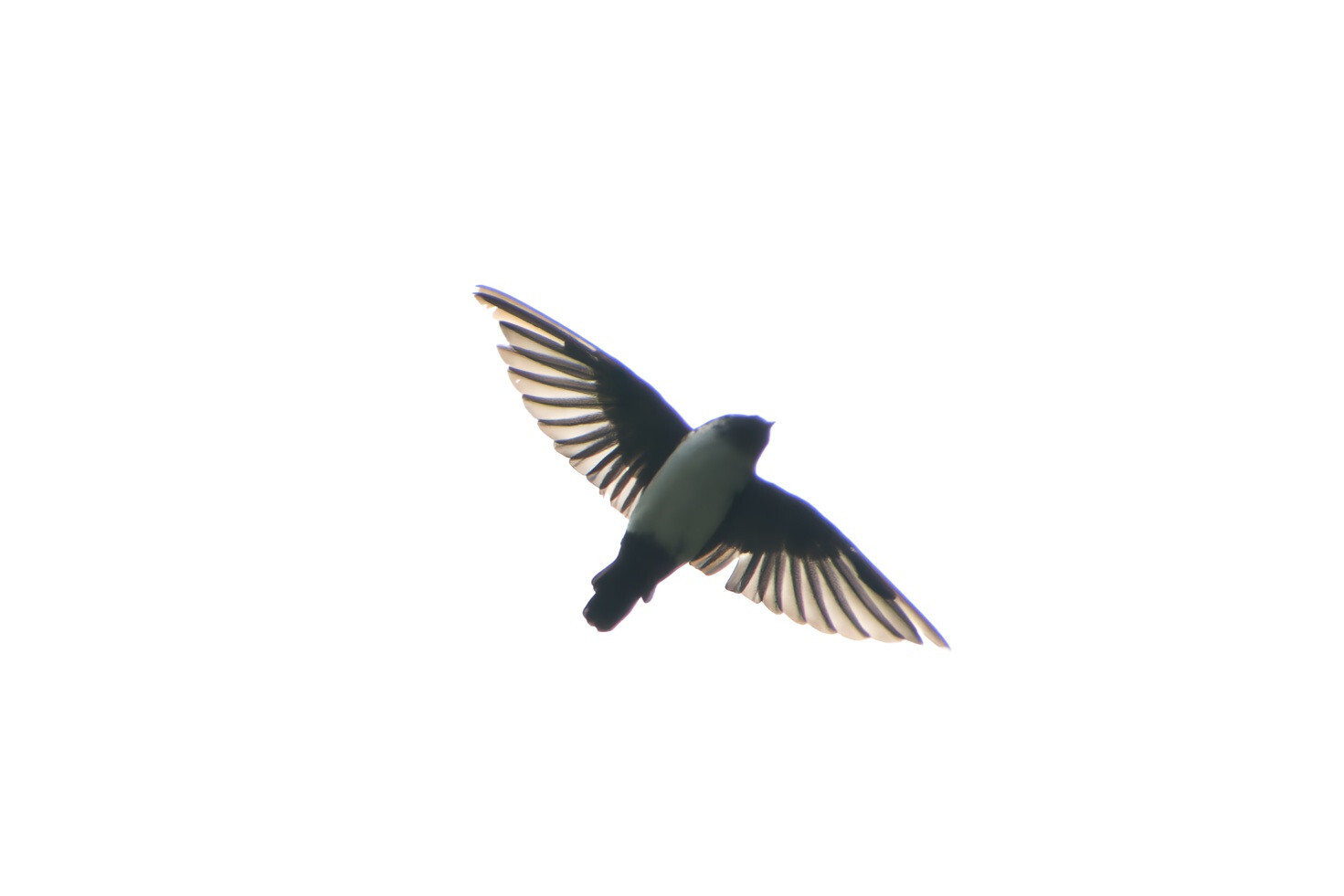
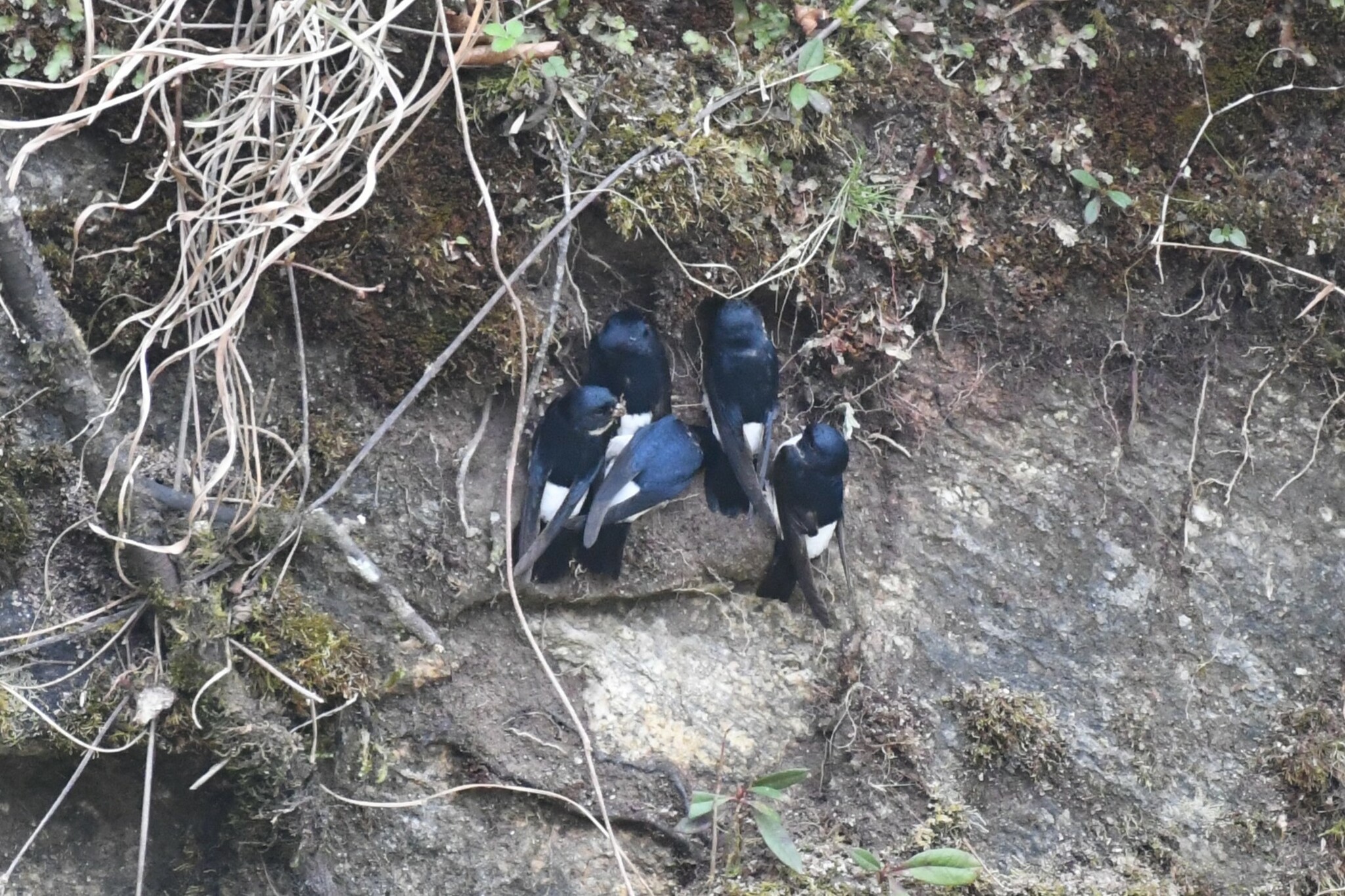
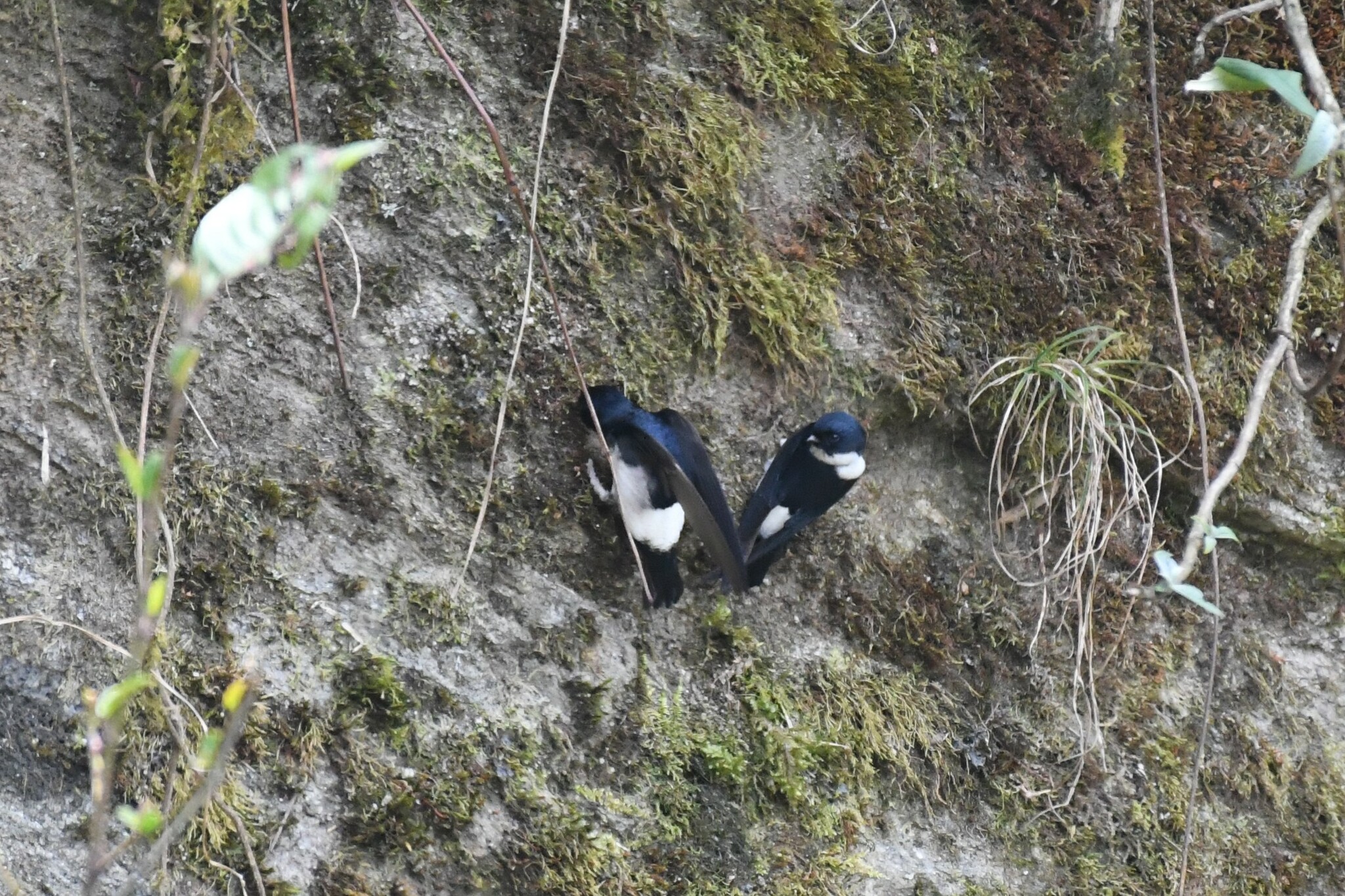
A small martin measuring 13 cm in length with a compact build typical of the genus Delichon. The upperparts are glossy blue-black, contrasting sharply with a pure white rump that is visible in flight. The underparts are entirely white. The tail and upperwings are brownish-black, while the underwings appear grey-brown. The legs and feet are brownish-pink and feathered white, the eyes are brown, and the bill is black. The chin and throat show geographic variation in black coloration, extending further onto the breast in northeastern populations. There is no sexual plumage difference, though juveniles are less glossy with a duskier throat and buff-washed underparts. The eastern subspecies has slightly longer wings than the western nominate form.
Identification
The most reliable distinguishing features are the black chin and black undertail coverts, which separate this species from the similar Asian house martin and common house martin. The tail is noticeably squarer compared to related species. In the northeastern part of the range, the black throat coloration extends onto the upper breast, while western and southern populations show progressively more restricted black marking, sometimes only on the chin. The combination of white rump, white underparts, black chin, and square tail is diagnostic where the species occurs. Care should be taken in areas of range overlap with Asian house martins, which lack the black throat and have less sharply defined white rump.
Distribution & Habitat
The species occupies a discontinuous range along the Himalayas and into Southeast Asia. The nominate subspecies breeds from Garhwal east through Nepal, northeastern India, and Bangladesh to western Myanmar. The eastern subspecies D.n. cuttingi occurs in northern Myanmar, along the Yunnan border, and in northern Vietnam's Tonkin region. Habitat consists of river valleys and wooded ridges at 1,000–4,000 meters elevation, though primarily below 3,000 meters. While largely resident, birds descend to around 300 meters outside the breeding season, occasionally reaching 150 meters. Vagrant records exist from northern Thailand in winter, though the species' status there remains poorly documented.
Behavior & Ecology
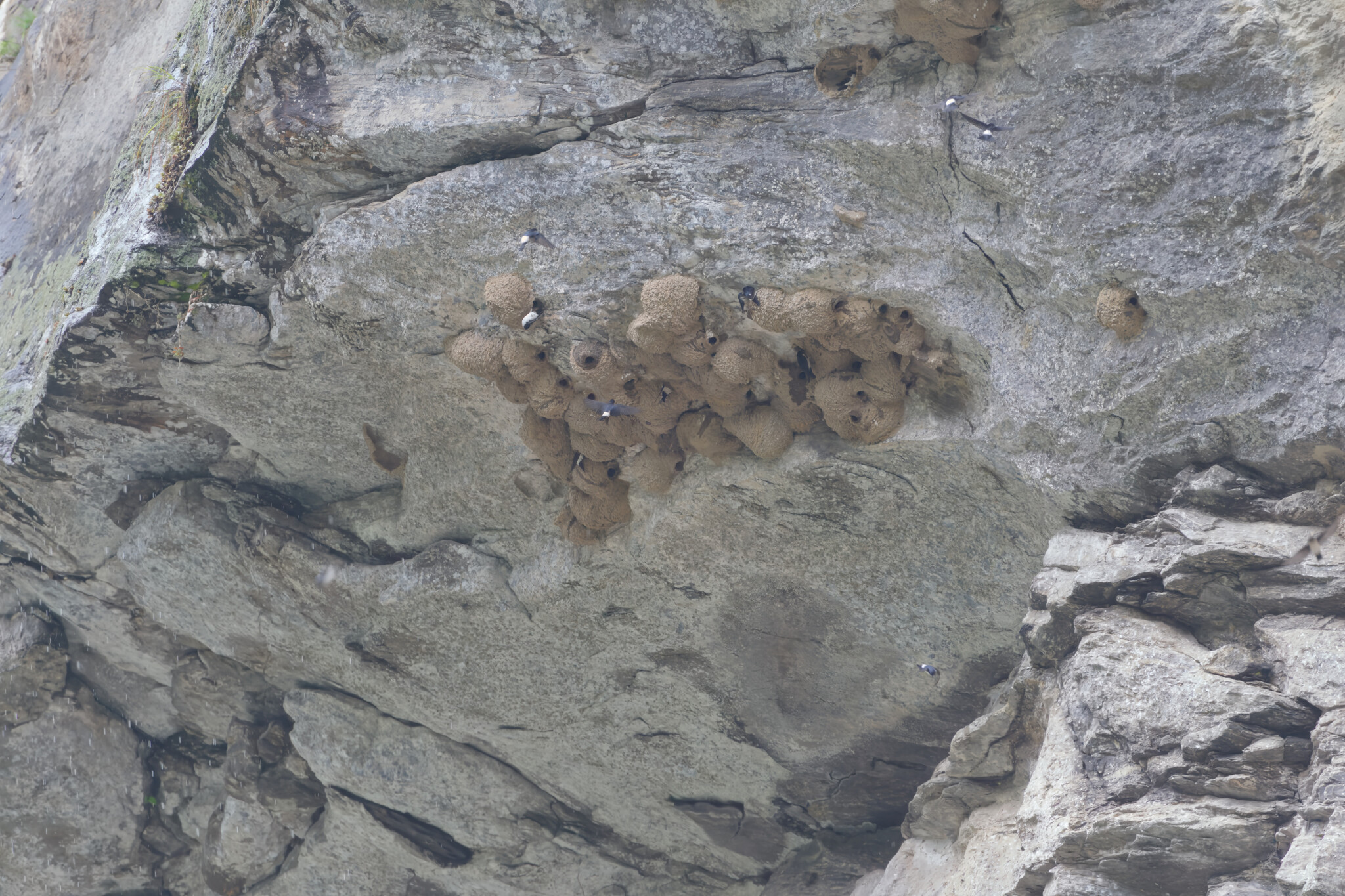
Breeding occurs between March and July, with two broods typical. Colonies contain hundreds of enclosed mud nests built beneath cliff overhangs, lined with grasses or feathers. Both parents share nest-building, incubation, and chick-rearing duties. The diet consists of insects caught in flight, particularly flies, with hunting typically along ridges or above treetops. This is a highly gregarious species, feeding in mixed flocks with other hirundines and aerial species such as Himalayan swiftlets and barn swallows. Vocalizations are limited to an occasional short chi-i call in flight, and a brief three-note breeding song. Some birds remain at colonies year-round, using nests as winter roosts.
Conservation
Evaluated as Least Concern by the IUCN due to its large range exceeding 20,000 square kilometers and estimated population of more than 10,000 mature individuals, with no evidence of significant decline. The species is fairly common throughout much of its Nepalese range and very abundant in some regions, though localized by the requirement for suitable cliff nesting sites. Previous accounts have noted it as uncommon in parts of Nepal. No major threats have been identified, though the reliance on specific cliff habitat means localized disturbances could affect colonies. The collared falconet has been recorded as a predator.
Culture
The species has limited documented cultural significance beyond its scientific connections to exploration and natural history. The type specimen was collected by Brian Houghton Hodgson in Nepal, and early literature sometimes referred to the bird as Hodgson's martin in his honor. British entomologist Frederic Moore formally described the species in 1854, placing it in the new genus Delichon he created with American naturalist Thomas Horsfield. In Sikkim, the species has been recorded nesting under school roofs near the Fambong Lho Wildlife Sanctuary, providing occasional opportunities for local observation.
Source: Wikipedia · CC BY-SA 3.0
Taxonomy
- Order
- Passeriformes
- Family
- Hirundinidae
- Genus
- Delichon
- eBird Code
- nephom1
Subspecies (2)
-
Delichon nipalense cuttingi
northeastern Myanmar to southern China (southwestern Yunnan), northern Thailand, northern Laos, and western Tonkin
-
Delichon nipalense nipalense
Himalayas from Nepal and southeastern Tibet to western and eastern Myanmar
Data Sources
Species description from Wikipedia, licensed under CC BY-SA 3.0.
Bird images and sounds sourced from GBIF, contributed by citizen scientists worldwide under Creative Commons licenses.
Taxonomy data from AviList 2025.