Lesser Whitethroat
Curruca curruca
白喉林莺
Introduction
The lesser whitethroat (Sylvia curruca) is a small warbler inhabiting European and Central Asian woodlands, farmland, hedgerows, scrubland, and orchard edges. This species displays gray and white plumage, with males and females appearing nearly identical. It forages by hawking insects within dense vegetation and produces a distinctive rattling song. The species migrates across the Mediterranean and Sahara to winter in sub-Saharan Africa, Arabia, and India. Its characteristic harsh 'tet-tet-tet' call distinguishes it from other sylviid warblers. The lesser whitethroat remains common and widespread across much of its range.
Description
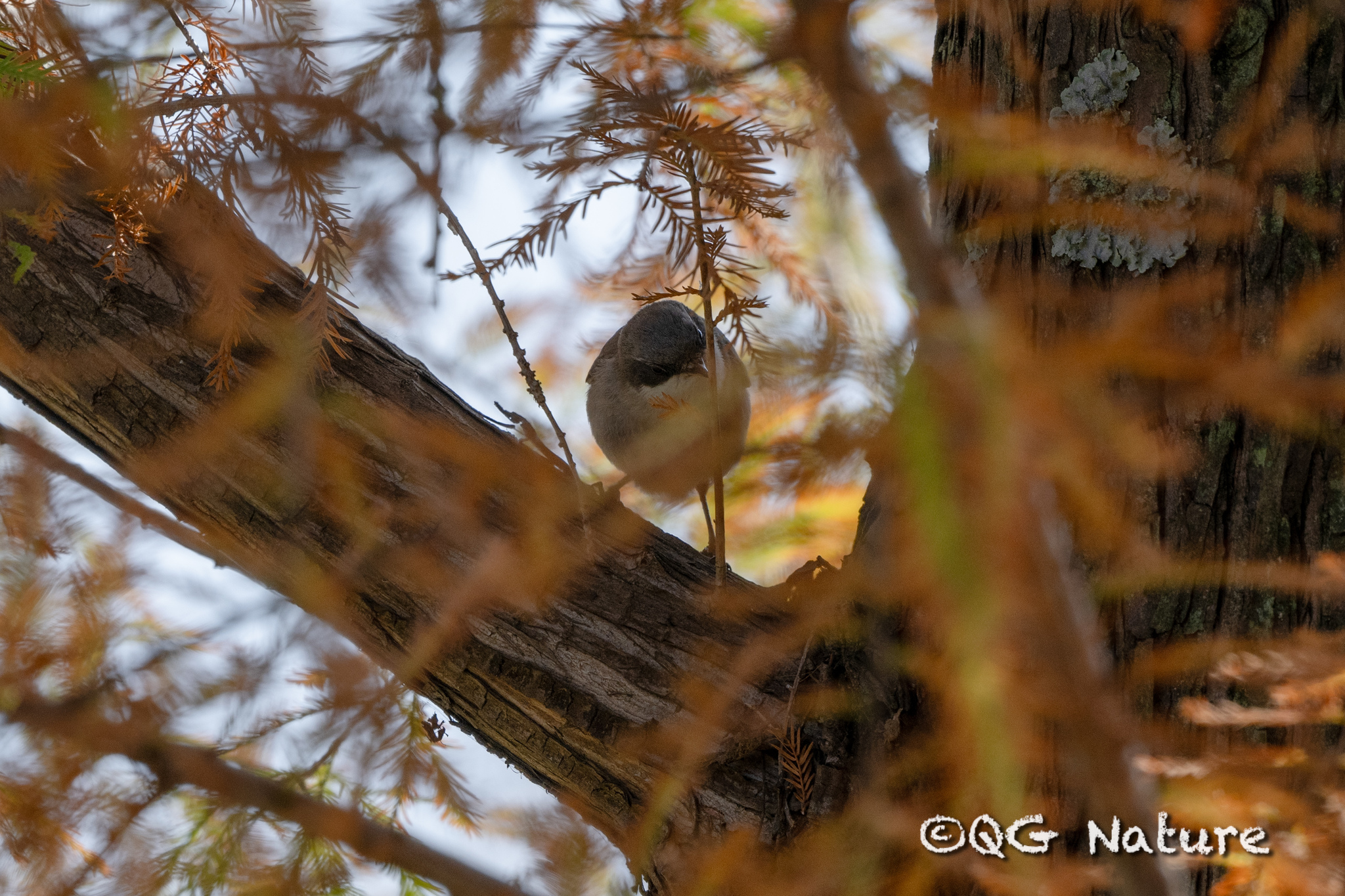
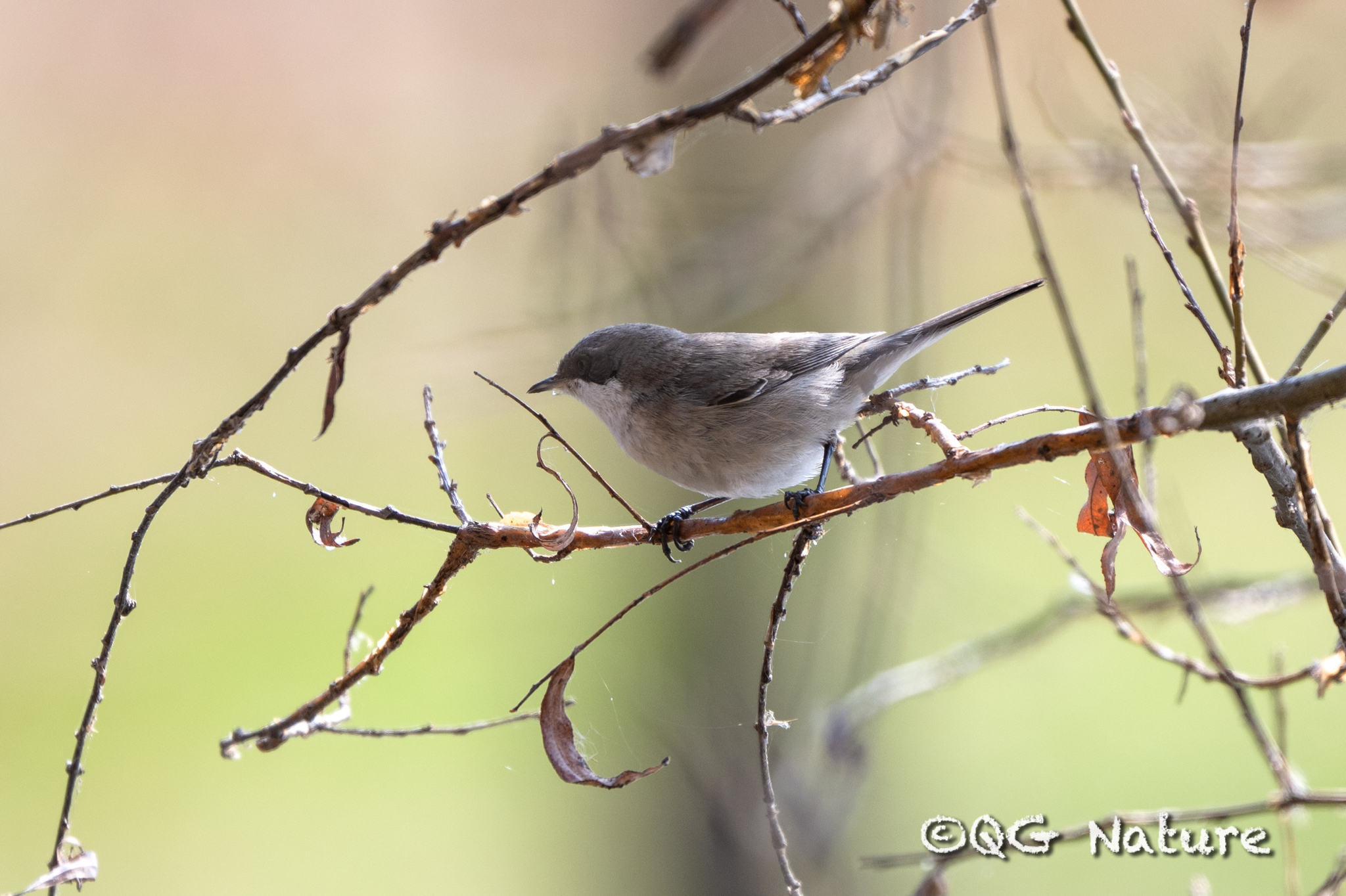
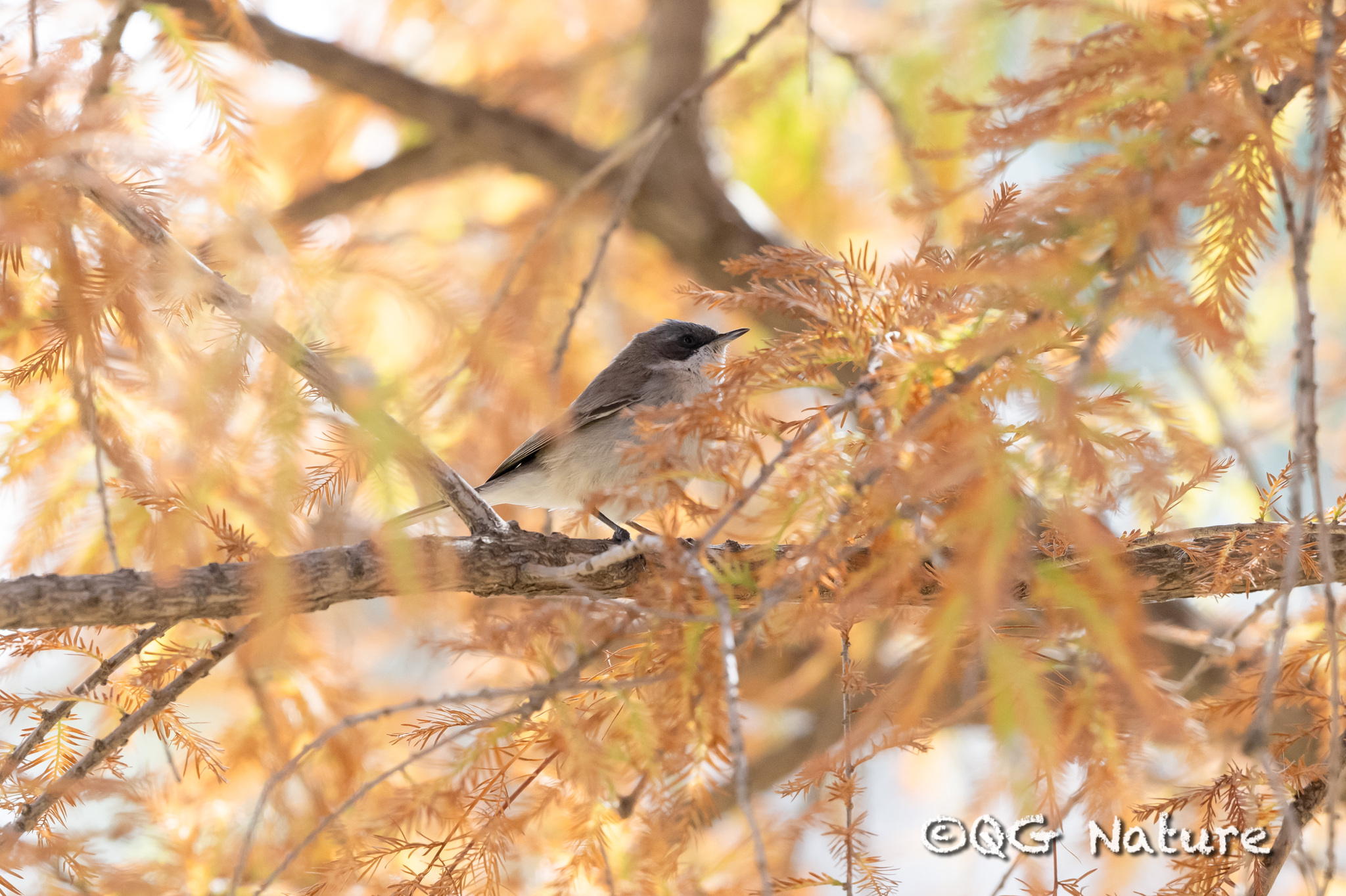
This is a compact, small warbler measuring approximately 13-14 cm in length with a wingspan of 18-20 cm. The upperparts are uniformly gray, while the underparts show a clean whitish coloration that may carry a subtle warm wash on the breast and flanks. The head is gray, immediately recognizable by the distinctive dark gray or blackish mask that runs through the eyes, creating a bandit-like facial pattern. The throat is strikingly white, providing sharp contrast against the gray head and breast. The legs are dark gray, and the bill is relatively short and pointed, dark with a paler base to the lower mandible. The wings appear relatively plain without the chestnut panels seen in the similar common whitethroat. The species exhibits minimal sexual dimorphism, with females sometimes showing marginally duller plumage tones.
Identification
The lesser whitethroat is most easily confused with its close relative, the common whitethroat, but several distinguishing features separate these species. The lesser whitethroat is noticeably smaller and more compact, lacking the long tail and prominent white outer tail feathers of the common whitethroat. Most diagnostic is the wing color: the common whitethroat displays obvious chestnut panels on the wing feathers, while the lesser whitethroat has plain gray wings. The head pattern also differs—the common whitethroat shows uniform cinnamon-gray coloring across the face and head, whereas the lesser whitethroat exhibits the distinctive dark eye mask contrasting with the otherwise gray head. The scolding, scratchy song of the common whitethroat sounds completely different from the fast, rattling 'tet-tet-tet' series of the lesser whitethroat, providing the most reliable field identification when visual confirmation proves difficult.
Distribution & Habitat
The breeding range extends across temperate Europe, absent only from the southwestern regions including most of Iberia, and continues eastward through western and central Asia to western Siberia and Central Asia. In Britain and Ireland, it breeds locally in England and Wales but remains scarce or absent from Scotland and Ireland. The species favors habitats consisting of open countryside with scattered trees, hedgerows, woodland edges, orchards, and gardens with substantial shrub cover. This migratory species leaves its breeding grounds between August and October, crossing the Mediterranean and Sahara to winter in sub-Saharan Africa from Senegal east to Ethiopia, as well as in Arabia and the Indian subcontinent. Return migration occurs between March and May, with individuals returning to precise breeding territories.
Behavior & Ecology
The diet consists primarily of insects and their larvae, including flies, beetles, moths, and caterpillars, which the bird gleans from foliage or catches in aerial sallies. Berries and other soft fruits become important supplementary food, particularly during late summer and autumn migration. The breeding season begins in late April, with pairs establishing territories in hedgerows, bramble thickets, and low shrubs. The untidy cup-shaped nest is constructed from grasses, stems, and rootlets, lined with finer materials, typically placed 0.5-1.5 meters above ground. Clutches of 3-7 eggs are incubated by both parents for approximately 12-13 days, with fledging occurring after another 10-14 days. The species raises one or two broods annually. The distinctive rattling song, a rapid series of harsh notes, is delivered from hidden perches within shrubs and is the primary method for detecting this often-secretive bird.
Conservation
The lesser whitethroat is classified as Least Concern by the IUCN, reflecting its extensive range and large global population estimated at 27-42 million breeding pairs. European populations appear stable overall, though some local fluctuations have occurred due to agricultural intensification and habitat loss. The species has benefited from traditional farming practices that maintain hedgerows and field margins, though the trend toward clean cultivation has reduced suitable breeding habitat in some regions. Its migratory habits expose it to various threats along the flyway, including habitat degradation at stopover sites and in wintering areas. Climate change impacts on the Sahel wintering grounds and phenological mismatches with prey availability may pose future conservation concerns.
Source: Wikipedia · CC BY-SA 3.0
Taxonomy
- Order
- Passeriformes
- Family
- Sylviidae
- Genus
- Curruca
- eBird Code
- leswhi4
Subspecies (6)
-
Curruca curruca althaea
breeds mountains of eastern Iran to Afghanistan and northern India; winters to southern India
-
Curruca curruca blythi
eastern Siberia to northern Altai and northern Mongolia; probably winters northeastern Africa, the Middle East, and southern Asia
-
Curruca curruca curruca
breeds Europe eastward to western Russia (approximately to the Ural Mountains), the Caucasus, Türkiye, and western Iran; winters primarily in northeastern Africa, less commonly westward to Senegambia
-
Curruca curruca halimodendri
breeds central Asian steppes, from the lower Ural River and Transcaspia eastward to western Mongolia; winters mainly in southwestern Asia (southeastern Iran to northwestern India), but perhaps also in eastern Africa
-
Curruca curruca margelanica
breeds north-central China; winter range likely southern Asia
-
Curruca curruca minula
breeds from Uzbekistan, Turkmenistan, and central Iran east through northern Afghanistan and Tajikistan to western China; winters to the south
Data Sources
Species description from Wikipedia, licensed under CC BY-SA 3.0.
Bird images and sounds sourced from GBIF, contributed by citizen scientists worldwide under Creative Commons licenses.
Taxonomy data from AviList 2025.