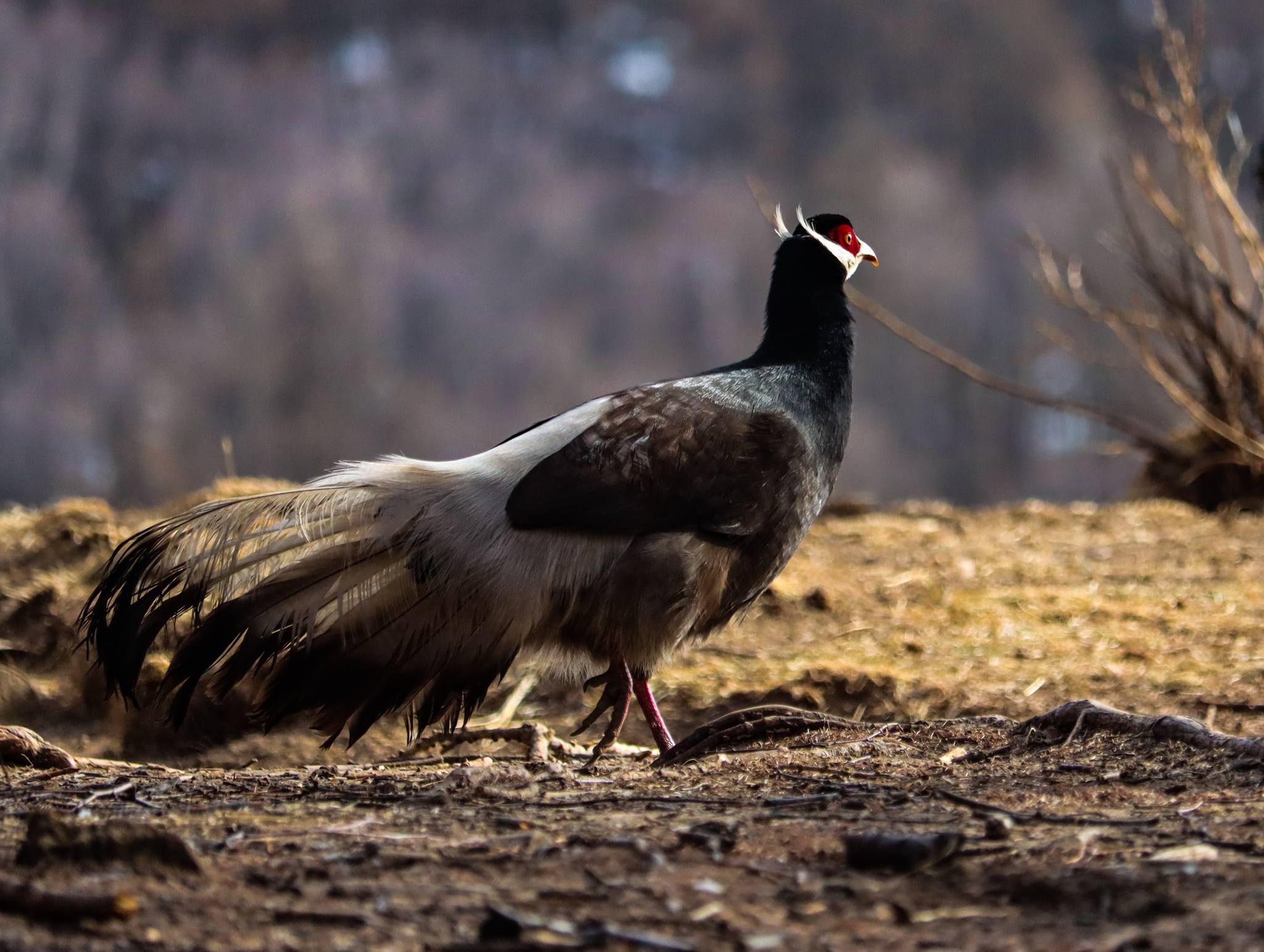
Brown Eared Pheasant
Crossoptilon mantchuricum
褐马鸡
Introduction
A large pheasant species in the family Phasianidae, growing 83–110 cm in length. The body is dark brown overall with black head and neck, and bare bright red facial skin covered in small wart-like bumps. Long, stiff white ear tufts emerge from the sides of the head, forming a bundle and extending backward above the head resembling horns. Both sexes are similar in appearance. Endemic to the mountain forests of northern China.
Description
The body is dark brown overall with black head and neck. Crown feathers are velvety dark brown with a faint white band across the nape. The base of the forehead is white with black tips, and white markings occur behind the nostrils and ear coverts. The upper back and shoulders are glossy brown with hair-like feather tips. The lower back, rump, upper tail coverts, and tail are silvery white with black tips showing metallic purplish-blue sheen. The tail has specialized structure with outer feathers having smooth vanes and inner pairs developing long hair-like filaments; the central two pairs are almost entirely filamentous and raised like a drooping horse's tail. The chin and throat are white. Iris is orange-yellow to reddish-brown, bill pink, legs and toes coral red. Males bear a tarsal spur.
Identification
Similar to the blue eared pheasant but distinguished by its dark brown body plumage (rather than blue) and white lower back and tail. Both sexes appear identical. The prominent white ear tufts and bright red facial skin are distinctive field marks. The specialized tail structure with filamentous central feathers creates a unique silhouette.
Distribution & Habitat
Endemic to China, occurring in the Xiaowutai Mountains of northwestern Hebei, and northwestern Shanxi and Lüliang Mountains regions. Inhabits low mountains and hilly areas below 2,500 meters elevation. Summer and autumn habitat consists of secondary mixed coniferous and broad-leaved forests or coniferous forests. Winter range includes lower-elevation broad-leaved farmland, forest edges, and shrublands. Mainly terrestrial, favoring open spaces within forests or grasslands along forest edges, and roosts at night on pine or palm trees.
Behavior & Ecology
Outside breeding season, forms flocks of 20–60 birds by late September. Flocks follow a clear hierarchy led by a dominant male with a sentinel bird. Foraging occurs throughout the day with midday rest and dust bathing. Birds follow fixed routes to feeding sites in loosely organized lines. When startled, flocks disperse then regroup into organized units. Escape behavior involves running uphill to ridge tops before gliding to valleys. Vocalizations include a 'gu-ji' or 'gu-gu' contact call, repeated 'ji-ji' alarm call, and rhythmic 'gua-gua-gua' courtship display call. Diet consists primarily of plant materials with seasonal variation and some animal matter. Breeding season runs April to June. Nests are simple bowls built on the ground under cover or at base of rocks/stumps, lined with vegetation, measuring about 28.6–32.7 cm wide and 9.9 cm deep. Clutches contain 4–17 eggs (most commonly 6–9), pale brown to bluish-green or whitish, averaging 59.9 × 43.8 mm and 58.8 g. Female incubates alone for 26–27 days while male guards territory. Territories measure 0.7–1.3 ha per pair. Chicks are precocial, leaving nest on day two.
Conservation
Classified as Vulnerable on the IUCN Red List. Population trend is decreasing. Threats include habitat loss and degradation from deforestation, agricultural expansion, and human disturbance throughout its limited range in northern China.
Culture
Known in Chinese as 褐马鸡 (hè mǎ jī).
Source: Wikipedia · CC BY-SA 3.0
Taxonomy
- Order
- Galliformes
- Family
- Phasianidae
- Genus
- Crossoptilon
- eBird Code
- brephe1
Distribution
montane forest of northeastern China (Liaoning and Shanxi)
Data Sources
CBR Notes: IUCN红色名录等级由VU降为LC
Species description from Wikipedia, licensed under CC BY-SA 3.0.
Bird images and sounds sourced from GBIF, contributed by citizen scientists worldwide under Creative Commons licenses.
Taxonomy data from AviList 2025.