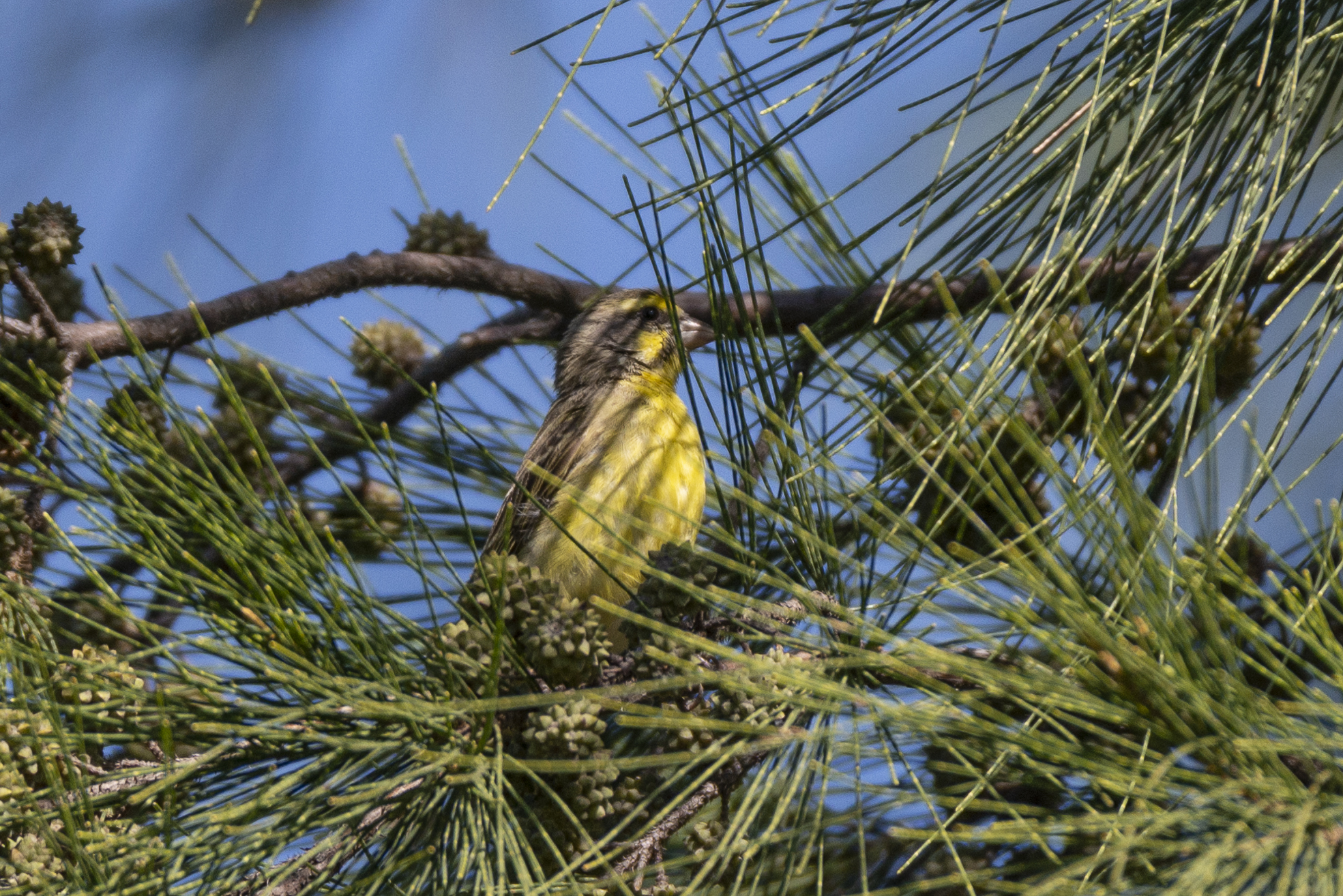
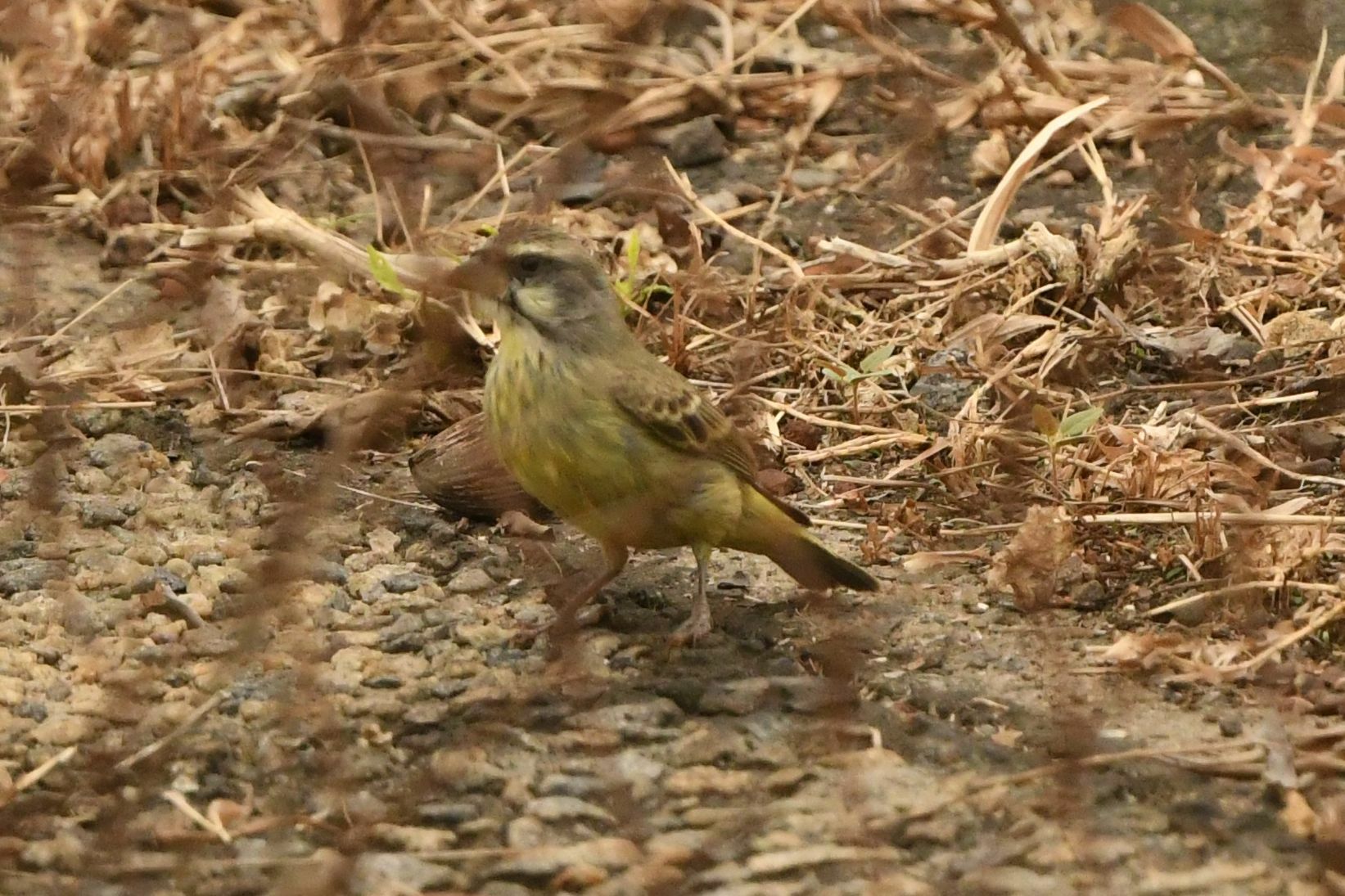
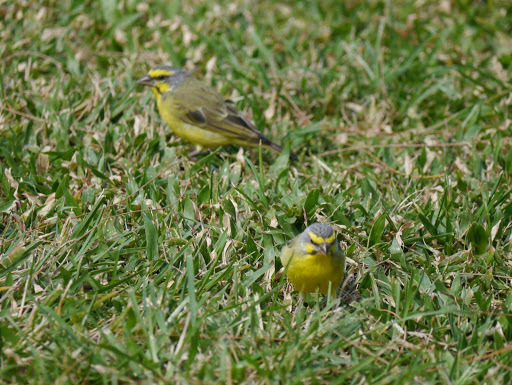
Yellow-fronted Canary
Crithagra mozambica
黄额丝雀
Introduction
A small seedeater found across Africa south of the Sahara Desert. Inhabits open woodland and cultivated areas, gathering in flocks outside the breeding season. Introduced populations exist on several islands and in the Hawaiian archipelago.
Description
A compact small finch measuring 11-13 cm in length. The adult male has a green back with brown wings and tail, yellow underparts and rump, and a yellow head marked by a grey crown and nape crossed by a prominent black malar stripe. The female resembles the male but displays a weaker head pattern and duller yellow underparts. Juveniles are overall greyer than the female, with the grey coloration most pronounced on the head.
Identification
This species is identified by its small size and distinctive green and yellow plumage. Males are recognizable by their yellow head with grey crown and nape, combined with the characteristic black malar stripe running from the beak. Females and juveniles are duller overall and show reduced head markings. The combination of yellow underparts, green back, and compact size helps distinguish it from similar finches in its range.
Distribution & Habitat
A resident breeder across Africa south of the Sahara Desert, inhabiting open woodland and cultivation areas. The species has been introduced to numerous locations including Mauritius, Rodrigues, Réunion, Assumption Island, Mafia Island, Puerto Rico, and the Hawaiian Islands, where populations occur on western Hawaii, southeastern Oahu, and Molokai.
Behavior & Ecology
A social seedeater that forms large flocks, especially outside the breeding season. It nests in trees, constructing a compact cup nest where it lays three or four eggs. Its song is a distinctive warbled 'zee-zeree-chereeo' that birdwatchers can use to locate the species. The birds are often detected by their vocalizations before being seen.
Conservation
As a common and widespread species with no major threats identified, this finch is not considered threatened.
Culture
The species is known in aviculture as the green singing finch or green singer, valued for its melodious song and attractive appearance.
Source: Wikipedia · CC BY-SA 3.0
Taxonomy
- Order
- Passeriformes
- Family
- Fringillidae
- Genus
- Crithagra
- eBird Code
- yefcan
Subspecies (10)
-
Crithagra mozambica barbata
southern Chad, Central African Republic, western Sudan, western and southern South Sudan, eastern Democratic Republic of the Congo, Uganda, southwestern Kenya, and central Tanzania
-
Crithagra mozambica caniceps
Senegal to Cameroon (southward to Benue plain)
-
Crithagra mozambica gommaensis
Eritrea and northwestern and central Ethiopia
-
Crithagra mozambica granti
eastern South Africa (Mpumalanga and KwaZulu-Natal southward to Eastern Cape), eastern Eswatini, and southern Mozambique
-
Crithagra mozambica grotei
southeastern Sudan (east of the Nile), eastern South Sudan, and western and southwestern Ethiopia
-
Crithagra mozambica mozambica
coastal Kenya and Mafia Island (Tanzania) southward to Zimbabwe, Mozambique, eastern and southeastern Botswana, and northeastern South Africa (North West and Limpopo to Free State)
-
Crithagra mozambica punctigula
Cameroon (northward to Toukte, Grand Capitaine, and Koum)
-
Crithagra mozambica samaliyae
southeastern Democratic Republic of the Congo to southwestern Tanzania, and adjacent Zambia
-
Crithagra mozambica tando
Gabon to northern Angola and southwestern Democratic Republic of the Congo; introduced São Tomé
-
Crithagra mozambica vansoni
far southeastern Angola and adjacent Namibia to northern Botswana and southwestern Zambia
Data Sources
Species description from Wikipedia, licensed under CC BY-SA 3.0.
Bird images and sounds sourced from GBIF, contributed by citizen scientists worldwide under Creative Commons licenses.
Taxonomy data from AviList 2025.