Corn Crake
Crex crex
长脚秧鸡
Introduction
A medium-sized crake of the family Rallidae, this species breeds across temperate Europe and Asia, with core populations concentrated in Russia and Kazakhstan. It inhabits traditionally managed hay meadows, unimproved grasslands, and other open grassy habitats where dense vegetation provides ground-level cover. The species nests on the ground among tall vegetation, remaining concealed during daylight hours. Males produce a repetitive grating call audible up to 1.5 kilometers, used for territorial advertisement during the breeding season. The species undertakes nocturnal migration. Global conservation status is Least Concern, though populations have declined significantly in western Europe due to agricultural intensification, particularly early-season mowing that destroys nests and chicks. Conservation efforts focus on modifying mowing schedules and preserving traditional grassland management in affected regions.
Description
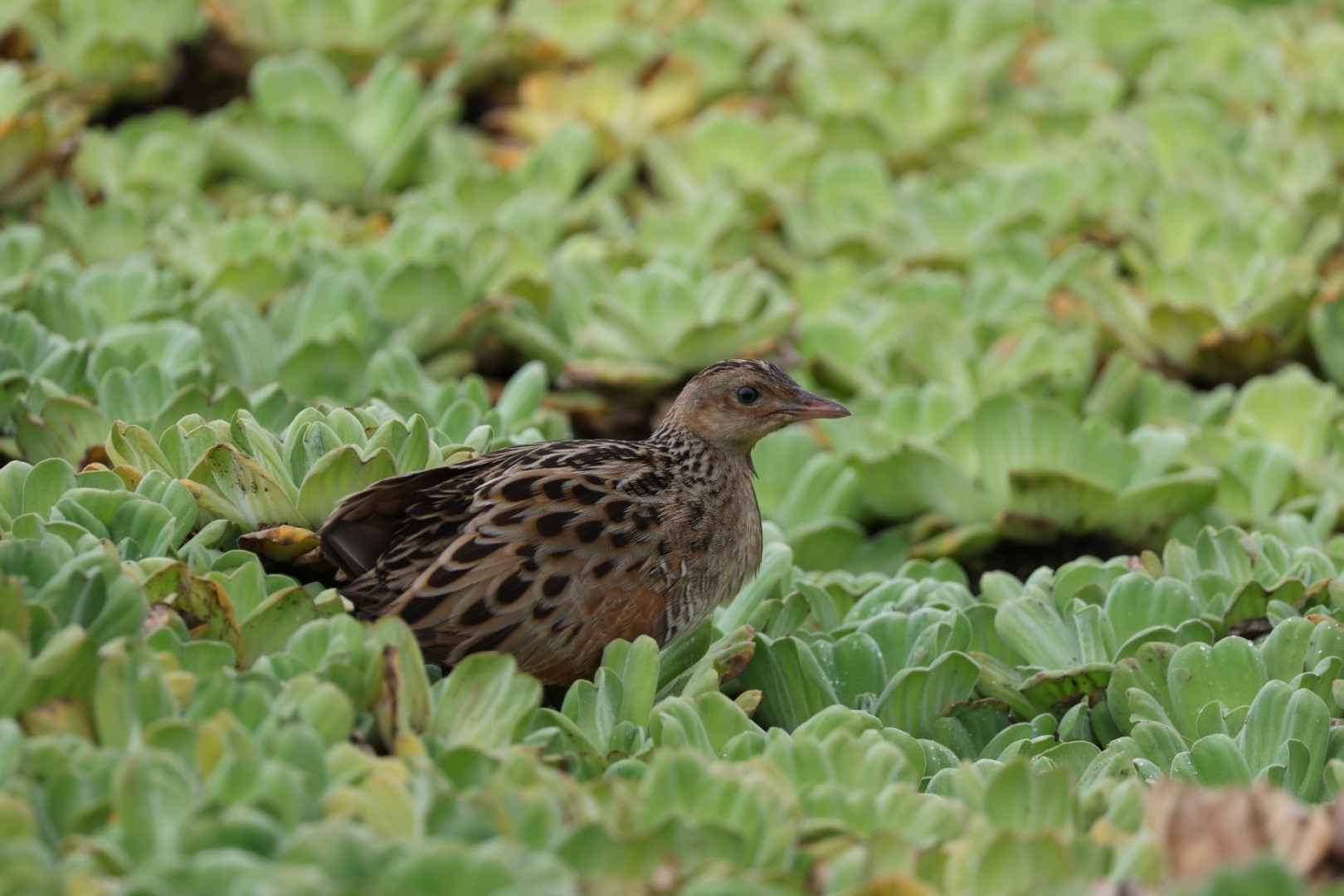
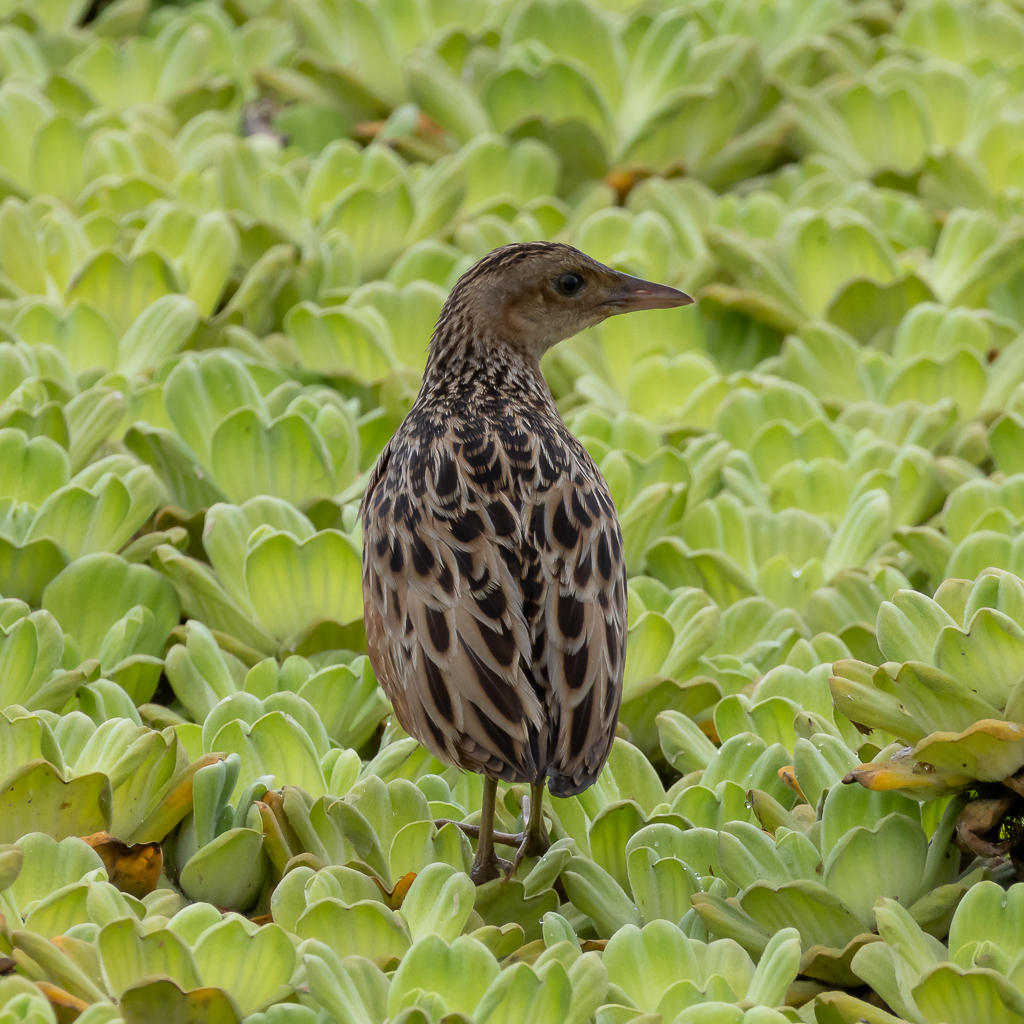
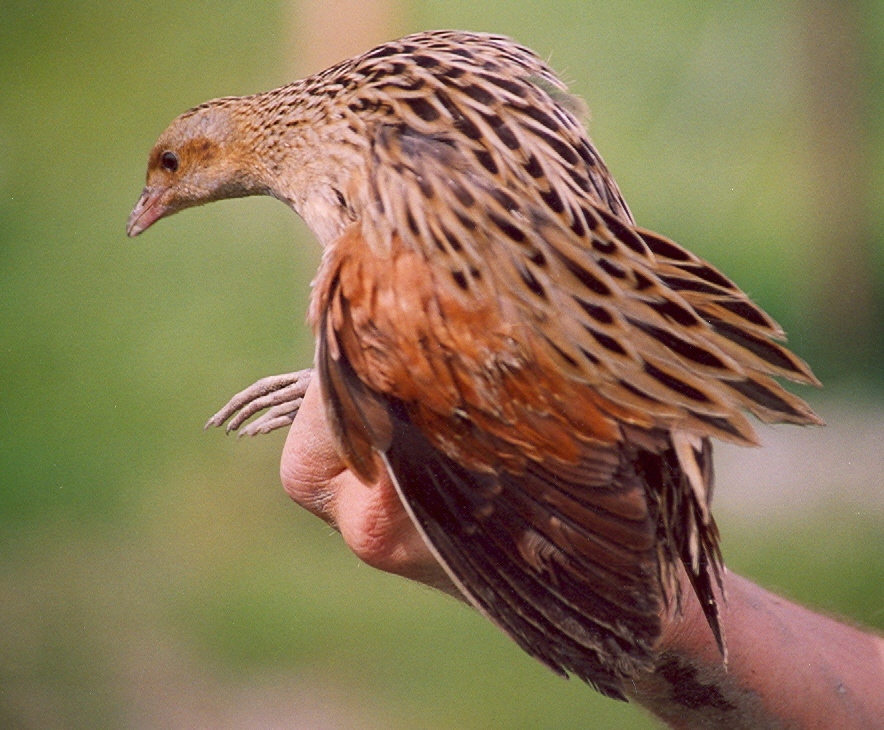
A medium-sized rail measuring 27-30 cm in length with a wingspan of 42-53 cm. Males average 165 g and females 145 g. The adult male has brownish-black upperparts heavily streaked with buff or grey, and distinctive chestnut wing coverts marked with white bars. The face, neck and breast are blue-grey, contrasting with a white belly, while the flanks and undertail display barring in chestnut and white. The stout bill is flesh-coloured, the iris pale brown, and the legs and feet pale grey. Females have warmer-toned upperparts with a narrower, duller eye streak. Juveniles resemble adults but show yellow tones on the upperparts and buff-brown underparts. Adults undergo a complete moult after breeding, finished by late August before migration. No subspecies exist, though eastern populations are generally paler than western ones.
Identification
Larger than the sympatric African crake, with paler upperparts, tawny upperwings and a different underparts pattern. In flight, it shows longer, less rounded wings with shallower wingbeats and a conspicuous white leading edge on the inner wing. The dangling legs and chestnut wing patch distinguish it from gamebirds it may resemble in flight. Within its breeding and wintering ranges, it is unlikely to be confused with other rails, which are smaller with white markings on the upperparts, different underparts patterns and shorter bills. Males can be identified individually by subtle differences in their repetitive krek krek calls.
Distribution & Habitat
Breeds from Ireland east through Europe to central Siberia, with a significant population in western China. The historic range extended from 41°N to 62°N, though it has vanished from much of western Europe. It winters primarily in Africa, from the Democratic Republic of Congo and central Tanzania south to eastern South Africa, with about 2,000 birds in KwaZulu-Natal and the former Transvaal. Migration follows two main routes: a western route through Morocco and Algeria and a more important flyway through Egypt. The species is mainly a lowland bird but breeds up to 1,400 m in the Alps, 2,700 m in China and 3,000 m in Russia. Breeding habitat consists of cool moist grassland used for hay production, particularly traditional farmland with limited fertilizer use.
Behavior & Ecology
Solitary on wintering grounds where each bird occupies 4.2-4.9 hectares, though flocks of up to 40 form on migration, sometimes with common quails. Migration occurs at night. Most active early and late in the day and after rain. The characteristic flight is weak and fluttering, but migration flights show steadier action with legs drawn up. It walks with a high-stepping gait and can run swiftly through grass. The male's advertising call is a loud, repetitive grating krek krek audible from 1.5 km away, delivered with head and neck almost vertical. It may repeat the call more than 20,000 times nightly, peaking between midnight and 3 am. The female gives a similar call, a barking sound and high-pitched cheep. Diet is omnivorous but mainly invertebrates including earthworms, beetles and grasshoppers, plus occasional small amphibians, mammals, grass seed and cereal grain. Breeding is partly polygynous, with males holding territories of 3-51 ha. The female builds a nest in a ground scrape, laying 6-14 cream-coloured eggs blotched with rufous. Incubation lasts 19-20 days by the female alone, and chicks fledge in 34-38 days.
Conservation
Classified as least concern on the IUCN Red List due to huge range and large populations in Russia and Kazakhstan, estimated at 5.45-9.72 million individuals overall. However, steep declines have occurred across western Europe, where it is classed as near threatened. The European population is 1.3-2.0 million breeding pairs, three-quarters in European Russia. Conservation measures have enabled recovery in several countries, including a five-fold increase in Finland and doubling in the UK. The main threat is mechanised hay-making, which destroys 38-95% of chicks at some sites, with losses averaging 50% of first brood chicks. Habitat loss from drainage, fertilisation and conversion to arable land compounds the threat. In Egypt, up to 14,000 birds are captured annually in nets set for quail. Conservation efforts focus on delayed mowing, uncut field margins and cutting from the centre outwards. Reintroduction attempts are underway in England.
Culture
As a formerly common farmland bird with a loud nocturnal call that disturbed rural sleepers, this rail acquired numerous folk names including landrail, corncrake, daker, quailzie and king of the quail. The seventeenth-century poet Andrew Marvell featured it in 'Upon Appleton House', depicting a mower unknowingly killing chicks. John Clare wrote semi-comically about the difficulty of seeing the bird in 'The Landrail', while D.H. Lawrence used its call as a soundtrack to unsettled moments in his novels and poetry. The Finnish poet Eino Leino referenced it in 'Nocturne'. The species' grating call has become a metaphor for an unmelodious voice, dating to at least the early nineteenth century. In music, The Pogues' Shane MacGowan used its cry to illustrate urban alienation in 'Lullaby of London', and The Decemberists' Colin Meloy referenced the call in 'The Hazards of Love'. Traditional recipes survive, with Mrs Beeton recommending roasting four on a skewer when they were common in England.
Source: Wikipedia · CC BY-SA 3.0
Taxonomy
- Order
- Gruiformes
- Family
- Rallidae
- Genus
- Crex
- eBird Code
- corcra
Distribution
breeds British Isles eastward to northwestern China and central Siberia, and southward from central Europe, the Caucasus, Kyrgyzstan, northwestern Xinjiang (northwestern China), and northern Mongolia; winters mainly from eastern Democratic Republic of the Congo and southern Tanzania southward to eastern South Africa
Data Sources
Species description from Wikipedia, licensed under CC BY-SA 3.0.
Bird images and sounds sourced from GBIF, contributed by citizen scientists worldwide under Creative Commons licenses.
Taxonomy data from AviList 2025.