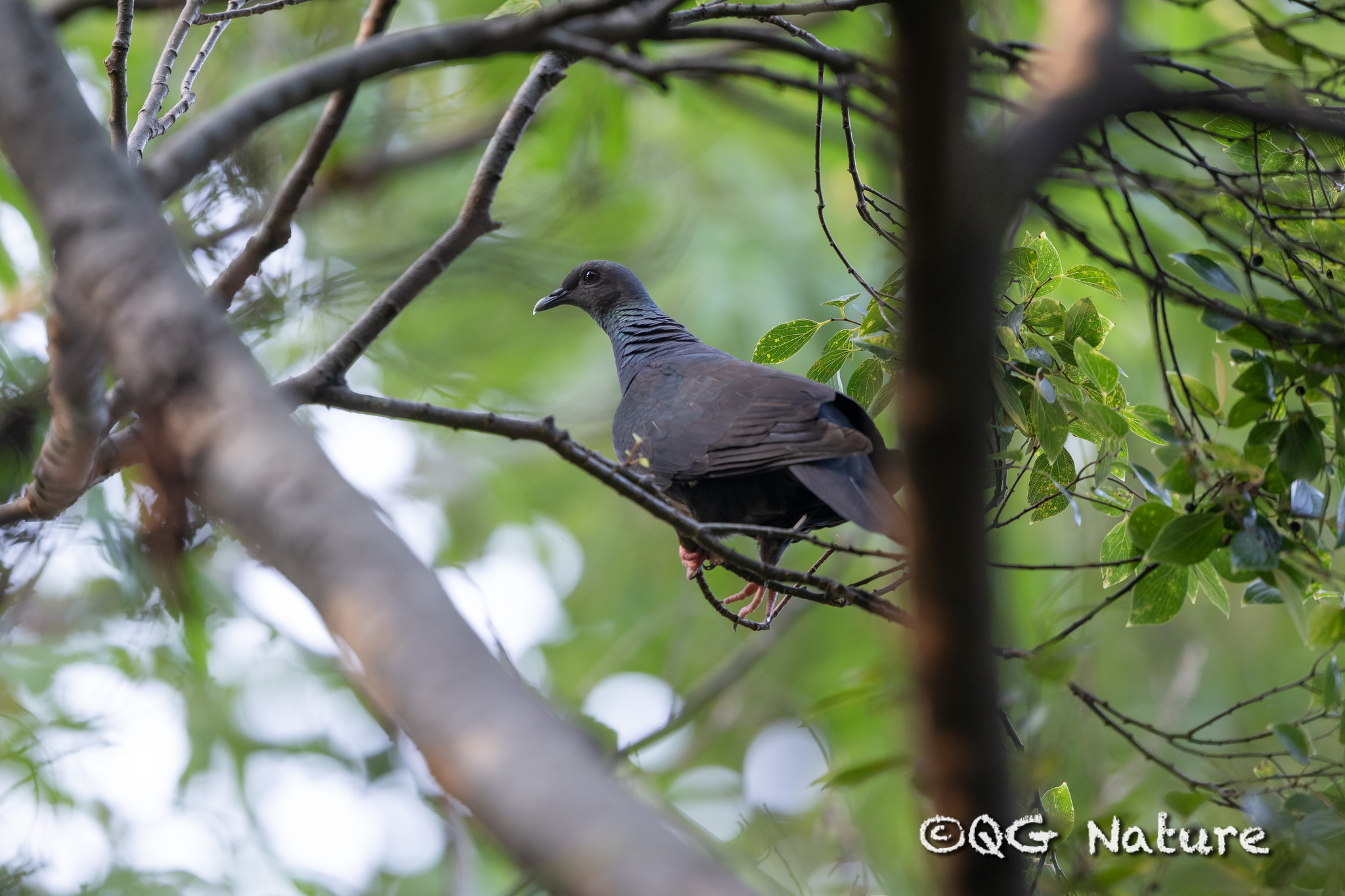
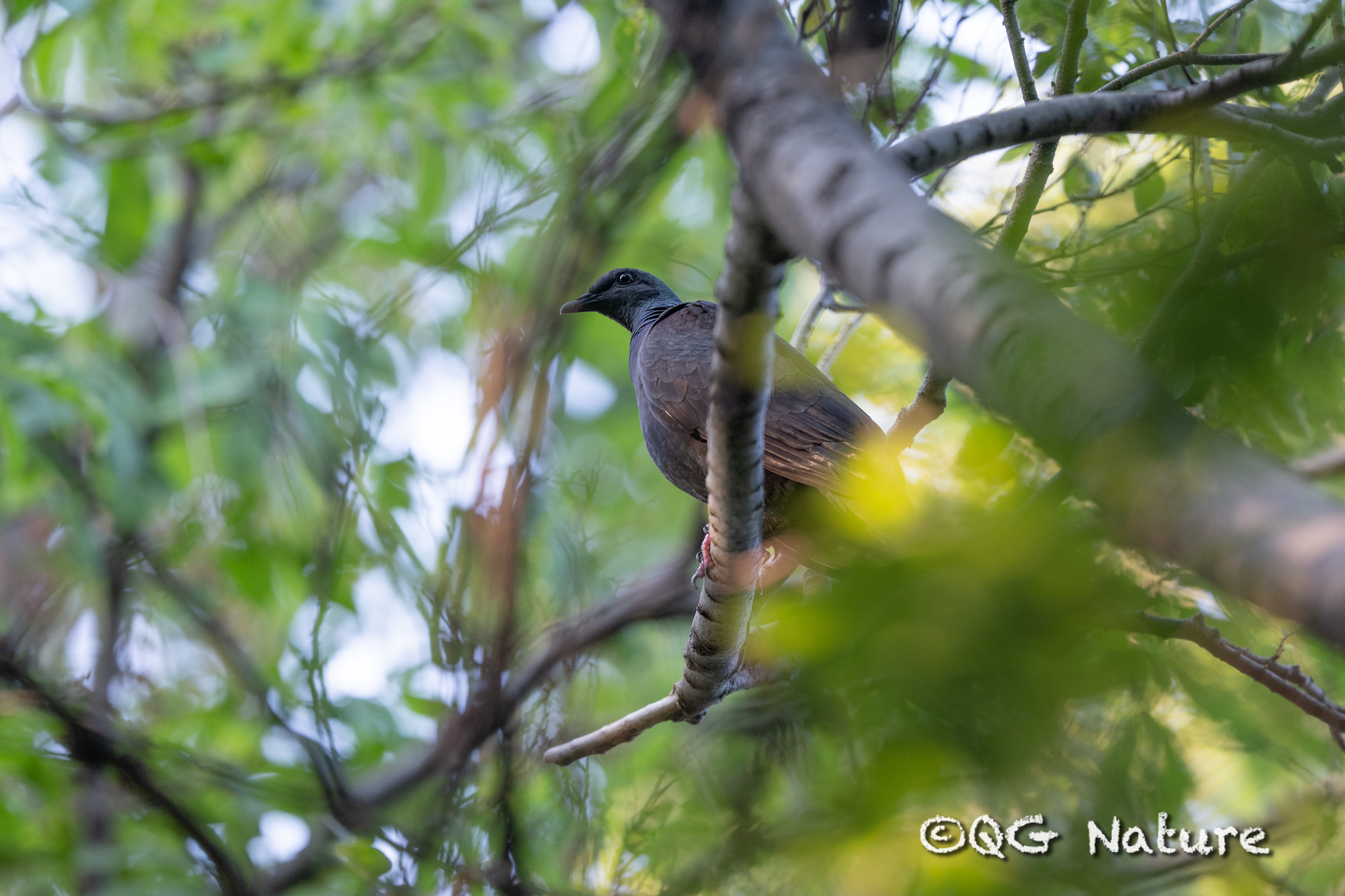
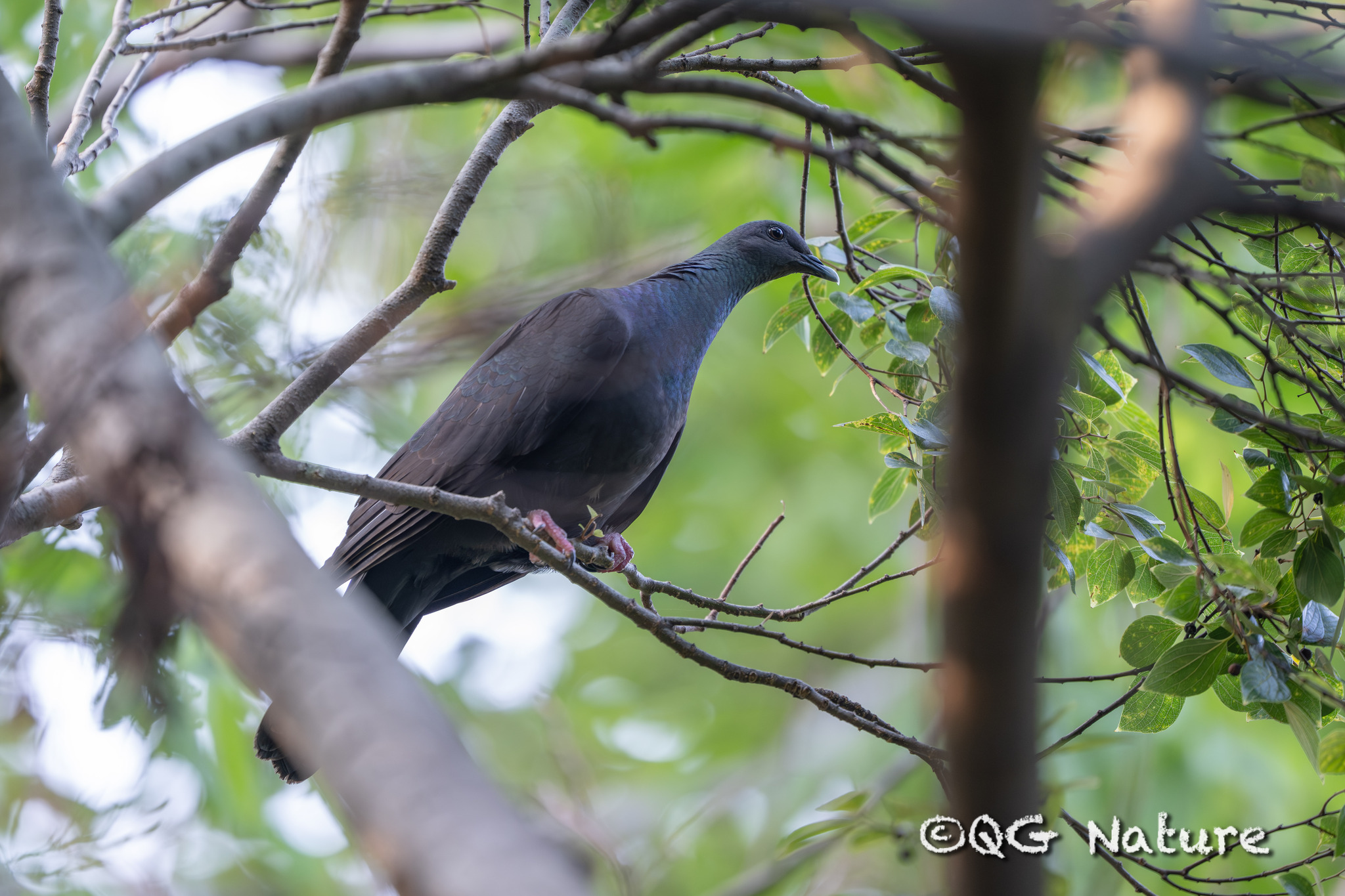
Black Wood Pigeon
Columba janthina
黑林鸽
Introduction
This pigeon is the largest member of its genus. It inhabits subtropical and temperate evergreen forests across East Asian island chains. It favors mature forests with berry-producing trees, particularly those bearing large drupes. It is the only bird capable of processing the largest native fruits, making it the primary seed disperser for these tree species. The species forms loose populations across scattered island groups and has never been common even in undisturbed habitat. Populations have contracted significantly since human settlement of the archipelagos, and it now survives only on isolated island remnants of its former range.
Description
The largest pigeon in East Asia, this species measures 37 to 40 centimeters in length, occasionally reaching 43.5 centimeters, and weighs approximately 550 grams. It possesses a notably small head, longish neck, and long tail, creating a distinctive silhouette. The plumage is predominantly soot-black throughout, with striking iridescent green or purple on the crown, shoulders, and sides of neck. The crown and rump display bright metallic purple, while the back and chest show greenish-purple metallic sheen. The bill is long, narrow, and dark, showing greenish-blue coloration with an ivory to pale yellow tip; the cere is small. Eyes have brown irises and legs are red in adults, paler in juveniles. There is no sexual dimorphism, though juveniles show generally paler plumage with reduced development of any neck marking. In flight it resembles a crow, with broad wings and a slightly fanned tail.
Identification
This large, very dark pigeon is distinctive within its range. The small head, long neck, and long tail create an elongated profile unlike most other pigeons. The overall soot-black plumage with bright metallic purple on the crown and rump, combined with iridescent green-purple on the shoulders, separates it from similar species. The red legs are conspicuous when perched. Flight silhouette resembles a crow, with broad wings and slightly spread tailtip. The absence of any neck patch or collar, typical of many wood pigeon species, helps distinguish it from congeners. Juveniles are overall paler and lack the metallic iridescence of adults.
Distribution & Habitat
The species inhabits small islands of the East China Sea, ranging through the Ryukyu Islands, Iwo Jima, and Bonin Islands, and along the southern coasts of Korea and Japan. It is currently considered resident on approximately fifteen islands and islets. In South Korea, populations occur on Ulleungdo Island, Jeju-do, and scattered offshore islets. In Japan, it inhabits small islands off southern Honshu, Shikoku, and Kyushu, extending south through the Nansei-Shoto to the Yaeyama Islands, Izu Islands, and the Ogasawara and Iwo Islands. It has been recorded as a vagrant in eastern Russia, Shandong, mainland China, and Taiwan. The species requires dense subtropical and warm temperate evergreen broadleaf forests, being heavily dependent on mature laurel forest habitat.
Behavior & Ecology
This resident breeder inhabits dense laurel forests where it nests in tree cavities or rocky crevices, laying a single white egg in a flimsy twig nest during September. Although primarily herbivorous with a strong preference for plant material, it is considered omnivorous, consuming worms and small snails alongside its favored diet. It feeds on leaves, flowers, drupes, berries, fruits, acorns, pine nuts, and conifer seeds, foraging directly from trees with a particular fondness for trees near water sources. Favored food plants include various Ilex species, Camellia sasanqua, Camellia japonica, Machilus thunbergii, mulberry, and fig species. The diet shifts seasonally with fruit availability, and leaves may dominate during periods of scarcity. It serves a critical ecological role as the only bird capable of consuming the largest native drupes, dispersing seeds of threatened tree species.
Conservation
Classified as Near Threatened, the species has experienced significant population decline across its range. Numbers fell sharply following human colonization of the archipelagos, with the species now vanished from some islands entirely. The primary threat has been habitat loss from forest clearance for agriculture and development, particularly forestry activities during the 1980s on Okinawa. Additional pressures include hunting and nest predation by introduced species and rats. The subspecies C. j. nitens on the Ogasawara and Iwo Islands is particularly rare. Protection of remaining laurel forests and enforcement of hunting prohibitions could facilitate population recovery. In South Korea, the species holds protected status as Natural Monument 215, with specific breeding sites designated for conservation.
Culture
In South Korea, this pigeon holds protected cultural status as Natural Monument 215, designated on November 22, 1968. The country has established additional protections for critical breeding sites, including Ulleung Sadong Black Pigeon Habitat (Natural Monument 237, designated December 14, 1971) and Jeju Sasudo Seabirds Breeding Ground (Natural Monument 333, designated November 20, 1982). A provincial breeding site on Beomseom Island falls within the Munseom and Beomseom Nature Reserve. Visitors to Sasudo require permission from the Cultural Heritage Administration, reflecting the species' significance in Korean natural heritage.
Source: Wikipedia · CC BY-SA 3.0
Taxonomy
- Order
- Columbiformes
- Family
- Columbidae
- Genus
- Columba
- eBird Code
- jawpig1
Subspecies (3)
-
Columba janthina janthina
small islands southwest of South Korea to Ryukyu Islands (southern Japan) and islets off Taiwan
-
Columba janthina nitens
Ogasawara (Bonin Islands) and Iwo (Volcano Islands)
-
Columba janthina stejnegeri
Yaeyama Islands (southern Ryukyu Islands, Japan)
Data Sources
CBR Notes: IUCN红色名录等级由NT降为LC
Species description from Wikipedia, licensed under CC BY-SA 3.0.
Bird images and sounds sourced from GBIF, contributed by citizen scientists worldwide under Creative Commons licenses.
Taxonomy data from AviList 2025.