Greater Flameback
Chrysocolaptes guttacristatus
大金背啄木鸟
Introduction
This large woodpecker (33 cm length) occurs in South and Southeast Asia, from the Himalayan foothills to mangrove swamps. It inhabits open forest types. The species has an erect crest and long neck typical of woodpeckers, with zygodactyl feet and stiff tail feathers adapted for arboreal foraging. Plumage varies by subspecies: back and wings range from unmarked golden-yellow to dark brown, with a red rump and black tail. It forages on tree trunks, using a long, extensible tongue to consume invertebrate prey.
Description
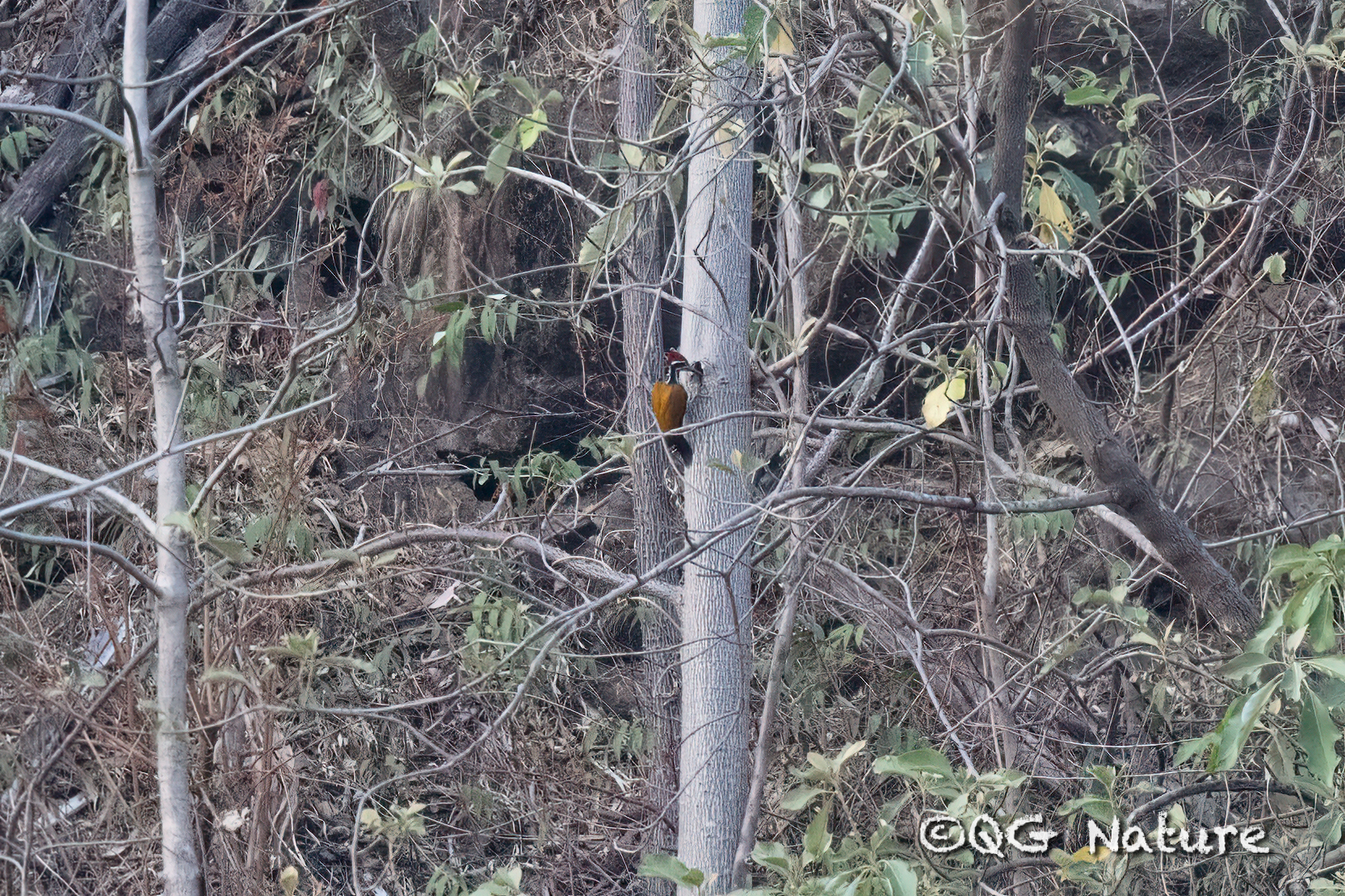
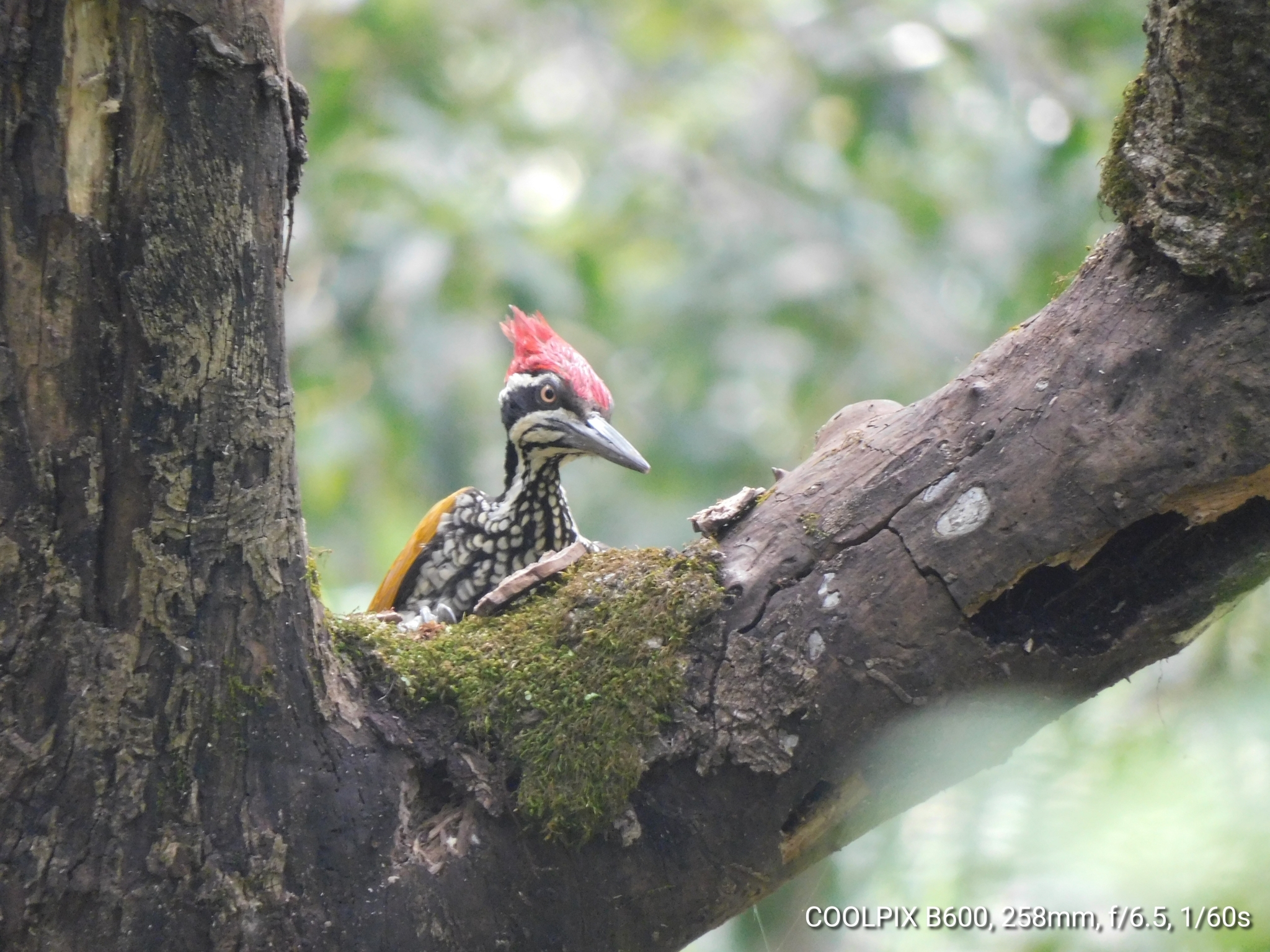
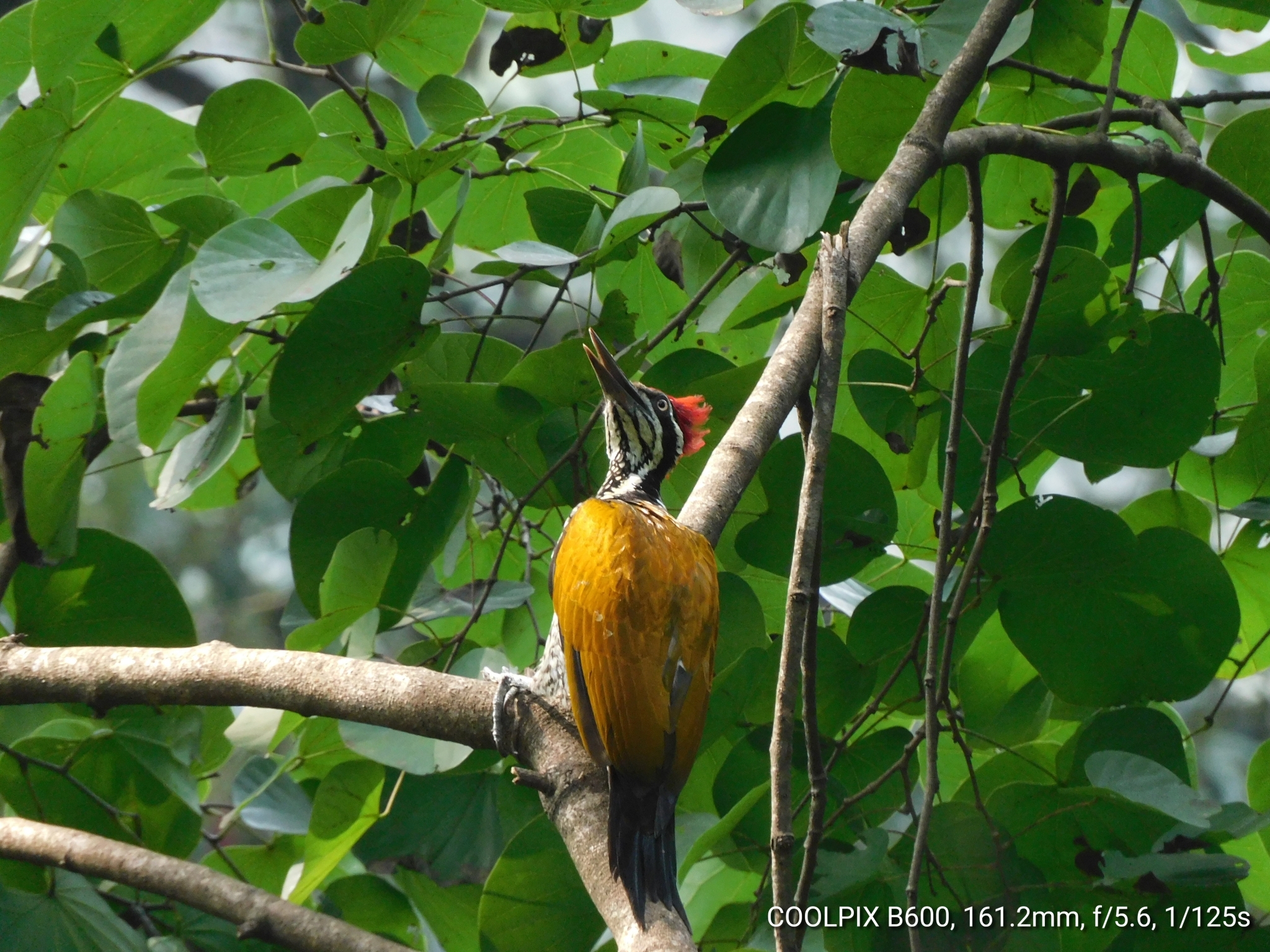
A large woodpecker measuring 33 cm in length with the typical woodpecker silhouette. It has a prominent erect crest and an elongated neck. The plumage shows considerable geographic variation, but the back and wings are always unmarked and range from golden-yellow to dark brown. The rump is conspicuously red while the tail is black. Underparts are either white with dark chevron, stripe, or band markings, or light brown throughout. Head coloration varies considerably by subspecies - it may be whitish with black patterning, yellow, brown, or red. The bill is straight, pointed, and notably longer than the head. Legs are lead-grey with zygodactyl arrangement (two toes forward, two back). Eyes have whitish to yellow irises. Adult males always display a red crown, while females show variable crown colors including black spotted with white, yellow, or brown with light dots. Juveniles resemble females but are duller with brown irises.
Identification
The three-toed Dinopium flamebacks present the closest identification challenge, though they are not closely related. The greater flameback can be distinguished by its inconspicuous moustache stripes, which are divided by white and therefore hard to see at distance. Most subspecies have a white hindneck (Sri Lankan C. stricklandi being an exception), and even in these birds the dark coloring does not extend between the shoulders as it does in Dinopium species. When viewed from behind, black-and-white-headed individuals outside Sri Lanka show a white neck bordered by black on the sides, unlike the entirely black neck and upper back of Dinopium species. Size is also a reliable indicator when comparison is possible - Dinopium flamebacks are smaller and have shorter bills that do not exceed head length. Dark irises and a longer bill are additional distinguishing features.
Distribution & Habitat
This species has an extensive range across South and Southeast Asia, occurring from the northern Indian subcontinent eastwards through southern China, the Malay Peninsula, Sumatra, western and central Java, and northeast Borneo. It inhabits a variety of open forest types including Himalayan foothill forests, Western Ghats woodland, and mangrove swamps. The species appears well-adapted to specific forest compositions, which affects its local abundance - it may be more common than the similar common flameback in some regions like Thailand, yet less so in others such as peninsular Malaysia. In Malaysian mangrove forests, it shows a preference for tall Avicennia alba trees for foraging.
Behavior & Ecology
Like all woodpeckers, this species forages by excavating wood with its robust bill to extract prey. Its zygodactyl feet and stiff tail feathers provide essential support against tree trunks. The long, extensible tongue is specialized for capturing wood-boring arthropods, though nectar also forms part of the diet. Breeding occurs in tree cavities where the female lays three or four white eggs. The species shows adaptations to particular forest types rather than generalist tendencies, influencing its distribution and abundance in different regions.
Conservation
With a wide distribution across multiple countries and habitat types, this species remains common in parts of its range. It is classified as Least Concern on the IUCN Red List, reflecting its overall stable population status despite local variations in abundance.
Culture
No cultural significance or folklore is documented for this species.
Source: Wikipedia · CC BY-SA 3.0
Taxonomy
- Order
- Piciformes
- Family
- Picidae
- Genus
- Chrysocolaptes
- eBird Code
- grefla1
Vocalizations
Subspecies (4)
-
Chrysocolaptes guttacristatus andrewsi
northeastern Borneo
-
Chrysocolaptes guttacristatus guttacristatus
foothills in east-central Nepal eastward to southern China (Yunnan) and southward to Bangladesh, eastern India (south to southeastern Madhya Pradesh and northern Andhra Pradesh), Thailand, and Indochina
-
Chrysocolaptes guttacristatus indomalayicus
Malay Peninsula to Sumatra and western Java
-
Chrysocolaptes guttacristatus sultaneus
Himalayan foothills in northwestern India and western Nepal
Data Sources
Species description from Wikipedia, licensed under CC BY-SA 3.0.
Bird images and sounds sourced from GBIF, contributed by citizen scientists worldwide under Creative Commons licenses.
Taxonomy data from AviList 2025.