Violet Cuckoo
Chrysococcyx xanthorhynchus
紫金鹃
Introduction
This cuckoo species inhabits Asian forests. The species is heard more often than seen, producing a distinctive series of rising notes during the breeding season. It occupies middle and upper canopy levels of forested habitats and exhibits brood parasitic behavior. Its presence is associated with healthy forest ecosystems.
Description
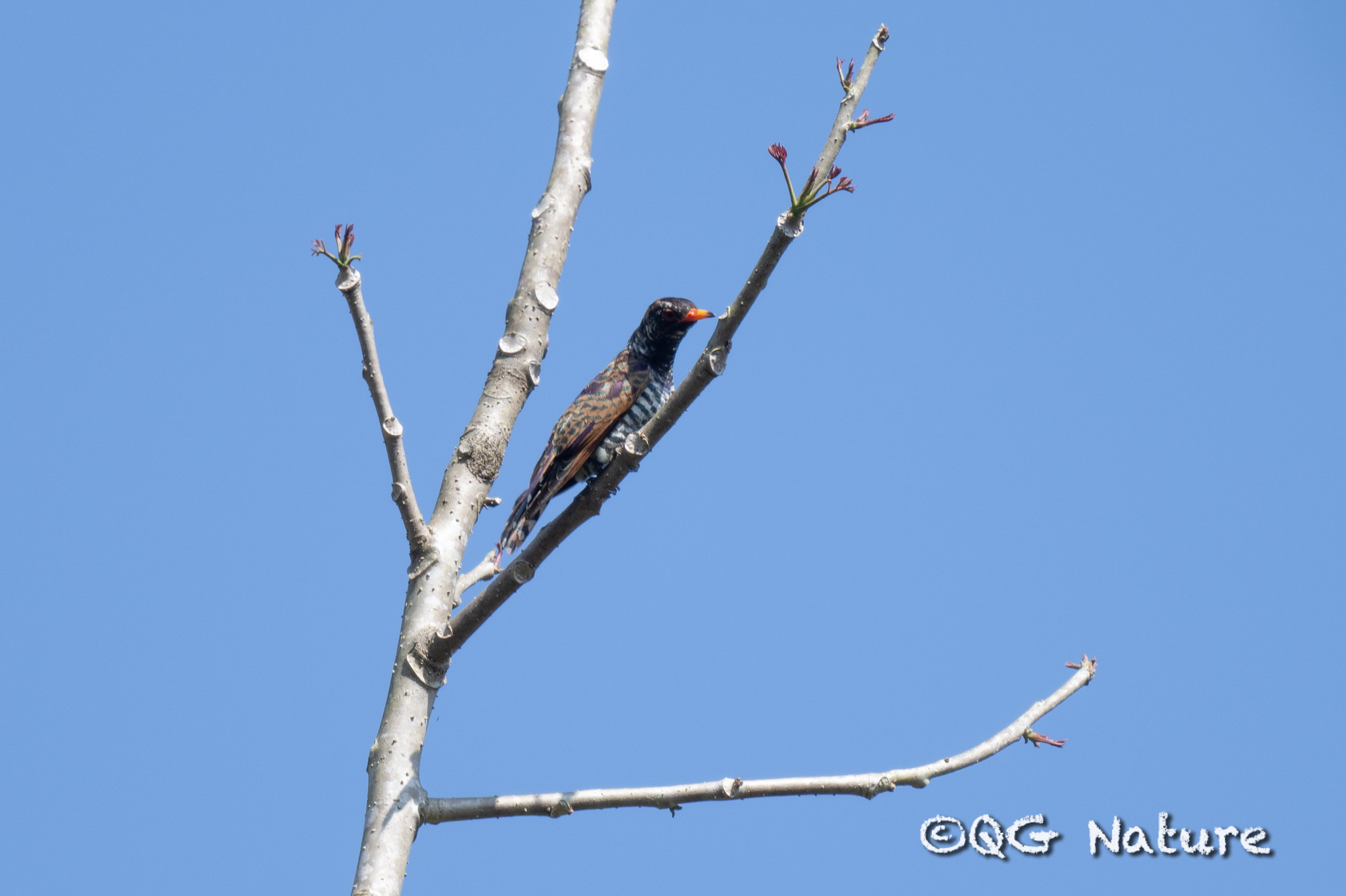
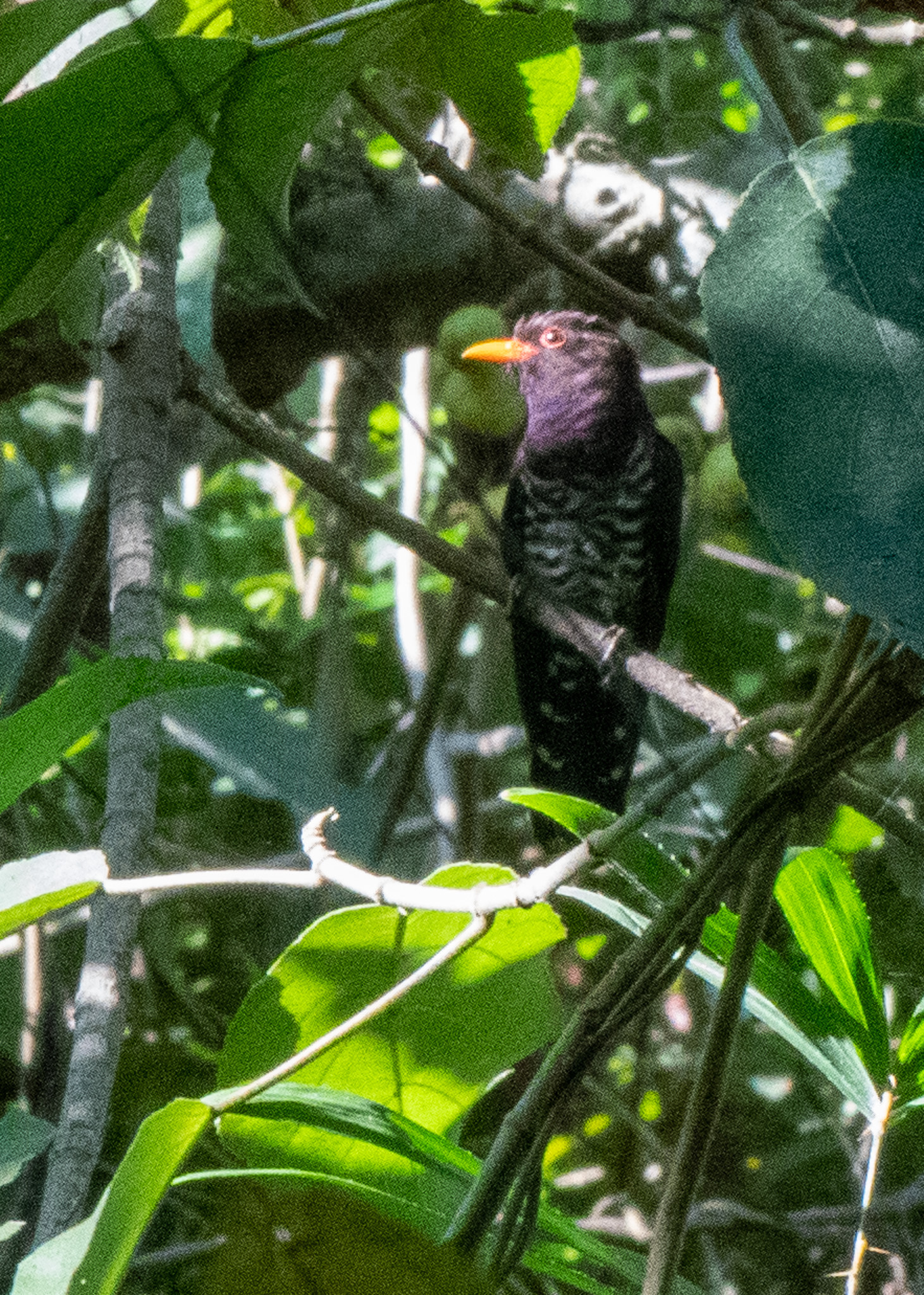
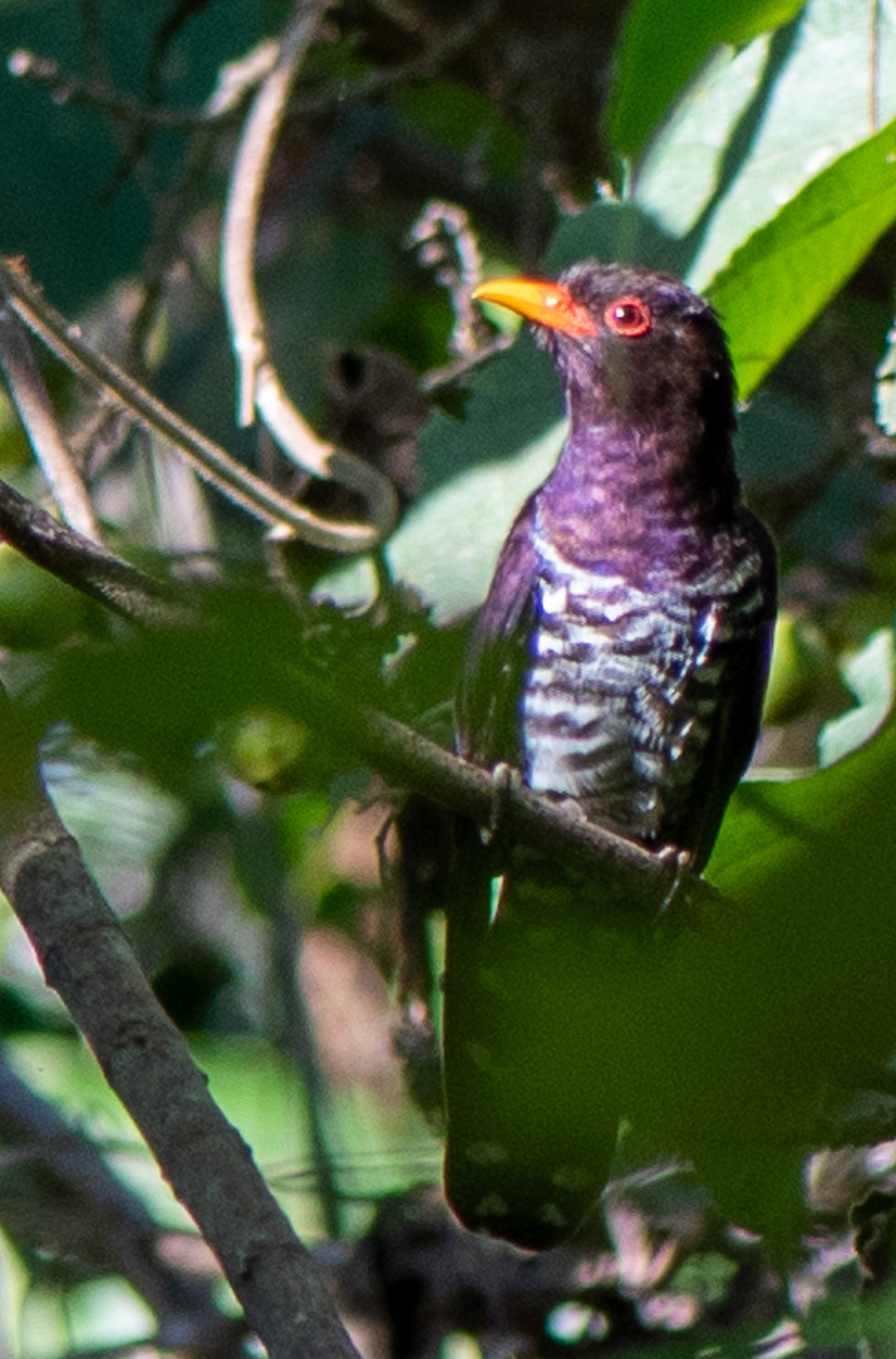
This is a small cuckoo, measuring 15-17 cm in length. Males display glossy violet feathers on the head and entire upperparts, creating a stunning iridescent effect in good light. The tail is blackish with a conspicuous white tip and barred outer feathers. The most striking feature is the brightly iridescent violet chin and upper breast, contrasting with the white belly marked with broad black, green, or violet bars. Mature males possess a distinctive red eye-ring. Females are more subdued, with mottled greenish-bronze upperparts and a dark brown crown. White markings accent the eye area and sometimes the forehead. The central tail feathers are greenish while outer feathers are rufous with greenish bars, and the outer rectrices are barred black and white. The whitish breast shows bronze-green bars with variable rufous wash. Juveniles have barred rufous and greenish-bronze upperparts, a bright rufous crown, rufous and mottled wings, and brown-barred white underparts.
Identification
Males are distinguished from the similar emerald cuckoo by their violet (not green) iridescence on the head and throat, and from C. amethystinus by having a reddish-violet throat and upper breast rather than the glossy blue-violet throat patch of that species. The combination of violet head, violet chin and upper breast, and white-tipped barred tail is diagnostic. Females are best identified by the combination of greenish-bronze mottled upperparts, rufous outer tail feathers with greenish bars, and the distinctive facial markings. The species often occurs in the canopy and can be difficult to observe, making the characteristic white tail tip and voice valuable identification aids.
Distribution & Habitat
The species ranges from northeastern India through Myanmar, Thailand, and Southeast Asia to the Greater Sundas islands, Palawan, and the Philippines. Southern populations are resident throughout their range, while northern populations in Assam, Bangladesh, and surrounding areas exhibit migratory movements. It inhabits subtropical and tropical moist lowland forests and mangrove forests, but also frequents gardens, orchards, and rubber plantations. It occurs from lowlands up to 1500 meters elevation, though it is most common below 700 meters. Although considered uncommon throughout its extensive range, the species is not currently threatened due to its broad distribution.
Behavior & Ecology
The diet consists primarily of insects, including hairy caterpillars that the bird shakes to remove stomach contents before consuming, along with various fruits. Foraging involves creeping along branches in the canopy and flycatching on the wing. As a brood parasite, females lay eggs in the nests of sunbirds and spiderhunters, with thirteen species of the genus Arachnothera recorded as hosts. Males become vocal and active during breeding season to attract mates, while females become secretive when searching for suitable host nests. Host species often recognize and mob adult cuckoos but typically fail to recognize cuckoo eggs or chicks as intruders. Cuckoo chicks are usually larger than host chicks, and while many cuckoo species eject host chicks, this behavior has not yet been documented in this species.
Conservation
The species is classified as Least Concern by the IUCN due to its extensive range, though it is considered uncommon throughout its distribution. The broad geographic range compensates for local population densities, preventing an endangered classification. However, habitat loss from deforestation poses potential threats in portions of its range, and some sources suggest the species may be locally threatened in areas experiencing significant forest degradation. Continued monitoring of populations in relation to habitat changes is recommended.
Culture
No significant cultural associations, folklore, or mythological connections were documented in available sources.
Source: Wikipedia · CC BY-SA 3.0
Taxonomy
- Order
- Cuculiformes
- Family
- Cuculidae
- Genus
- Chrysococcyx
- eBird Code
- viocuc1
Vocalizations
Subspecies (2)
-
Chrysococcyx xanthorhynchus amethystinus
Philippines (except Palawan)
-
Chrysococcyx xanthorhynchus xanthorhynchus
northeastern India to southeastern Asia, Greater Sundas, and Palawan
Data Sources
Species description from Wikipedia, licensed under CC BY-SA 3.0.
Bird images and sounds sourced from GBIF, contributed by citizen scientists worldwide under Creative Commons licenses.
Taxonomy data from AviList 2025.