
Himalayan Rubythroat
Calliope pectoralis
黑胸歌鸲
Introduction
The Himalayan rubythroat (Calliope pectoralis) is a small songbird in the Old World flycatcher family (Muscicapidae). It occurs in the Himalayas and Tien Shan ranges across Central Asia and the Indian subcontinent, inhabiting high-altitude forests and scrublands. Males display a scarlet throat patch contrasting with slaty upperparts and black breast. The species was previously grouped with the Chinese rubythroat under the name 'white-tailed rubythroat' and remains closely related to the Siberian rubythroat, which lacks white tail markings. Three subspecies are recognized across its range. It breeds in the high Himalayas during summer, descending to lower elevations in winter.
Description
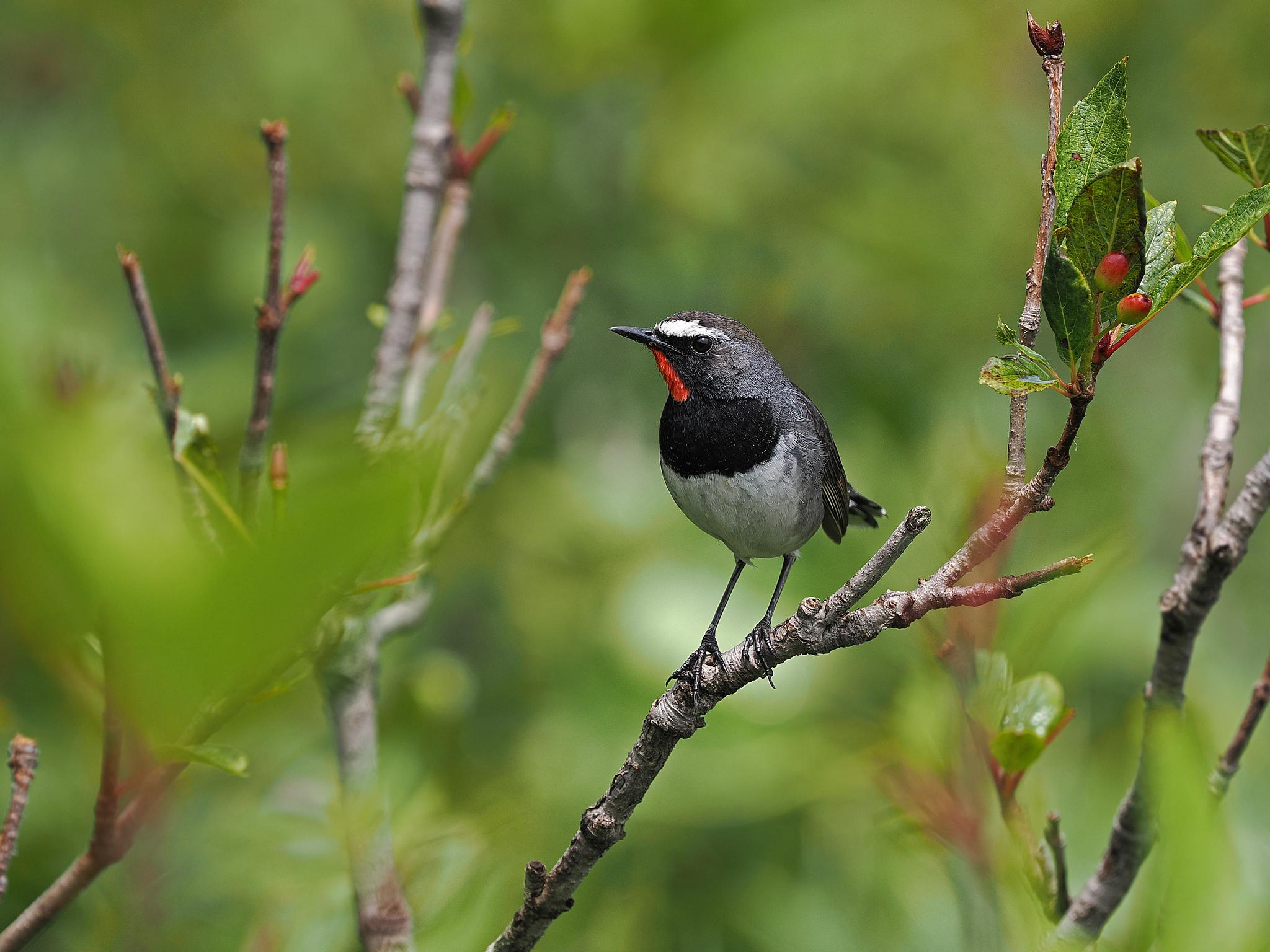
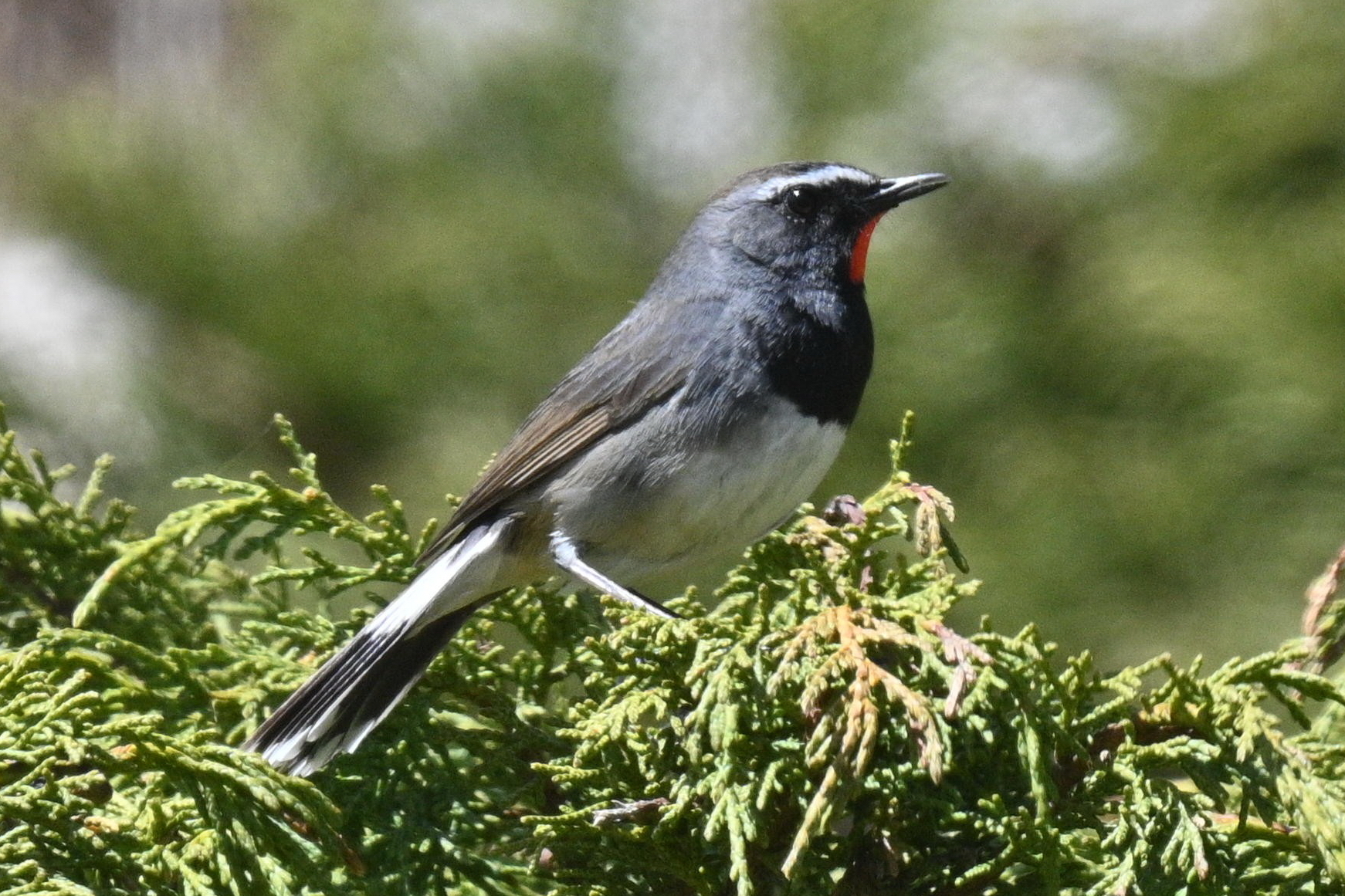
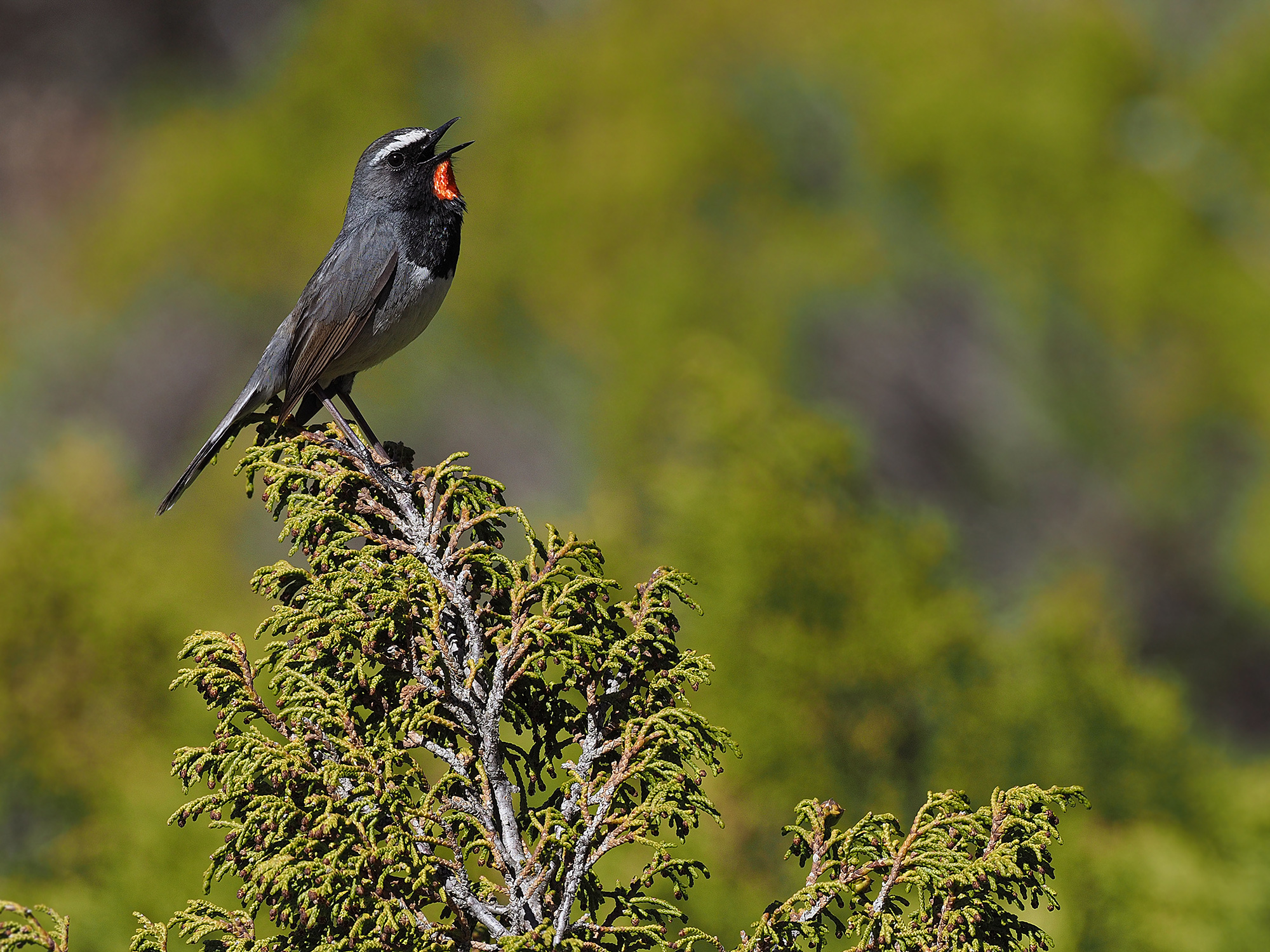
This compact songbird measures approximately 14-16 cm in length. The male displays a slaty brown upperparts with a conspicuous white forehead and supercilium, brownish wings, and a blackish tail marked by distinctive white bases and tips. Its most striking feature is the brilliant scarlet center to the chin and throat, framed by black sides to the throat and breast. Each black breast feather is narrowly edged with grey, creating a subtle scaled effect. The belly and vent are white. The female is considerably duller, wearing brownish-grey upperparts with a diffuse supercilium and smoky underparts. She shows a whitish center to the throat and, in eastern populations, a short whitish moustachial stripe. Subspecies ballioni in Afghanistan and Tien Shan has paler males, while confusa in the central and eastern Himalayas shows blacker upperparts, a more prominent white forehead, and a strong white submoustachial streak.
Identification
The most reliable field mark separating this species from the similar Siberian rubythroat is the white tail-tips and white tail base, which the Siberian species lacks entirely. The male's scarlet throat patch is diagnostic within its range, though the closely related Chinese rubythroat also shows this feature. Female identification is more challenging; they are generally duller than Siberian rubythroat females. The subspecies confusa is particularly noteworthy as it shows a face pattern superficially resembling the Siberian rubythroat with a strong white submoustachial streak, though its white tail markings distinguish it. Males can be aged by the grey fringing on breast feathers. In flight, the white tail markings are visible and provide a useful diagnostic clue.
Distribution & Habitat
This species occupies an extensive range across Central Asia and the Indian subcontinent, being found in Afghanistan, Bangladesh, Bhutan, India, Kazakhstan, Myanmar, Nepal, Pakistan, Russia, Tajikistan, Thailand, Turkmenistan, and Uzbekistan. It follows a typical altitudinal migration pattern, moving north and to higher altitudes during summer breeding months, then descending to lower elevations further south for winter. The subspecies ballioni occupies the western and northern parts of the range through Tien Shan to northeast Afghanistan, while the nominate subspecies occurs along the western and central Himalayas from northern Pakistan to central Nepal. The subspecies confusa is found from eastern Nepal through Bhutan. Its preferred habitat consists of open woodland and scrub, typically between 2,500 and 2,700 meters in the Tien Shan region.
Behavior & Ecology
Adults are typically shy and elusive, though they may venture into more open areas during breeding season. They are usually encountered singly or in pairs during the breeding period. The diet consists primarily of small insects including beetles and ants, with hairy caterpillars being an important food source for nestlings. The male sings throughout the day from an exposed perch during breeding season, delivering a variable series of squeaky notes. Females produce an upward-inflected whistle following a short, gruff note, and the alarm call is a sharp yapping 'skyap.' Breeding occurs in summer, with nests built by the female in shrubs or occasionally on the ground. The nest is typically a loose, ball-shaped structure with a side entrance, though cup-shaped nests also occur. A clutch of 4-6 greenish-blue eggs with rusty dots is incubated mainly by the female for about 14 days, and both parents feed the young, which fledge after approximately 16 days. Nests may be parasitized by common cuckoos and predated by martens and stoats.
Conservation
The Himalayan rubythroat is currently assessed as Least Concern by the IUCN, reflecting its relatively large range and stable population numbers across its extensive geographic distribution. While specific population estimates are not available, the species appears to maintain healthy numbers throughout its range from Afghanistan to Myanmar. Primary conservation concerns include habitat degradation through human activities such as grazing, development, and climate change impacts on alpine and subalpine ecosystems. Its migratory nature means it requires protection across multiple habitats throughout its annual cycle. While not currently considered threatened, monitoring of populations in the face of changing Himalayan environments would be prudent for long-term conservation planning.
Culture
The species achieved musical fame through Scottish composer and birdcall recorder Magnus Robb, who was inspired by the summer song of the male to create his 1995 composition 'Summoning Dawn.' Robb developed the melodic theme by playing the bird's calls at a quarter of their normal speed, revealing the beautiful tune hidden within what initially sounds like squeaky notes to human ears. This piece stands as a tribute to the musical abilities of small Himalayan songbirds and demonstrates how birders and musicians alike find artistic inspiration in the natural world. The composition has introduced the species to audiences beyond the birdwatching community, highlighting the aesthetic value of protecting these high-altitude habitats where such remarkable singers reside.
Source: Wikipedia · CC BY-SA 3.0
Taxonomy
- Order
- Passeriformes
- Family
- Muscicapidae
- Genus
- Calliope
- eBird Code
- himrub1
Subspecies (3)
-
Calliope pectoralis ballioni
breeds western China (western Xinjiang from Tien Shan to Kashgar); winters probably to lower elevations
-
Calliope pectoralis confusa
breeds eastern Himalayas (Nepal to Bhutan); winters to northeastern India
-
Calliope pectoralis pectoralis
breeds Himalayas from northern Pakistan, Kashmir, western Ladakh, and northern India eastward to central Nepal; non-breeders move to lower altitudes in foothills and adjacent plains of central Himalayas
Data Sources
Species description from Wikipedia, licensed under CC BY-SA 3.0.
Bird images and sounds sourced from GBIF, contributed by citizen scientists worldwide under Creative Commons licenses.
Taxonomy data from AviList 2025.