
Banded Bay Cuckoo
Cacomantis sonneratii
栗斑杜鹃
Introduction
This small cuckoo inhabits forests and hill areas across the Indian subcontinent and Southeast Asia. Males vocalize from exposed branches in the lower hills during the breeding season. The species produces a high-pitched four-note whistle starting at 2.4 kHz and falling in pitch over approximately one second. It measures approximately 22 cm in length. Populations exhibit migratory or partially migratory behavior, with presence in India strongly tied to the monsoon season. The species is brood-parasitic, laying eggs in the nests of bulbuls, babblers, and the common iora.
Description
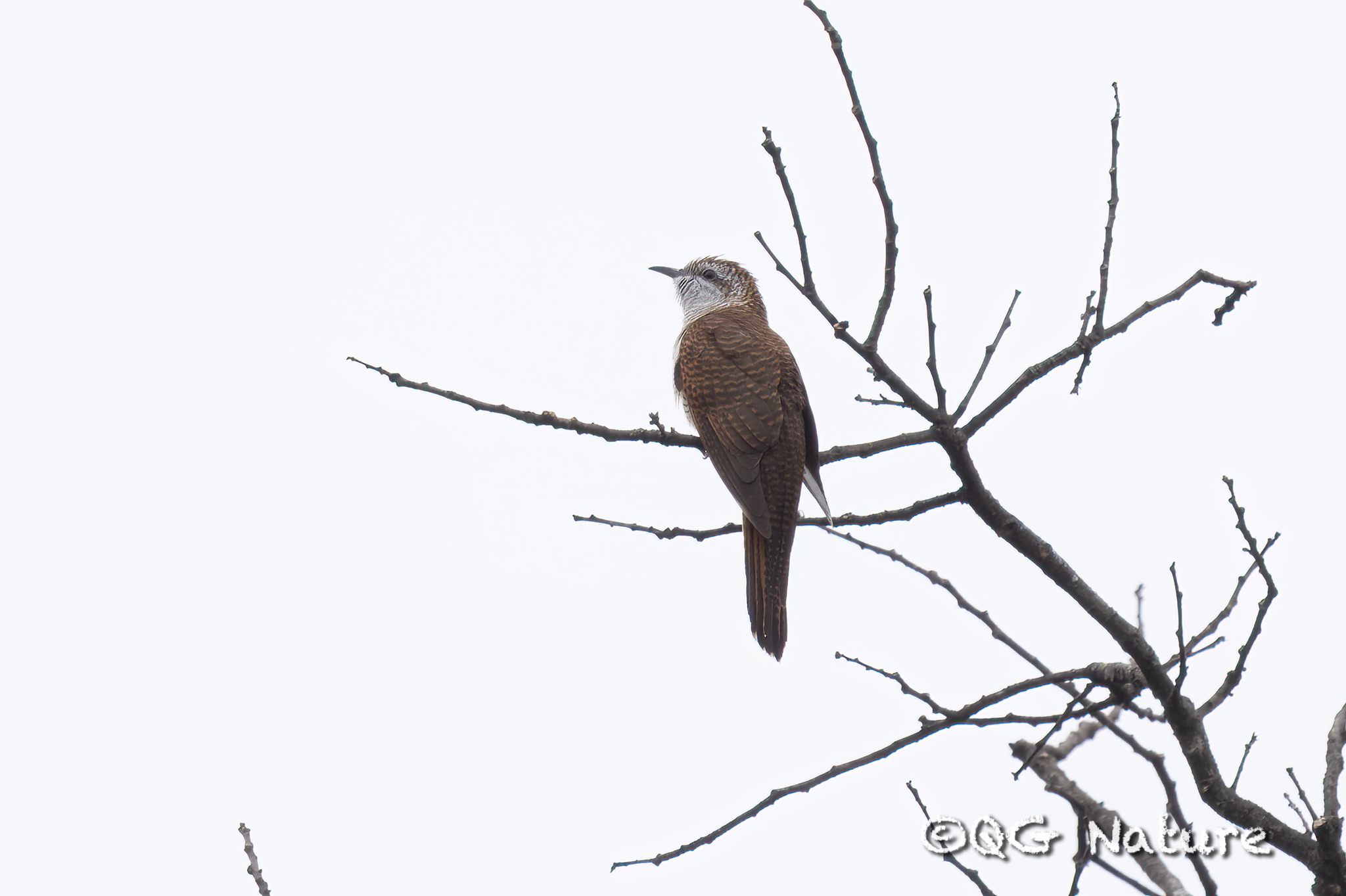
This small cuckoo measures about 22 cm in length. Adults have bright rufous or bay coloration on the head and back, broadly barred with dark brown. The most distinctive feature is the prominent whitish supercilium above a dark eye-line. The long, slightly curved bill is black with a greenish-grey base to the lower mandible. The wings are darker than the body, while the graduated tail has a dark brown center, subterminal black band, and white tips to the feathers. The yellow iris and grey tarsi complete the adult appearance. Both sexes look alike. Juveniles resemble adults but have a pale lower mandible and white fringes to the feathers of the upper body.
Identification
This species can be identified by its combination of white supercilium, long curved bill, and regularly barred rufous upperparts. The whitish underside shows fine striations. It is similar in size to the Plaintive Cuckoo and the Brush Cuckoo, both around 22 cm. The hepatic (brown) color phases of those species can appear similar, but this species is distinguished by its prominent white eyebrow, longer beak, and distinctly barred tail pattern. The graduated tail with white tips and subterminal black band is a reliable field mark.
Distribution & Habitat
This species ranges across the Indian subcontinent and Southeast Asia, including India, Nepal, Sri Lanka, Thailand, the Malay Peninsula, Java, Bali, Sumatra, Borneo, and Palawan in the Philippines. It inhabits well-wooded forests, particularly in hill areas. Populations are migratory or partially migratory; in India, it appears mainly during the monsoon months. Four subspecies are recognized: the nominate form from India through Thailand and the Malay Peninsula, C. s. musicus from Java and Bali, C. s. fasciolatus from Sumatra, and C. s. waiti from Sri Lanka.
Behavior & Ecology
As a brood parasite, this cuckoo has been recorded laying eggs in the nests of the common iora, red-whiskered bulbul, white-bellied erpornis, scarlet minivet, various bulbuls, and small Stachyris babblers. The eggs resemble those of the hosts, and host fledglings are evicted from the nest. The breeding season varies regionally: February to August near Mumbai, April to August in Assam, and year-round singing in the Eastern Ghats. In Sri Lanka, young have been observed in June and October. The diet consists primarily of insects, captured through gleaning foliage or aerial sallying.
Conservation
The species is currently listed as Least Concern by the IUCN. It has a very large range and appears to maintain stable population numbers despite its specialized brood-parasitic lifestyle. No significant threats have been identified, and it occurs in protected areas throughout its range. The adaptability to various well-wooded habitats likely contributes to its stable conservation status.
Culture
This cuckoo is notable among birdwatchers for its distinctive vocalizations, which are among the most recognizable in the genus. The four-note whistle has been widely transcribed by observers across its range. The species was originally described by John Latham and named after the French naturalist and explorer Pierre Sonnerat, reflecting its long-standing place in ornithological documentation.
Source: Wikipedia · CC BY-SA 3.0
Taxonomy
- Order
- Cuculiformes
- Family
- Cuculidae
- Genus
- Cacomantis
- eBird Code
- babcuc2
Vocalizations
Subspecies (4)
-
Cacomantis sonneratii fasciolatus
Sumatra, Borneo, and Palawan (southwestern Philippines)
-
Cacomantis sonneratii musicus
Java
-
Cacomantis sonneratii sonneratii
Himalayas from Himachal Pradesh eastward, and Peninsular India from southern Gujarat eastward to southern Indochina and the Malayan Peninsula
-
Cacomantis sonneratii waiti
Sri Lanka
Data Sources
Species description from Wikipedia, licensed under CC BY-SA 3.0.
Bird images and sounds sourced from GBIF, contributed by citizen scientists worldwide under Creative Commons licenses.
Taxonomy data from AviList 2025.