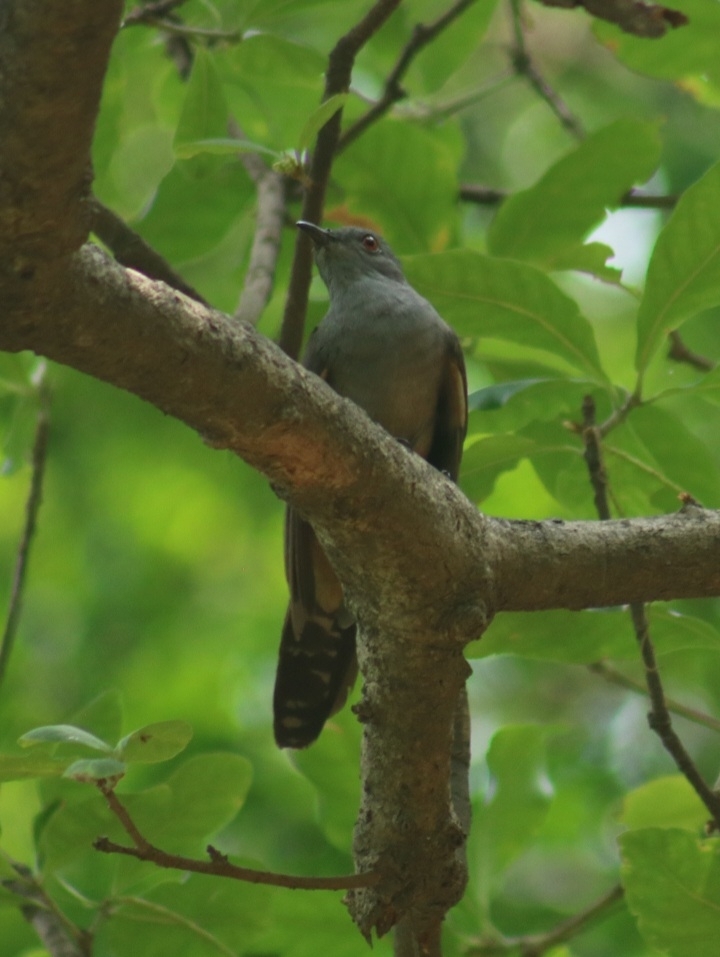
Plaintive Cuckoo
Cacomantis merulinus
八声杜鹃
Introduction
A small cuckoo. Resident across South and Southeast Asia, from the Indian subcontinent to the Indonesian archipelago. Inhabits forest edges, secondary forests, parkland, and garden margins. First described by Johann Friedrich Gmelin in 1788. The species epithet 'merulinus' derives from the Latin for 'melancholy' or 'mournful', referencing its vocalizations. Found in both natural woodland and human-modified landscapes.
Description
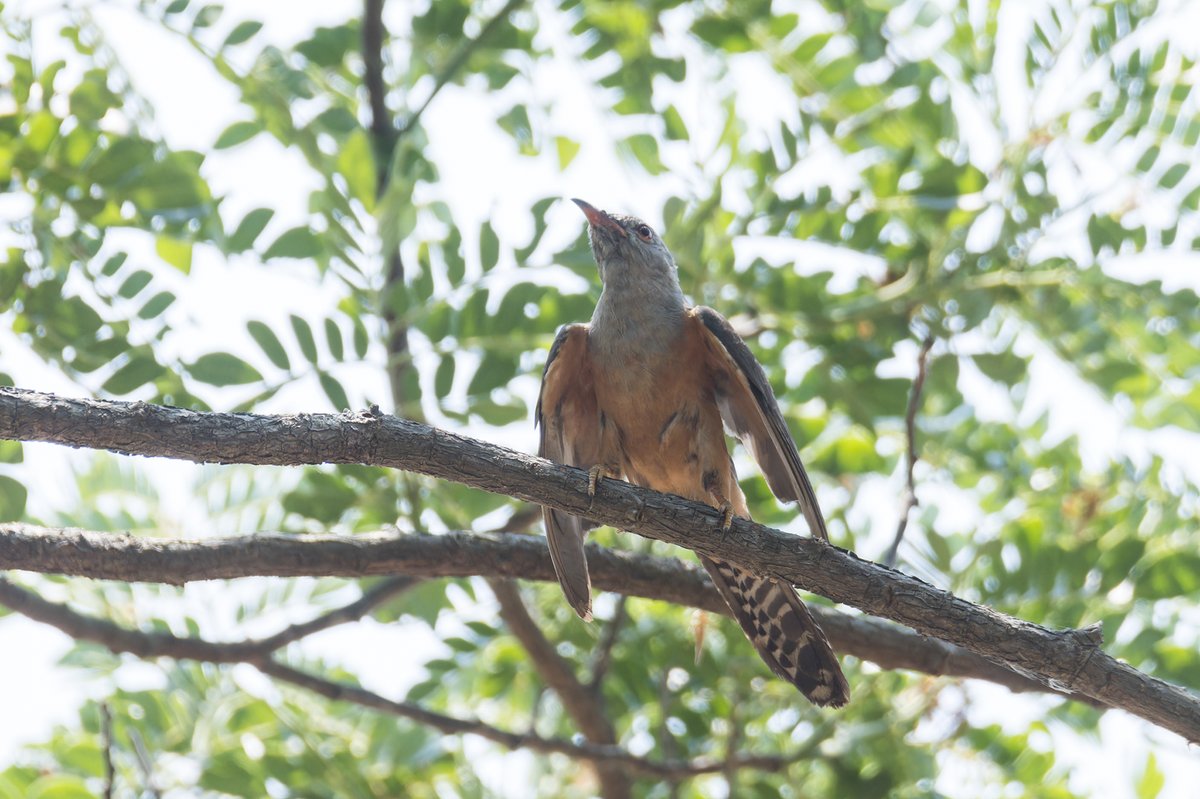
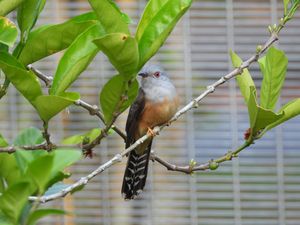
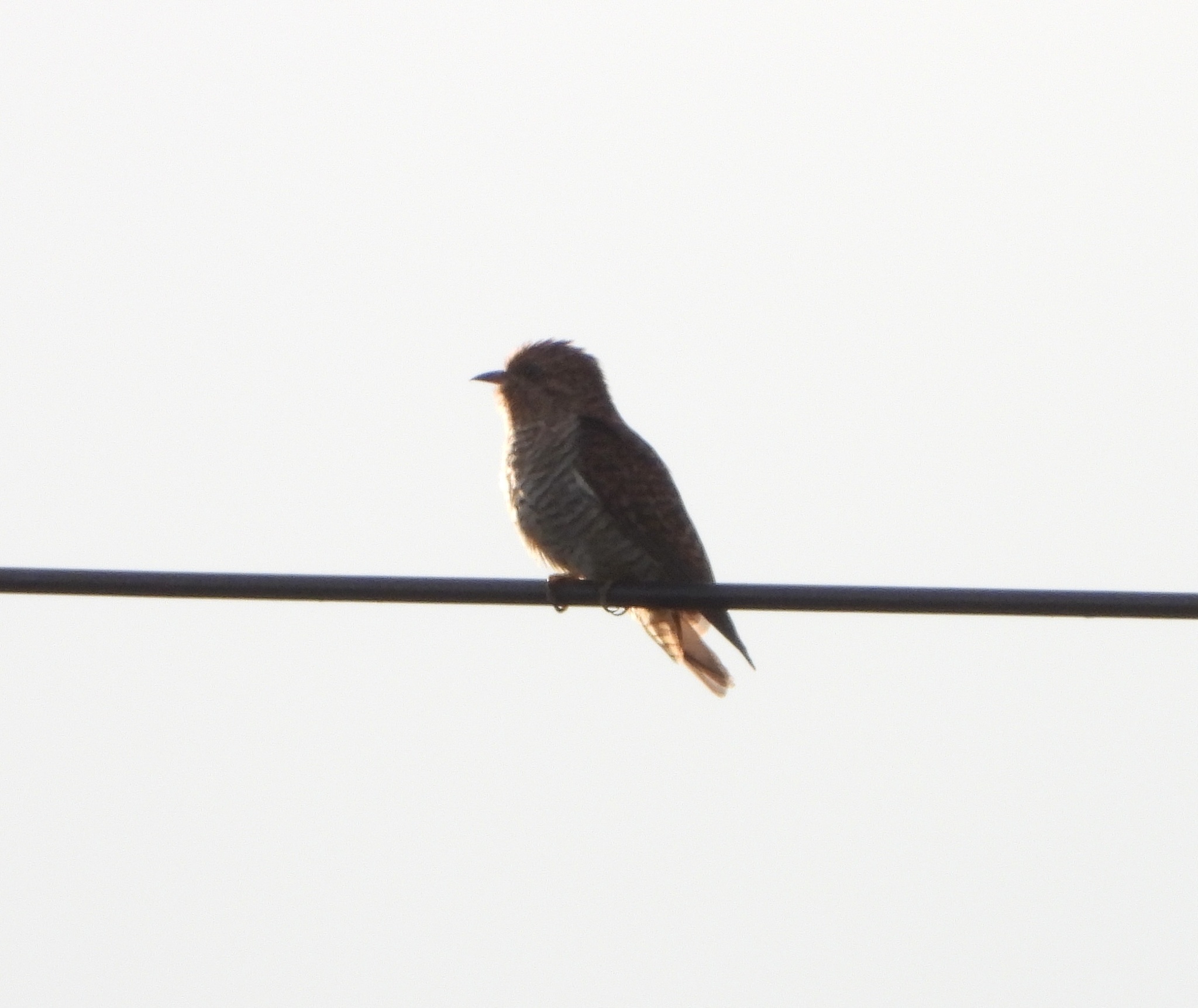
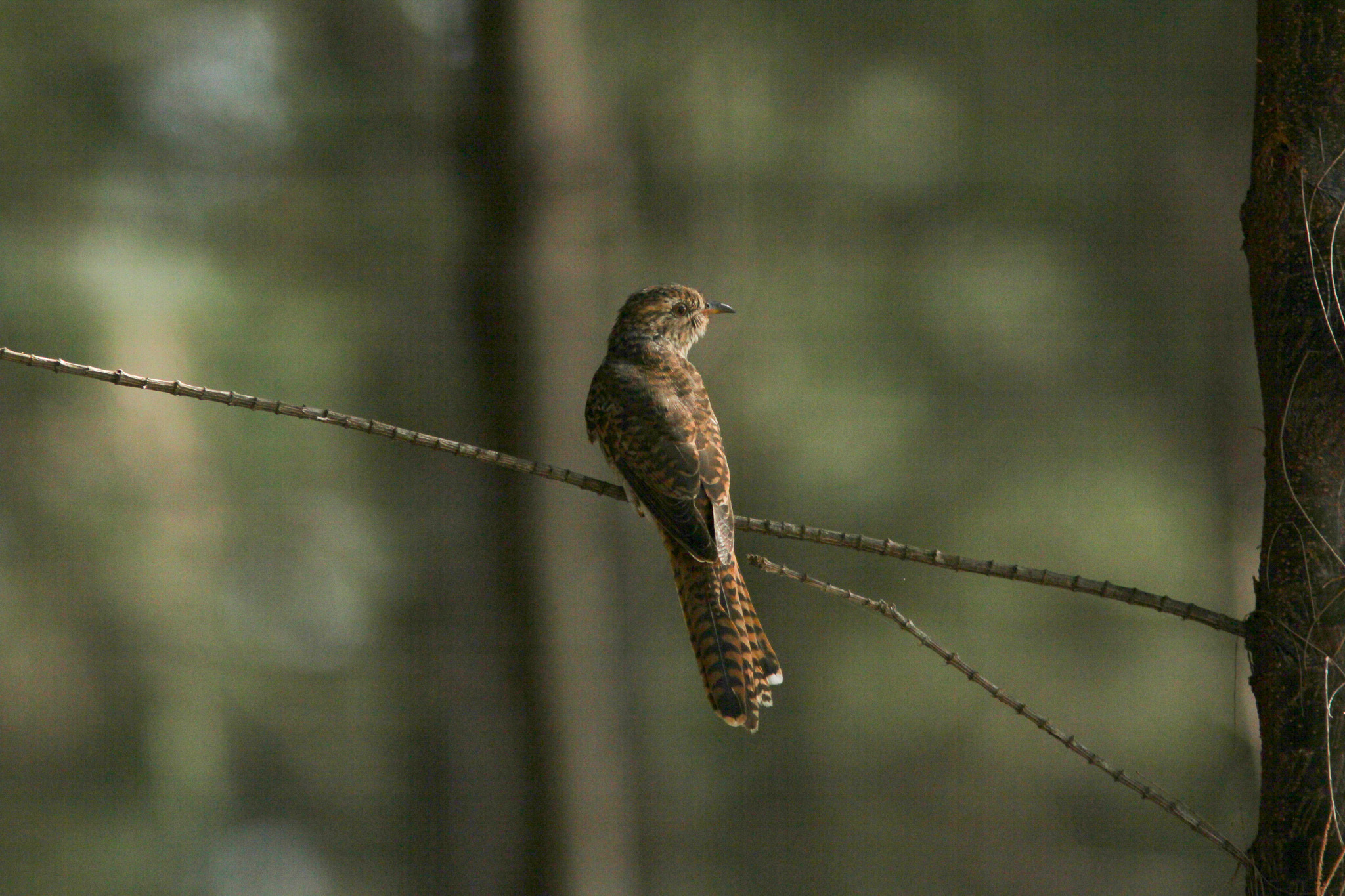
This is a small cuckoo measuring 21-24 cm in length. Adult males display grey-brown upperparts with orange underparts, while the head, throat and upper breast are grey. The tail feathers feature distinctive white tips. The legs and feet are bright yellow, the eye is red, and the bill is black on top with a yellow base. Females are variable but often occur in a 'hepatic' morph, showing reddish-brown upperparts with dark barring, paler underparts with fainter markings, a pale stripe above the eye, and a barred tail. Juveniles resemble hepatic females but are paler overall, with dark streaks rather than bars on the crown and throat.
Identification
The combination of small size, grey head, orange underparts and white-tipped tail feathers helps distinguish this species from similar cuckoos. The yellow legs and red eye are also characteristic field marks. The hepatic female morph, with its reddish-brown plumage and dark barring, can be confusing but is identified by the pale supercilium and distinctly barred tail. The similar grey-bellied cuckoo was formerly classified as a subspecies but is now treated separately; it lacks the orange underparts of the male and shows a different call pattern. The plaintive whistle—typically an ascending three-note phrase followed by descending notes—is the best auditory cue for identification.
Distribution & Habitat
Four subspecies are recognized across its range. The nominate form occupies the Philippines, where it is common on many larger islands. The widespread querulus subspecies occurs from northeastern India and Bangladesh through southern China, Myanmar, Thailand, Cambodia, Laos and Vietnam to Indonesia; it is a summer visitor to most of China, migrating south for winter. The threnodes subspecies is found in the Malay Peninsula, Sumatra and Borneo, while lanceolatus occurs in Java, Bali and Sulawesi. The species inhabits forest edge, open woodland, scrub, grassland, farmland, parks and gardens.
Behavior & Ecology
This solitary species feeds on invertebrates and is often difficult to observe as it skulks in dense vegetation. It is an obligate brood parasite, laying its eggs in the nests of cisticolas, prinias and tailorbirds. The eggs resemble those of the host species but are notably larger. The species is known for its distinctive vocalizations, which include an ascending series of three-note phrases and a descending series of 11-12 notes, both described as plaintive whistles. Small birds frequently mob the cuckoo to drive it away from their nests.
Conservation
The species is listed as Least Concern by the IUCN due to its extremely large range and apparently stable population trend. It is described as common across much of its extensive distribution and shows adaptability to human-modified habitats including farmland and parks. No significant population declines or major threats have been identified, though localized habitat changes could affect populations in specific areas.
Culture
The species derives its English name from its distinctive call, described as plaintive or mournful whistling. This melancholic quality has made the bird's voice recognizable to rural communities throughout its range, where it is often associated with the sounds of forest edges and garden habitats. No extensive folklore or mythological associations are recorded in the available literature.
Source: Wikipedia · CC BY-SA 3.0
Taxonomy
- Order
- Cuculiformes
- Family
- Cuculidae
- Genus
- Cacomantis
- eBird Code
- placuc1
Vocalizations
Subspecies (4)
-
Cacomantis merulinus lanceolatus
Java, Sulawesi, and Togian Islands (east of Sulawesi)
-
Cacomantis merulinus merulinus
Philippines
-
Cacomantis merulinus querulus
eastern Himalayas to southern China, Myanmar, Malay Peninsula, and Indochina
-
Cacomantis merulinus threnodes
southern Malay Peninsula, Sumatra, and Borneo
Data Sources
Species description from Wikipedia, licensed under CC BY-SA 3.0.
Bird images and sounds sourced from GBIF, contributed by citizen scientists worldwide under Creative Commons licenses.
Taxonomy data from AviList 2025.