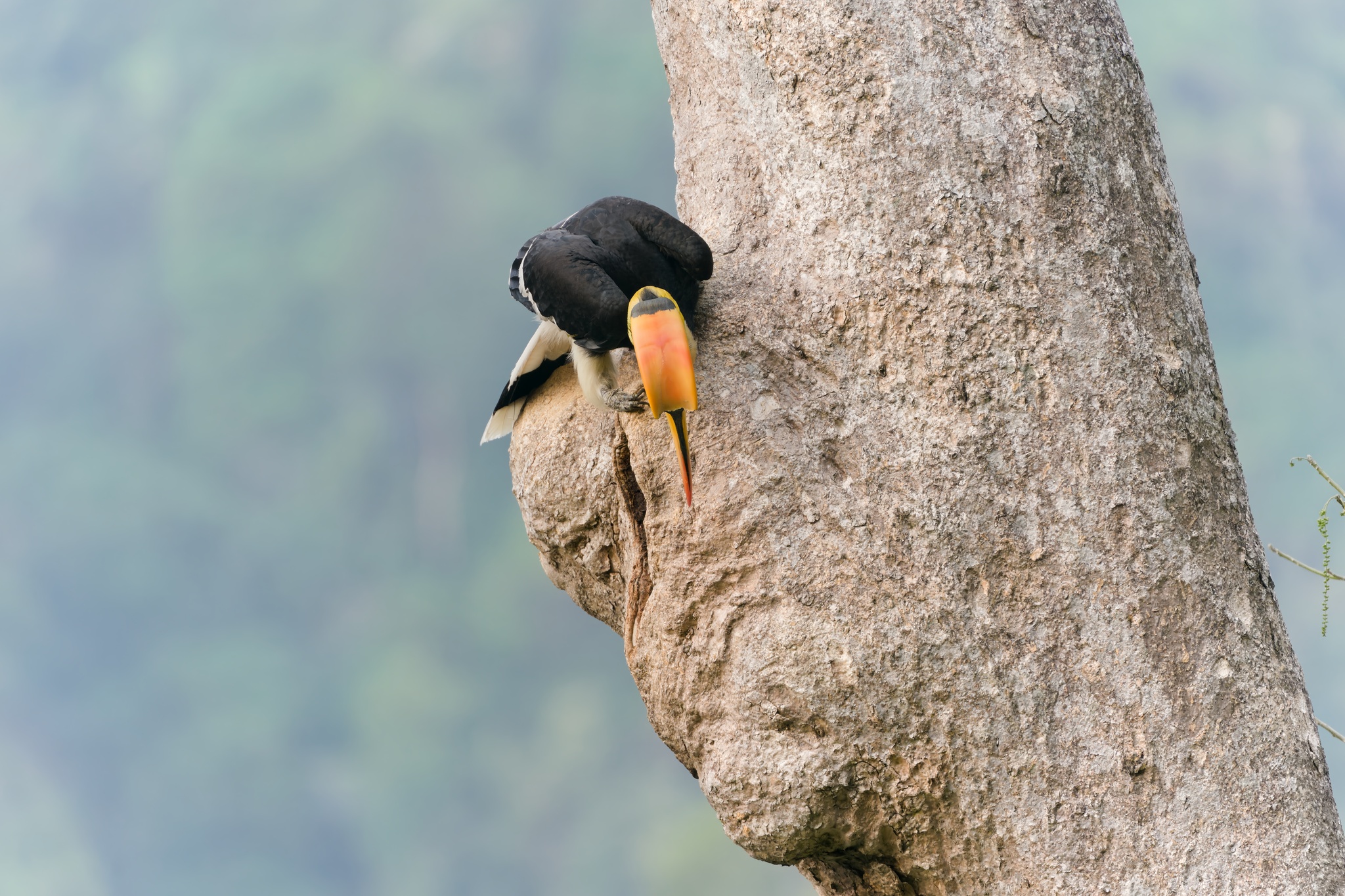
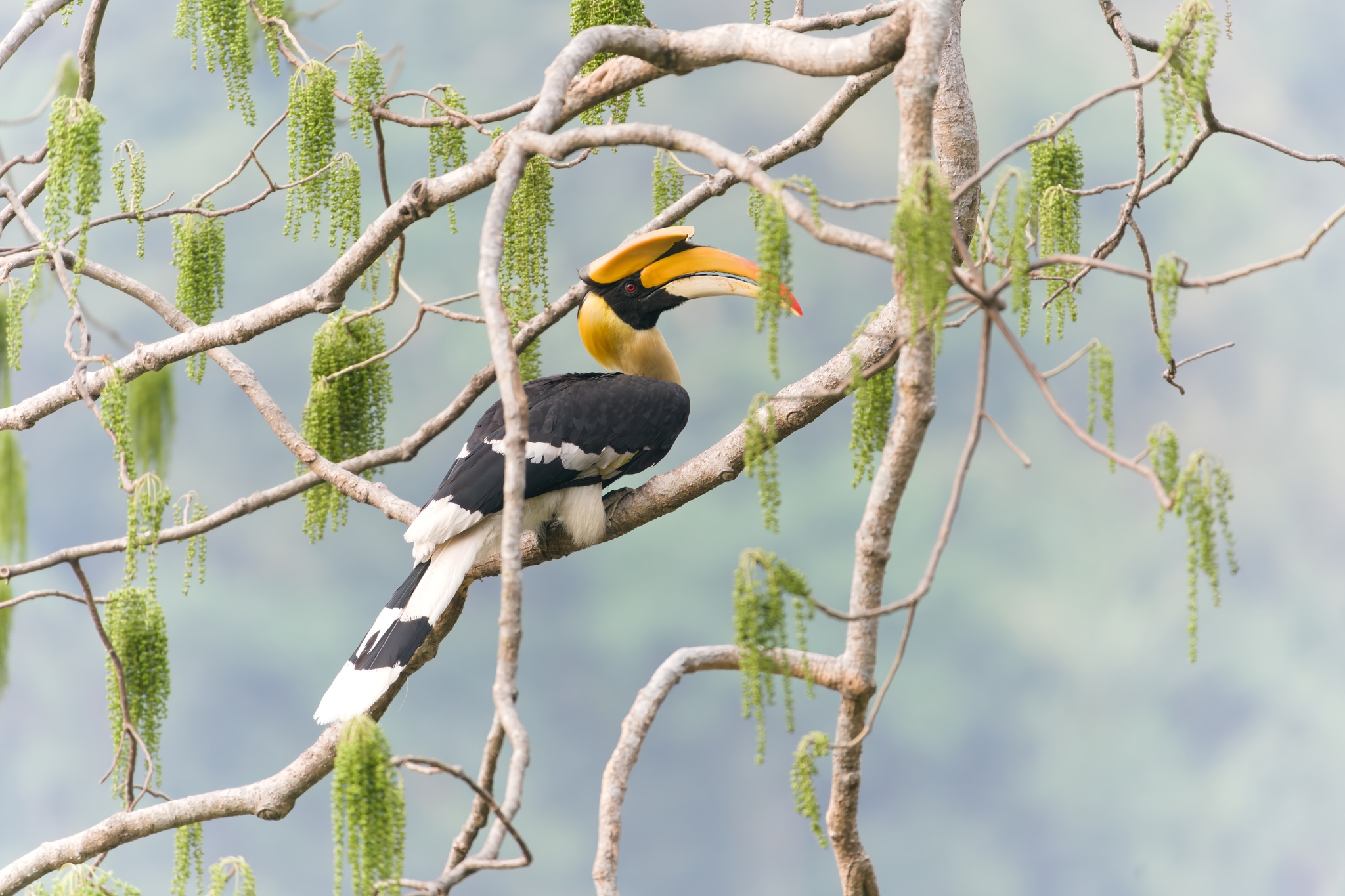
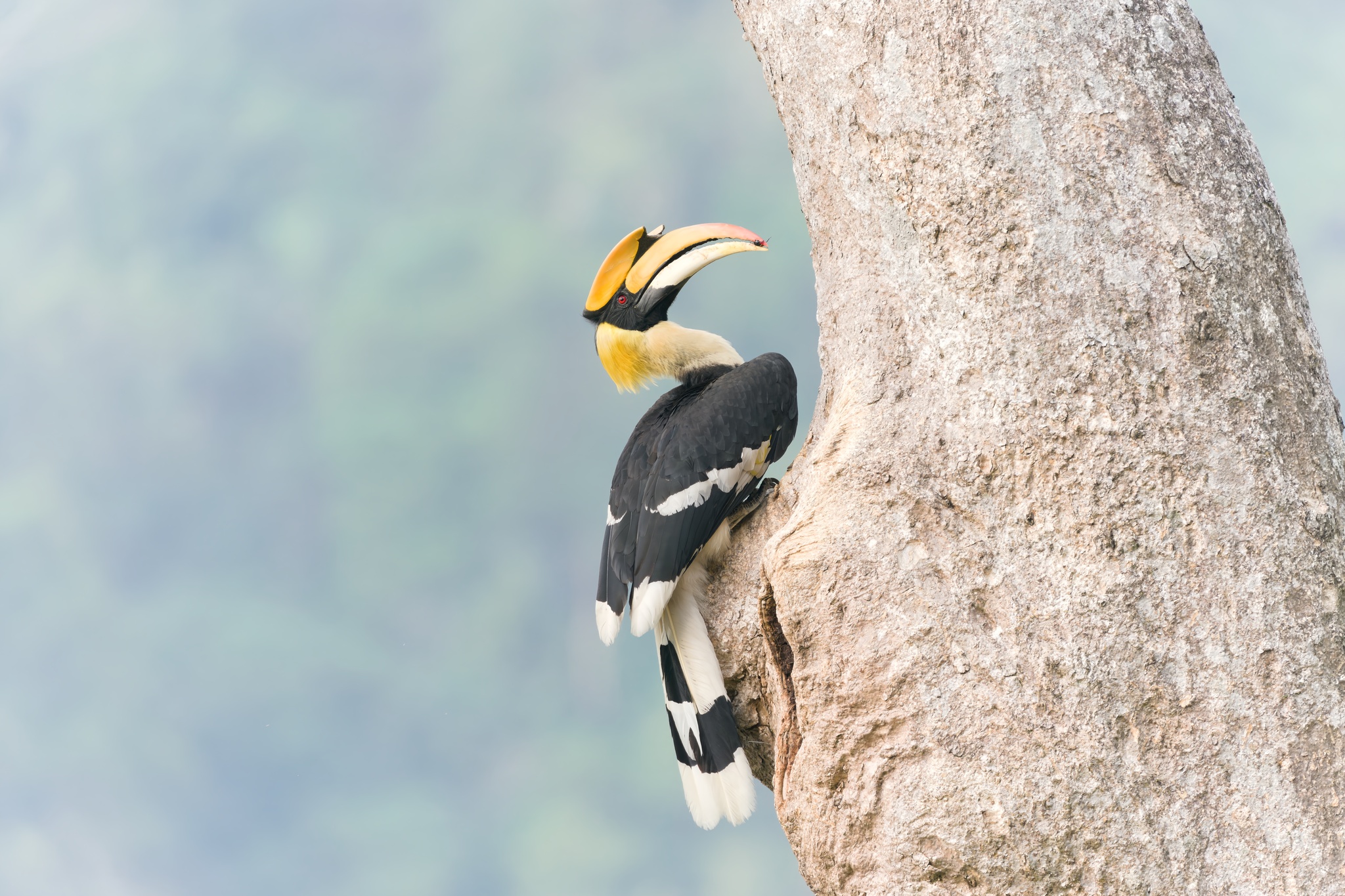

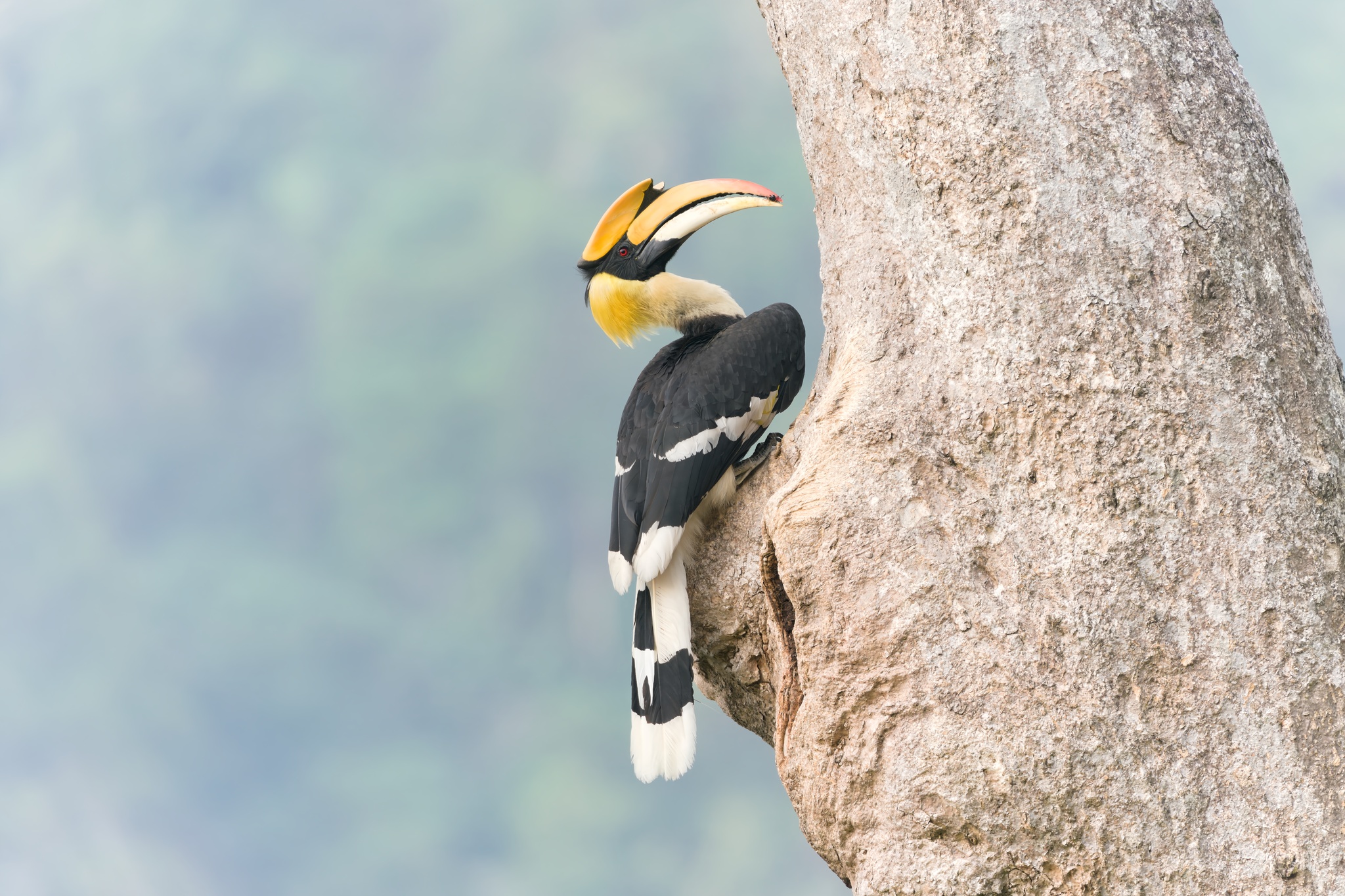
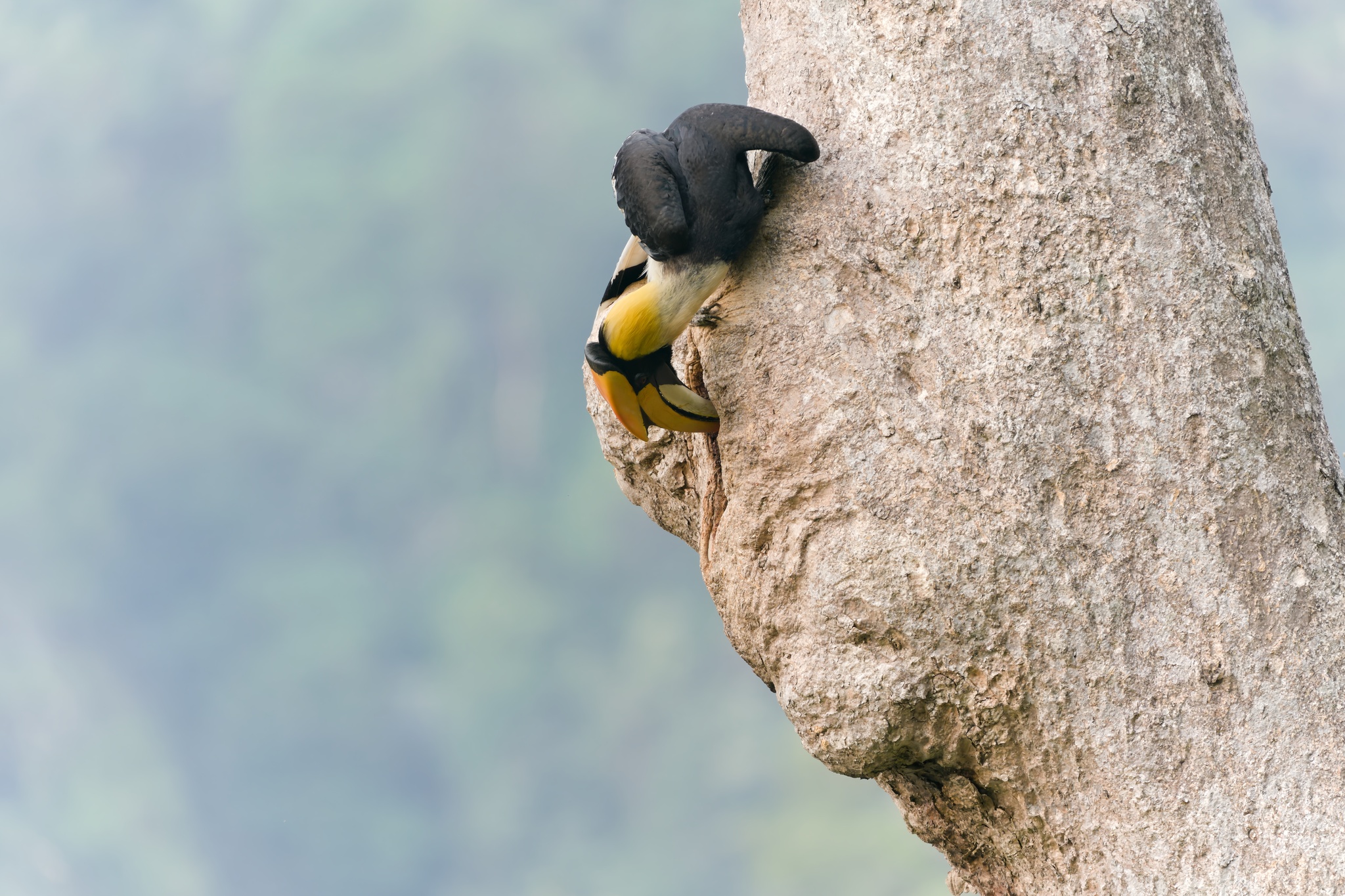
Great Hornbill
Buceros bicornis
双角犀鸟
Introduction
This large hornbill occurs across the forests of the Indian subcontinent and Southeast Asia. It features a prominent yellow and black casqued bill. Its diet consists predominantly of fruit, supplemented by small mammals, reptiles, and other birds. It serves as a seed disperser for many tree species. Groups of 2-40 individuals move through the canopy. Its heavy wingbeats produce a distinctive sound. Lifespan reaches nearly 50 years in captivity.
Description
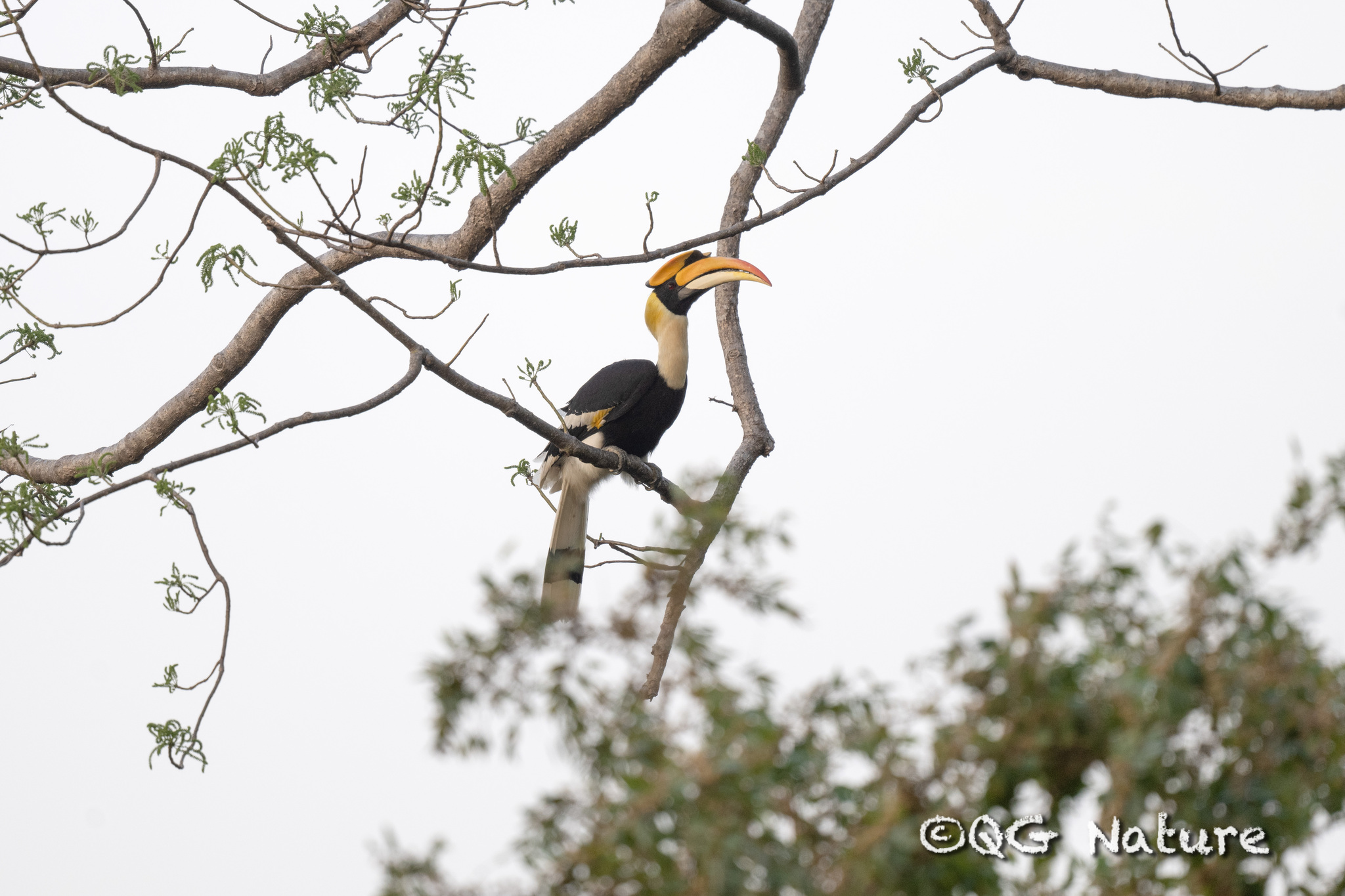
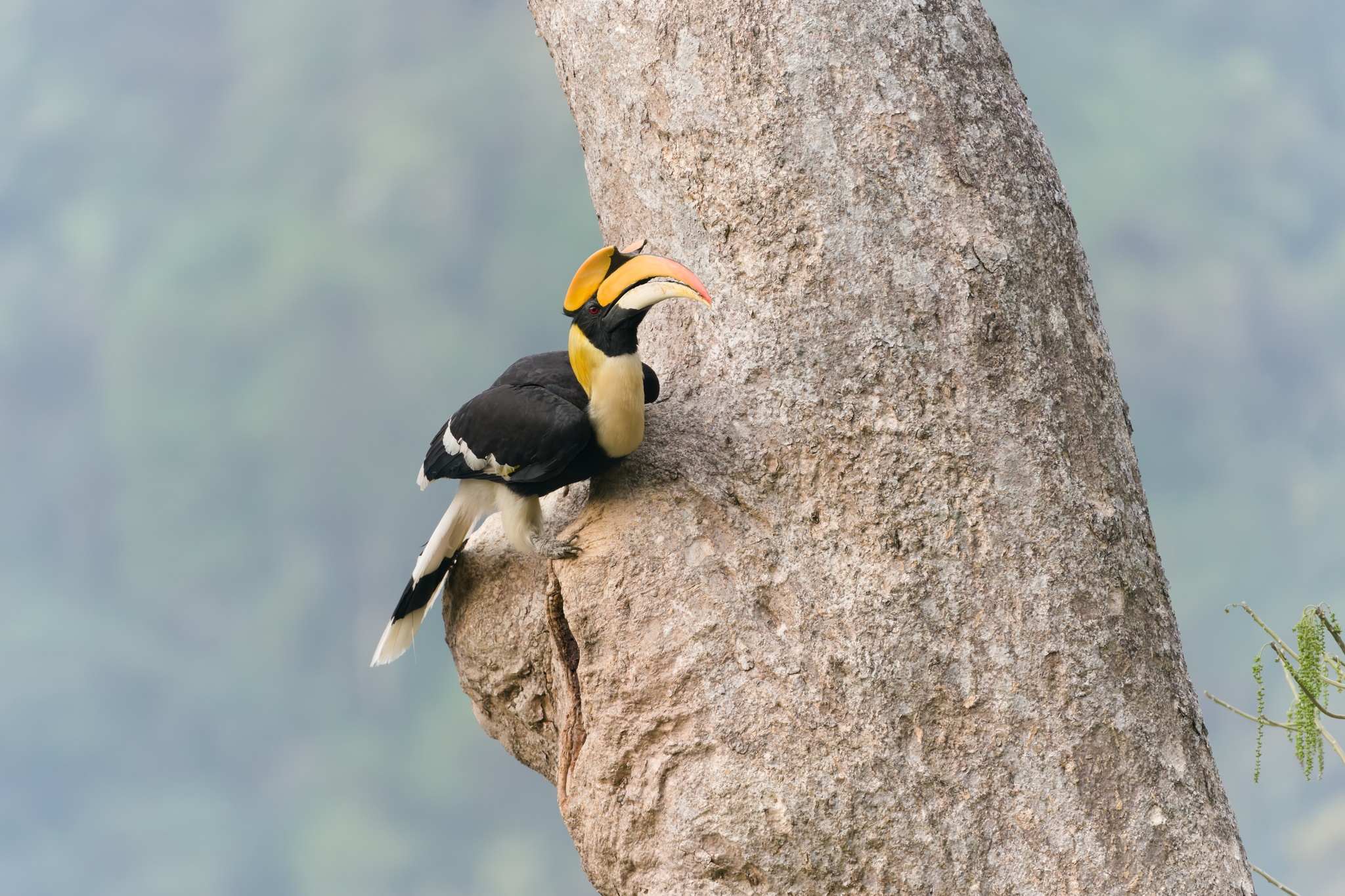
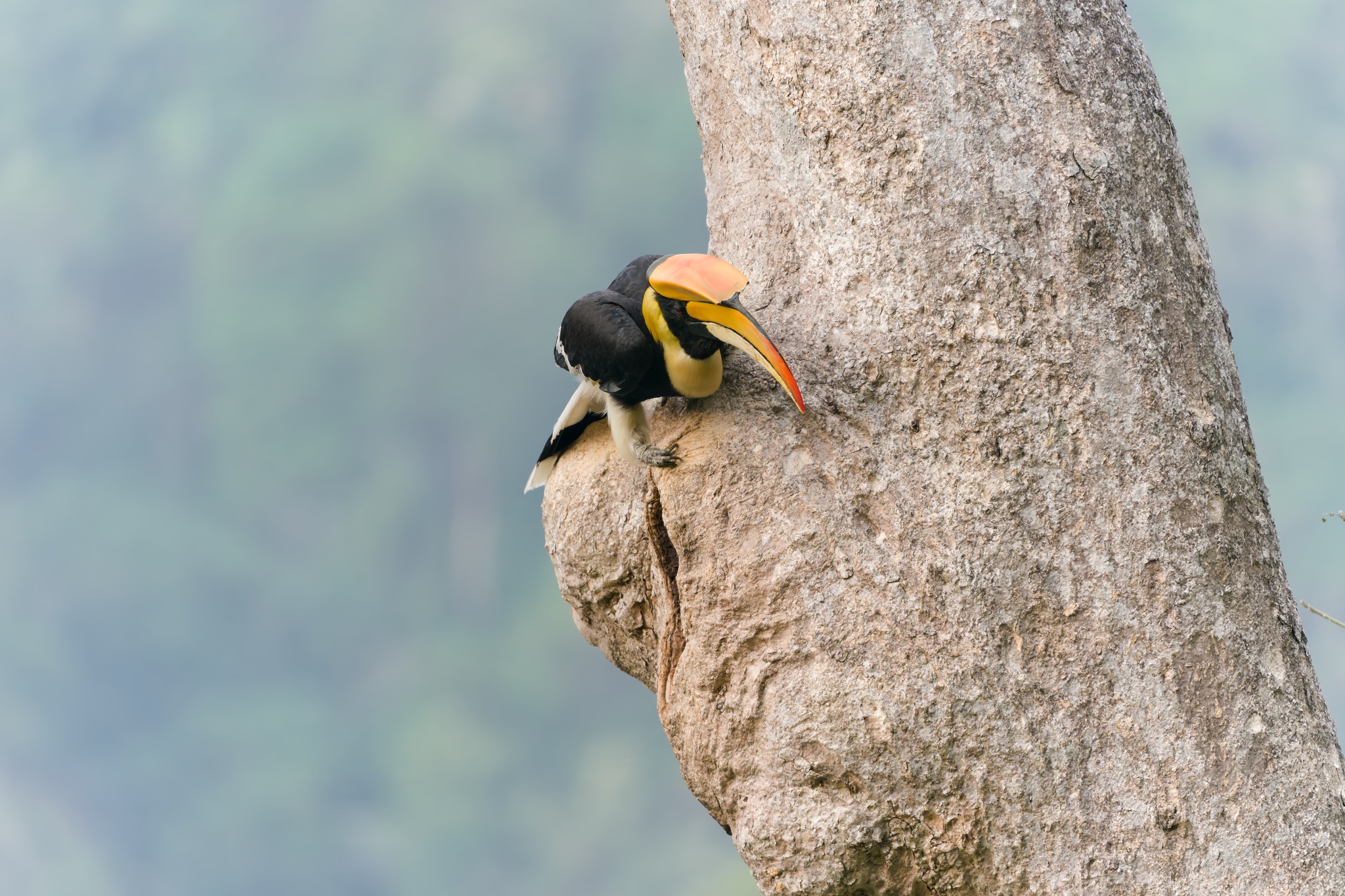
This is a large bird measuring 95-130 cm in length with a 152 cm wingspan and weighing 2-4 kg, making it the heaviest Asian hornbill. Males are slightly larger, averaging 3 kg compared to females at 2.59 kg. The most distinctive feature is the bright yellow and black casque, which appears U-shaped from the front with a concave top and ridged sides that form two points. Males have red eyes and a black underside to the casque, while females have bluish-white eyes, pinkish orbital skin, and a reddish back to the casque. Like other hornbills, they possess prominent eyelashes and a black serrated edge to the beak commissure. The wing beats are heavy and powerful, with highly pneumatized bones extending into the wing tips.
Identification
The great hornbill is unmistakable within its range due to its large size and the striking yellow and black casque. The concave top with two ridged points immediately distinguishes it from other hornbill species. Sexes can be reliably separated by eye color—males have red eyes while females have bluish-white eyes—and by casque coloration, with the back of the casque reddish in females. The heavy, labored flight with stiff flaps followed by glides with fingers splayed and upcurved is also characteristic. The combination of size, casque structure, and the black and yellow plumage pattern makes confusion with other species unlikely where this bird occurs.
Distribution & Habitat
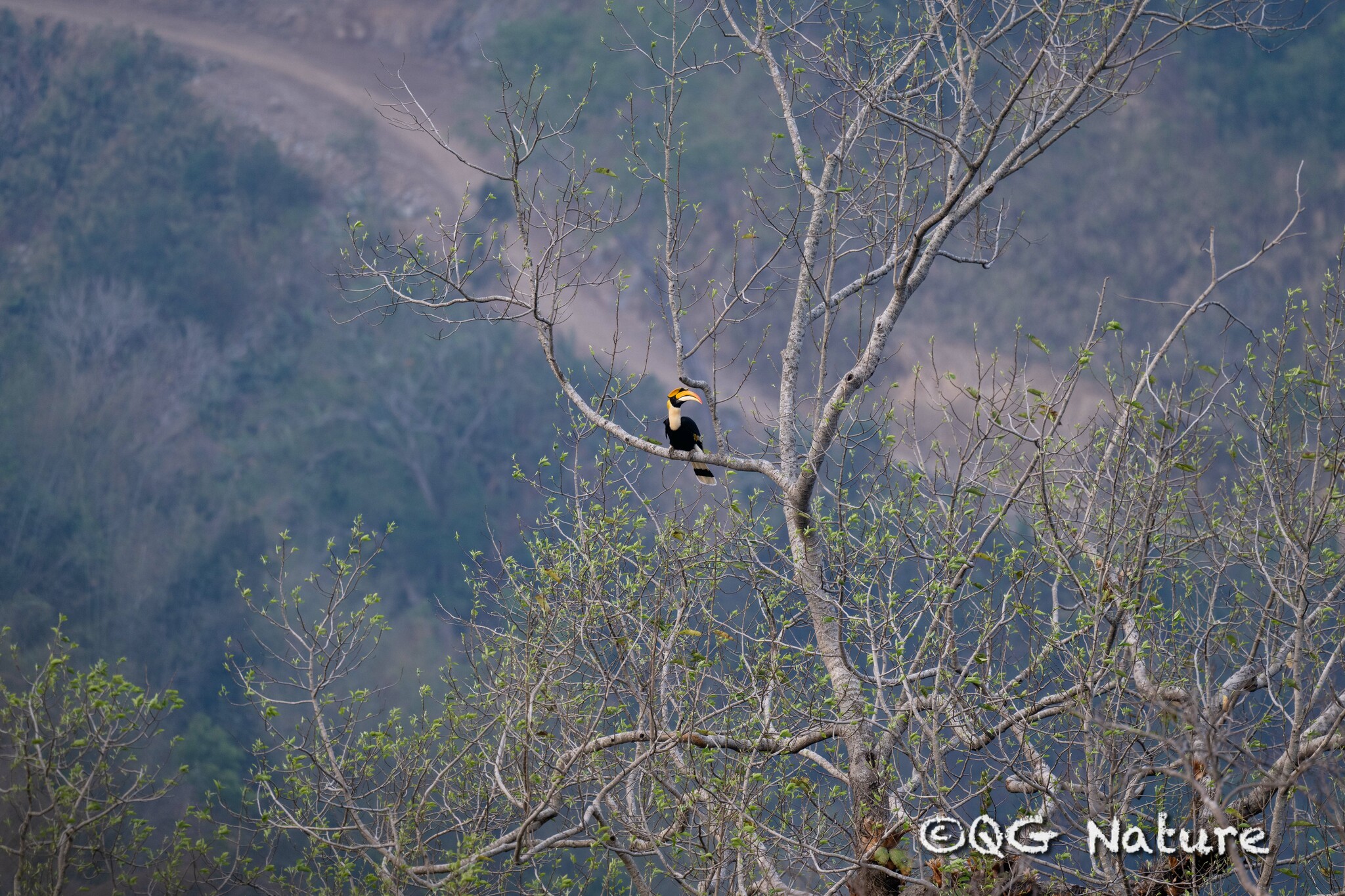
This species inhabits the forests of India, Bhutan, Nepal, mainland Southeast Asia, and Sumatra. Its distribution is now fragmented, particularly in the Western Ghats and Himalayan foothills, due to extensive deforestation. It shows strong preference for dense, old-growth unlogged forests in hilly regions and appears dependent on large continuous stretches of rainforest. In Thailand, male home ranges average 3.7 km during the breeding season but expand to about 14.7 km during the non-breeding period, indicating seasonal movements in response to fruit availability.
Behavior & Ecology
Great hornbills are typically seen in small parties, though larger congregations of 150-200 birds have been recorded at abundant fruit trees. They are predominantly frugivorous, with figs being especially important, supplemented by fruits from Lauraceae and Myristicaceae families. They obtain all water from their fruit diet. During the January to April breeding season, pairs perform loud duets starting with male 'kok' calls that escalate into rapid roars and barks as both birds call in unison. They form monogamous pairs and nest in large tree hollows, where the female seals herself inside and relies on the male for food throughout incubation and chick rearing. Group courtship displays involving up to 20 birds have been observed.
Conservation
The species has been listed as Vulnerable on the IUCN Red List since 2018. Habitat loss from deforestation represents the primary threat, compounded by hunting for meat, fat, and body parts including the casque and tail feathers used as adornments. Tribal peoples harvest various parts for traditional medicines, charms, and ceremonies. Young birds are considered a delicacy in some regions. It is listed in CITES Appendix I, and conservation programs have attempted to provide tribes with alternative materials such as ceramic casques and captive-feathered head-dresses to reduce pressure on wild populations.
Culture
Known locally as homrai in Nepal and banrao in Mussoorie, meaning 'King of the Jungle,' this bird holds significant cultural importance. It serves as the official state bird for both Kerala and Arunachal Pradesh. A captive hornbill named William became legendary as the 'office canary' of the Bombay Natural History Society, living for 26 years and becoming the model for the Society's logo. Among the Sema Nagas of northeastern India, the hornbill carries particular cultural significance—tribal members believe consuming its flesh causes sores on the feet, mirroring the bird's apparent inability to walk. They incorporate the feathers into elaborate head-dresses worn during traditional dances.
Source: Wikipedia · CC BY-SA 3.0
Taxonomy
- Order
- Bucerotiformes
- Family
- Bucerotidae
- Genus
- Buceros
- eBird Code
- grehor1
Distribution
lowlands of India to southwestern China, southeastern Asia, and Sumatra
Data Sources
Species description from Wikipedia, licensed under CC BY-SA 3.0.
Bird images and sounds sourced from GBIF, contributed by citizen scientists worldwide under Creative Commons licenses.
Taxonomy data from AviList 2025.