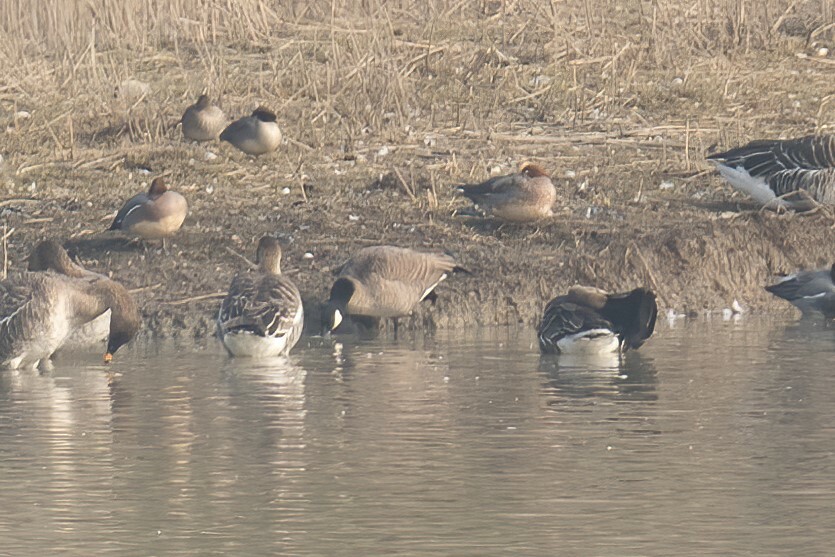
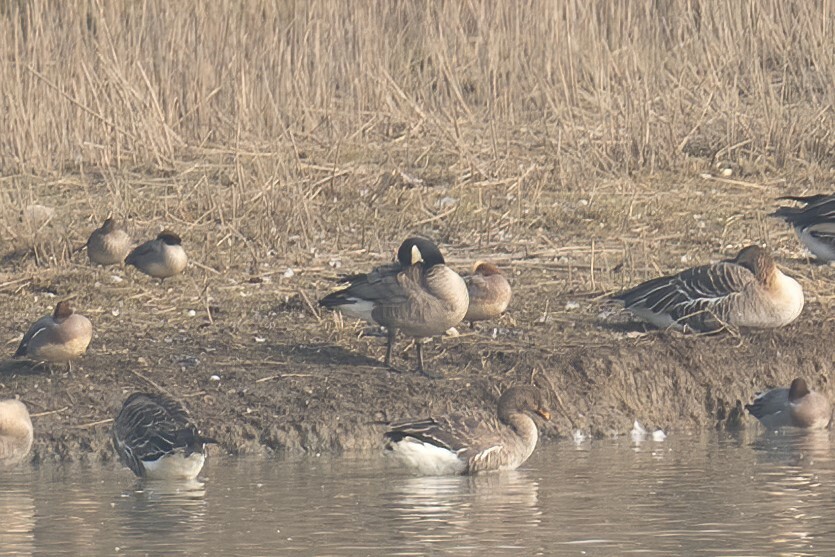
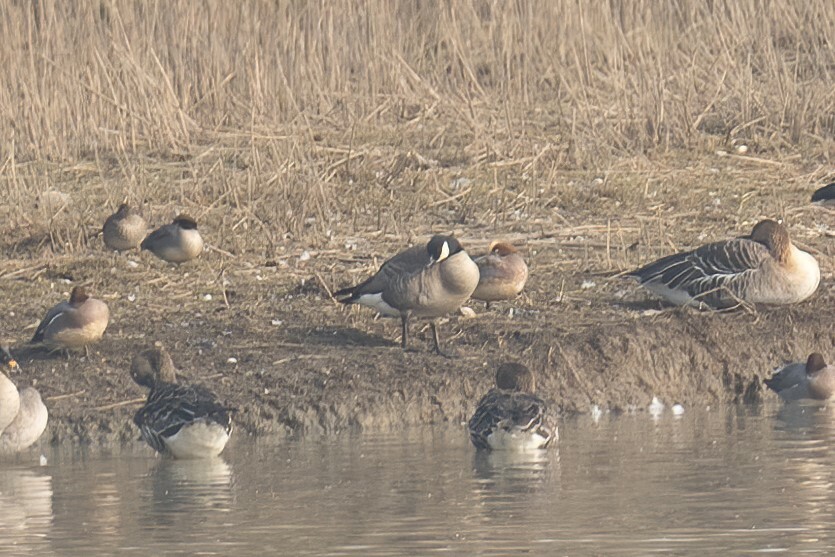
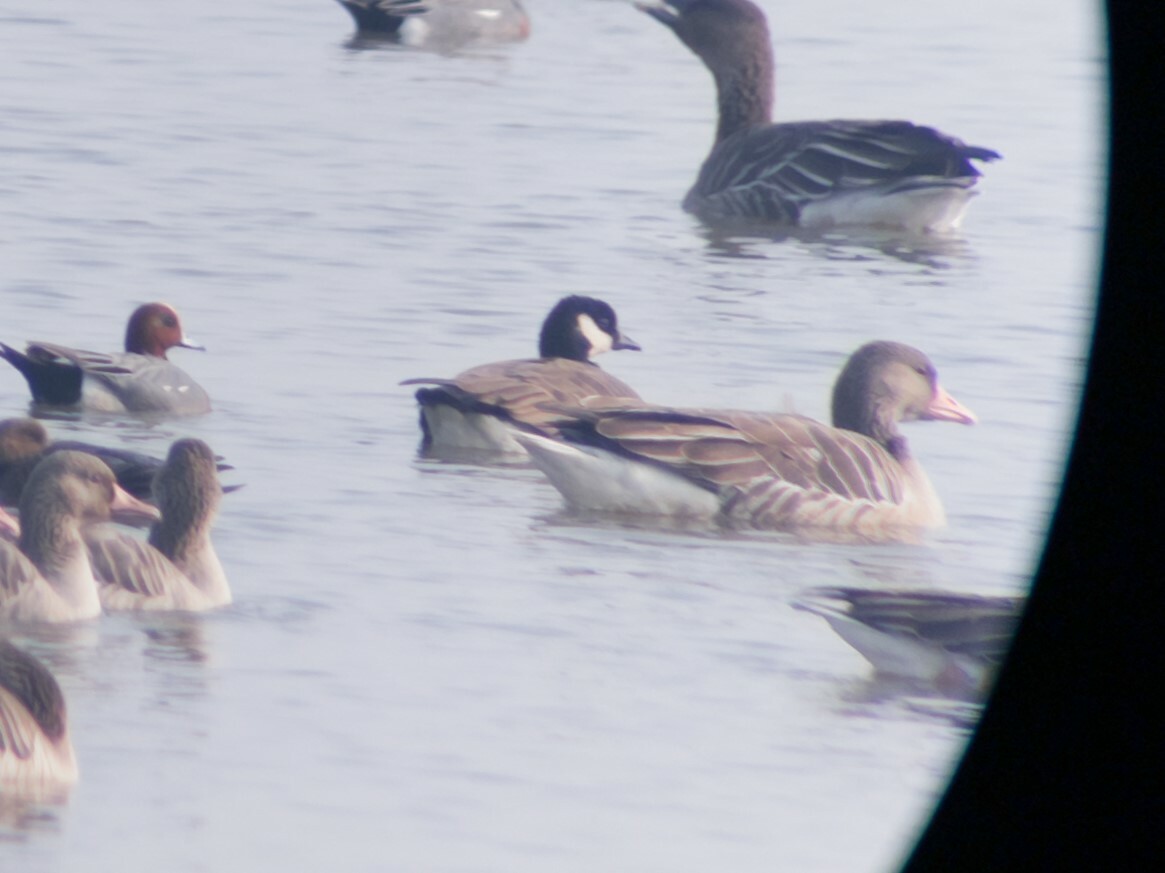
Cackling Goose
Branta hutchinsii
小美洲黑雁
Introduction
The cackling goose is a medium-sized goose of North America and East Asia, taxonomically distinct from the Canada goose following a formal split in 2004-2005. These geese breed on arctic and subarctic tundra across northern Canada and Alaska. Breeding behavior includes site defense, goslings following parents, and lifelong pair bonds. Fall migration brings flocks to wintering grounds across the continental United States, Mexico, and Pacific coast. The species' high-pitched call distinguishes it from the Canada goose. The population recovered from early 20th-century declines caused by overhunting and habitat loss, though some subspecies remain localized conservation concerns.
Description
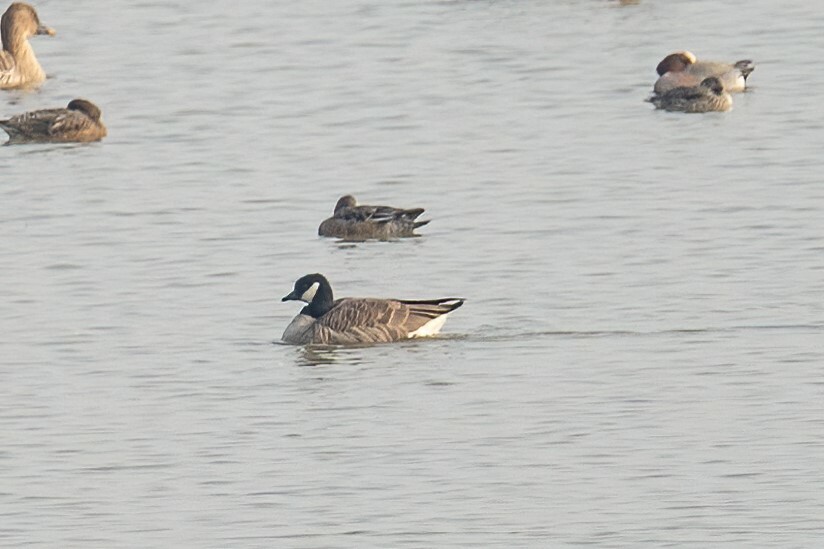
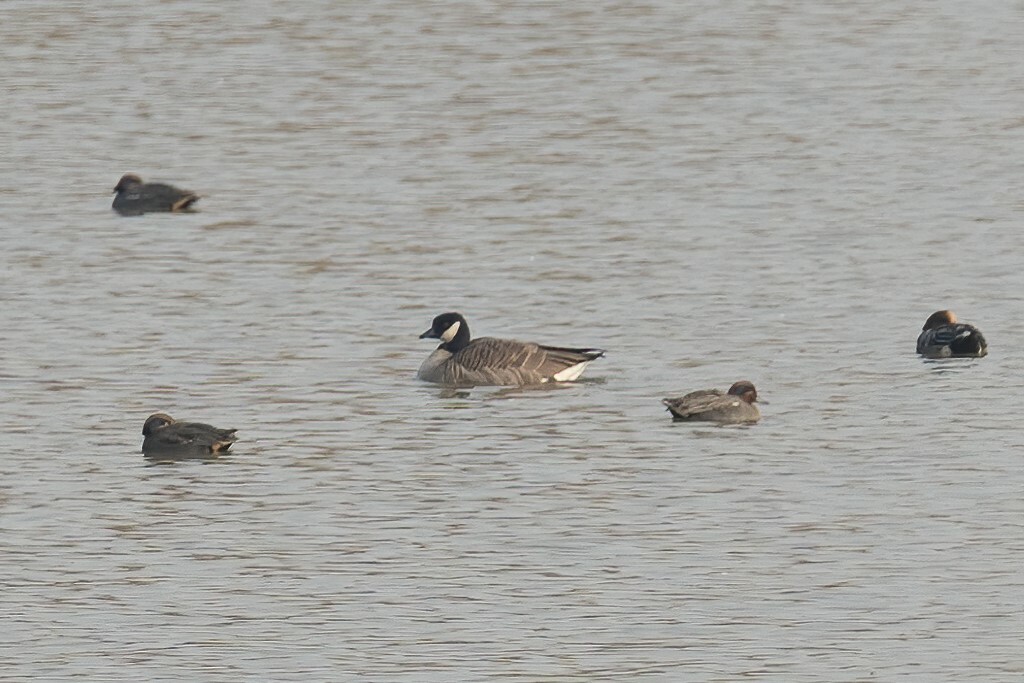
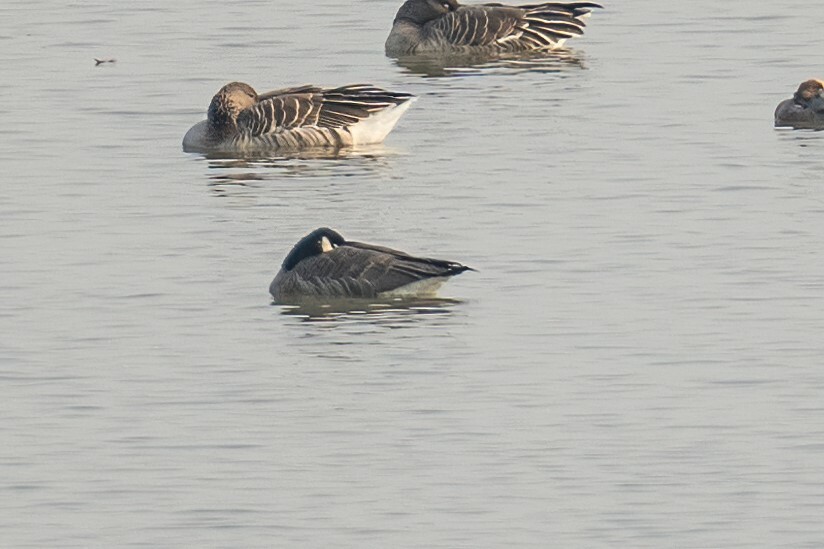
The cackling goose displays the classic Branta goose color pattern: black head, neck, and chinstrap against a lighter body. The face pattern is simpler than many geese, lacking the elaborate cheek markings seen in some relatives. The body plumage is brownish-gray overall, darker above and paler below. Sexes appear nearly identical, though females are slightly lighter in coloration and have a distinctly different voice. Between five subspecies, considerable size variation exists. The smallest subspecies minima weighs just 1.4 kg, while larger forms like hutchinsii reach up to 3 kg. Body measurements average 63-65 cm in length with a wingspan of 108-111 cm. This species closely resembles the Canada goose but averages smaller, though size overlap between the largest cackling and smallest Canada geese creates identification challenges. The barnacle goose, another relative, differs in having a black breast and gray body plumage.
Identification
The black head and neck with white chinstrap immediately narrow identification to Canada goose, cackling goose, or barnacle goose. Unlike the barnacle goose, this species lacks black breast feathering and shows brownish rather than gray body plumage. Distinguishing from Canada goose proves more difficult. The smallest cackling goose subspecies minima is significantly smaller than any Canada goose, but subspecies hutchinsii overlaps in size with smaller Canada goose subspecies. Call is perhaps the most reliable field character: the cackling goose gives a higher-pitched, more rapid cackle compared to the lower, resonant honk of Canada goose. Body shape may also differ, with cackling geese appearing more compact with a steeper forehead. In western Europe, any small Branta goose with this color pattern represents a potential vagrant cackling goose.
Distribution & Habitat
This species breeds across northern North America from Alaska through Arctic Canada to western Greenland, inhabiting various tundra habitats near water. Nests are placed in elevated sites with good visibility. The species is strongly migratory, with wintering grounds spanning most of the continental U.S., extending into northern Mexico and locally to western Canada and the Pacific coast. Some populations have shifted migration routes due to habitat changes. As natural vagrants, cackling geese regularly appear in western Europe, with at least subspecies hutchinsii documented. Vagrants have also been recorded around Russia's Kamchatka Peninsula, East China, and throughout the Japanese archipelago. The species was formerly considered extirpated from Japan, though recent reintroduction efforts are underway there and in Siberia.
Behavior & Ecology
Cackling geese form strong pair bonds that typically last for life, with pairs remaining together for approximately 20 years. Both parents participate aggressively in nest defense, chasing away potential threats including humans who approach too closely. Nests are shallow depressions lined with plant material and down, placed on elevated ground to reduce predation risk from mammals such as foxes, coyotes, cats, and rats. Goslings are led in lines with one parent at front and rear—the classic goose family parade. The diet is primarily herbivorous, consisting of aquatic plants, grasses, and agricultural grains left in fields. When feeding in water, they submerge head and neck like dabbling ducks, sometimes tipping forward completely. Small amounts of insects, molluscs, and crustaceans supplement the diet. Migration occurs in large flocks flying in characteristic V-formation, with high-pitched cackling calls audible from afar.
Conservation
The IUCN lists this species as Least Concern due to substantial population recovery following historical declines. By the early 20th century, overhunting and habitat loss had caused serious population crashes across the range. Since then, improved game laws and habitat restoration programs have enabled most populations to rebound successfully. However, not all subspecies have recovered equally. The minima and leucopareia subspecies remain causes for conservation concern, with localized populations still declining. The Komandorski and Kuril Islands population, historically wintering in Japan, disappeared around 1929 and is considered extinct. Reintroduction efforts are currently underway in Japan and Siberia to reestablish populations in parts of the historic range where the species was eliminated.
Culture
The cackling goose shares much of its cultural context with the Canada goose, which holds a prominent place in North American wildlife heritage as an iconic migratory bird. The species' high-pitched, almost laugh-like calls have long marked the changing seasons for observers across the continent. For Indigenous peoples throughout the Arctic and subarctic, geese held ceremonial and practical significance as food and symbolic resources. The taxonomic distinction between cackling and Canada geese, while scientifically important, has somewhat complicated conservation messaging since public education efforts must now distinguish between species that appear nearly identical to untrained observers. The dramatic population recovery of the species represents a conservation success story often cited in wildlife management literature.
Source: Wikipedia · CC BY-SA 3.0
Taxonomy
- Order
- Anseriformes
- Family
- Anatidae
- Genus
- Branta
- eBird Code
- cacgoo1
Subspecies (4)
-
Branta hutchinsii hutchinsii
breeds north-central arctic Canada; winters in the south-central USA (New Mexico to Louisiana, rarely eastward to New York) and northeastern Mexico
-
Branta hutchinsii leucopareia
breeds locally in Aleutian and Semidi islands, Alaska (formerly bred from Kuril and Commander islands eastward to near Kodiak Island); winters Oregon and California
-
Branta hutchinsii minima
breeds coastal western Alaska; winters primarily in California
-
Branta hutchinsii taverneri
breeds central Alaska to Mackenzie River delta; winters to Mexico
Data Sources
Species description from Wikipedia, licensed under CC BY-SA 3.0.
Bird images and sounds sourced from GBIF, contributed by citizen scientists worldwide under Creative Commons licenses.
Taxonomy data from AviList 2025.