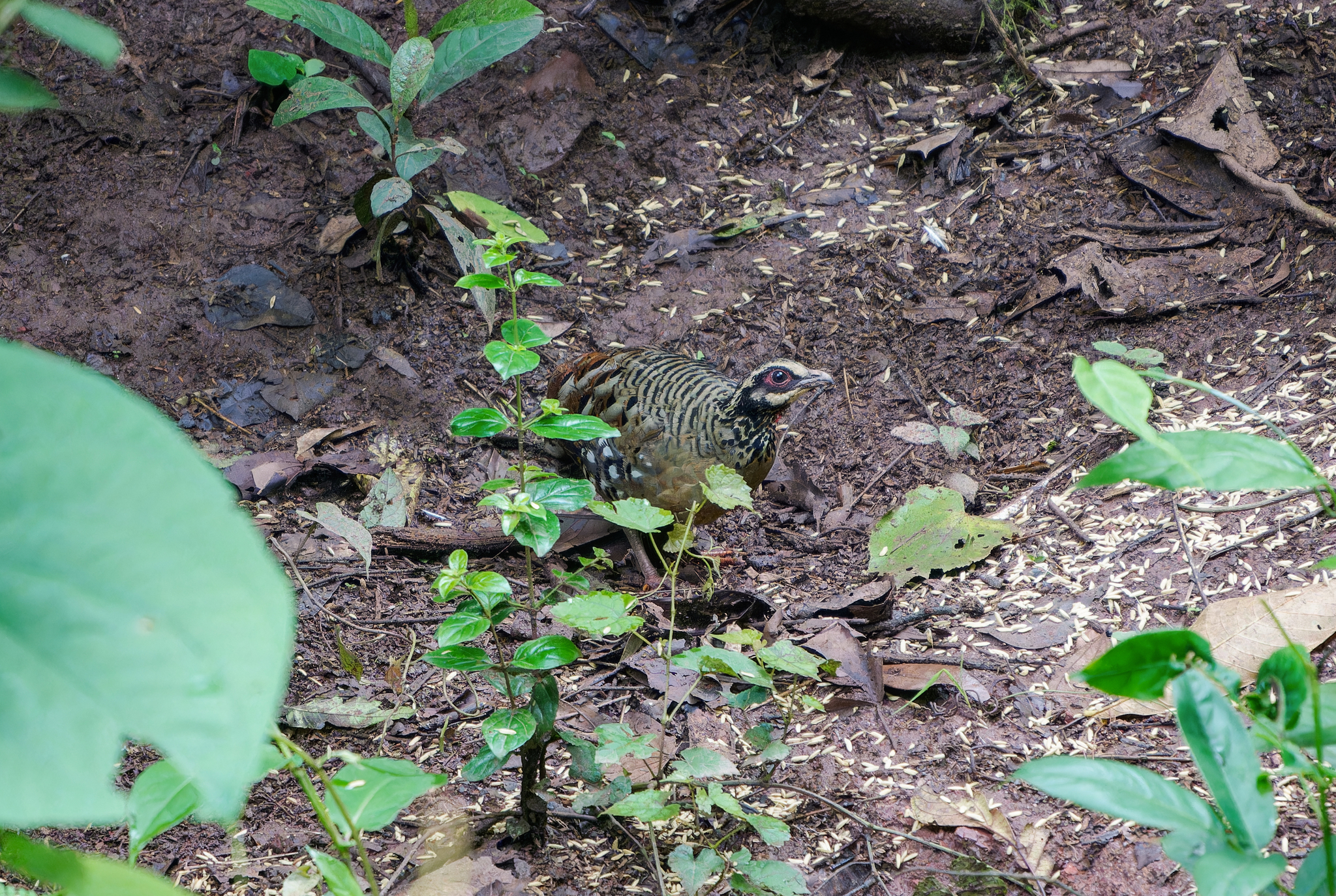
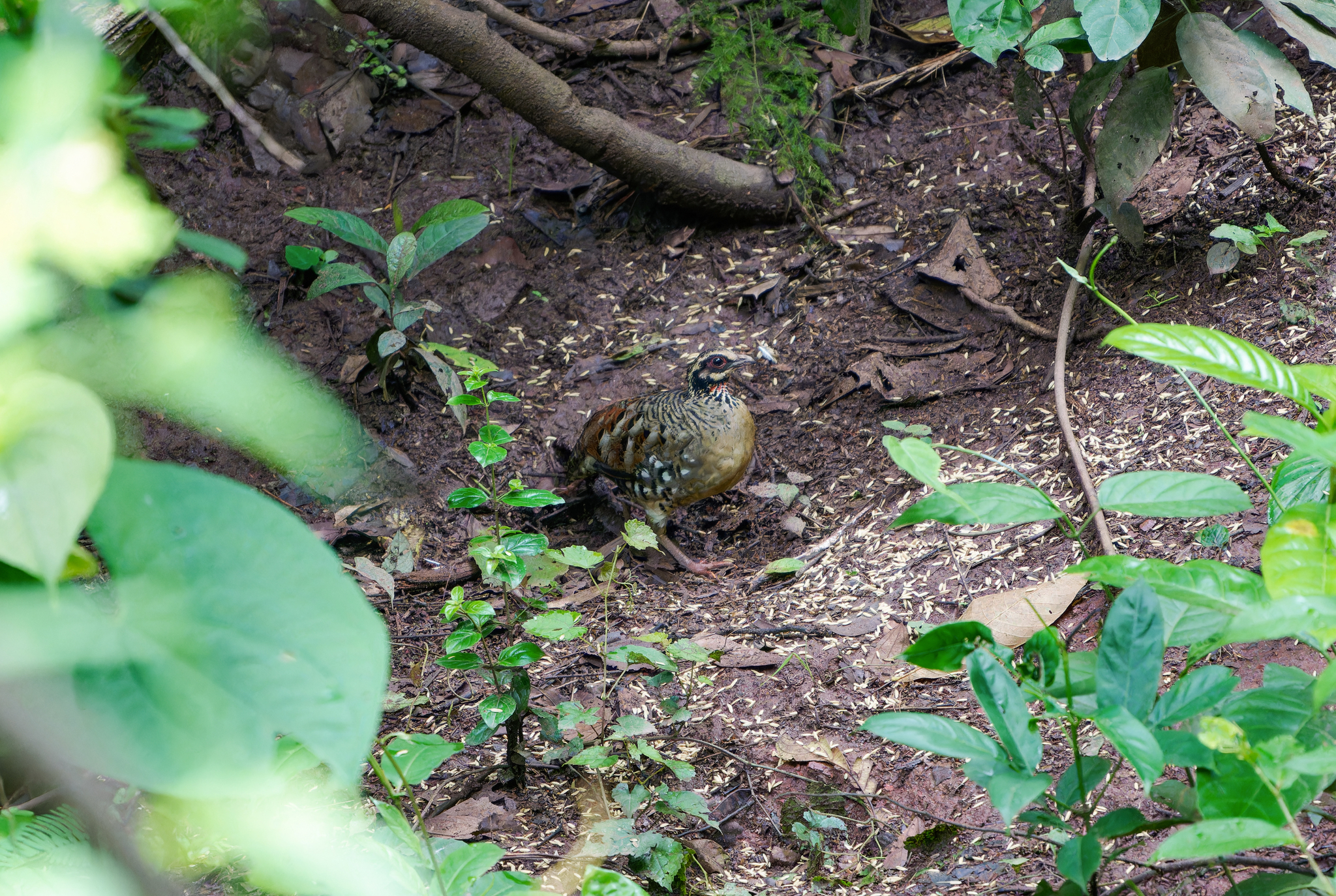
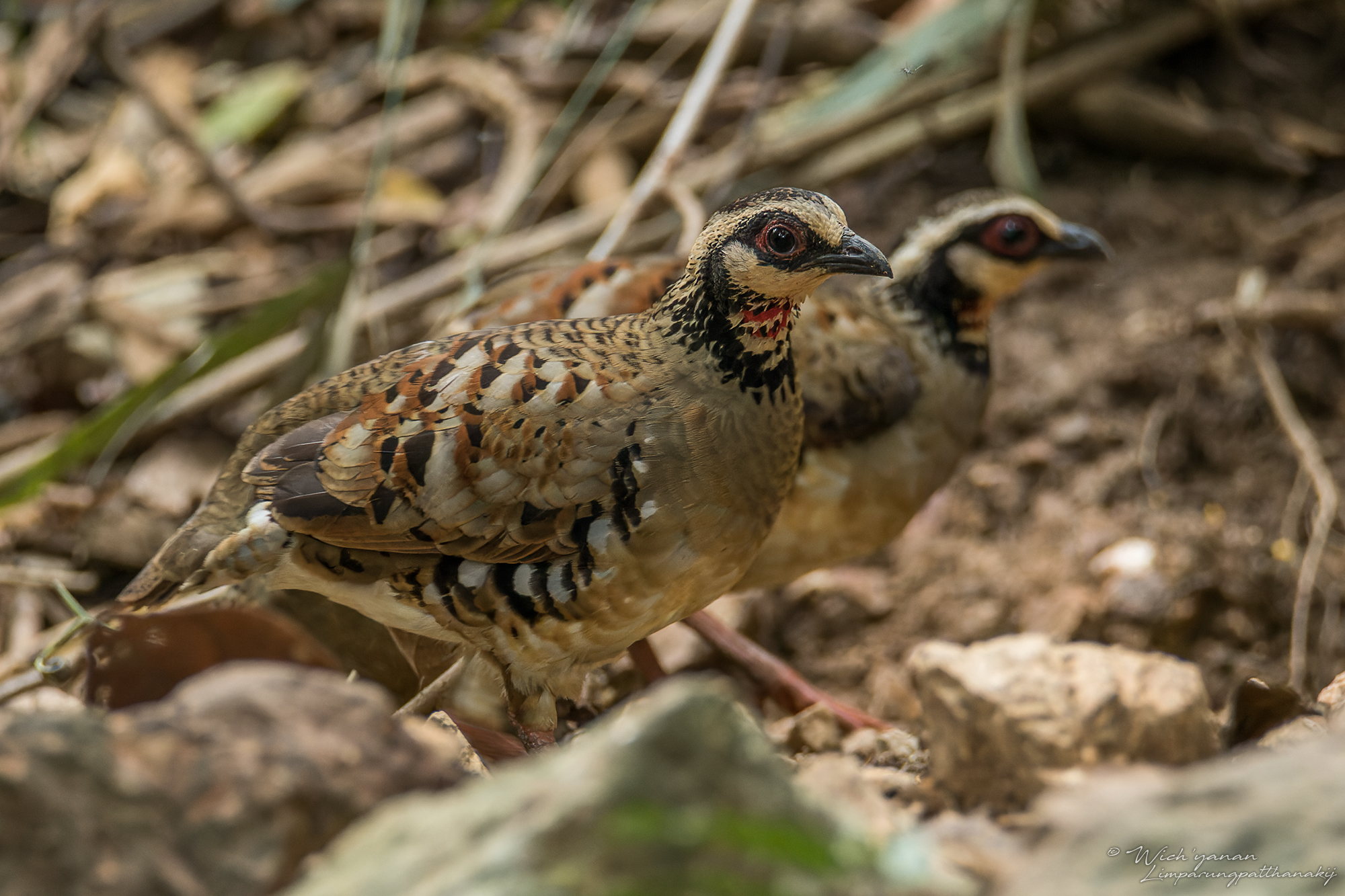
Bar-backed Partridge
Arborophila brunneopectus
褐胸山鹧鸪
Introduction
Ground-dwelling gamebird of Southeast Asian forests, ranging from southwestern China through Laos, Myanmar, Thailand, Vietnam, and Cambodia. Inhabits subtropical and tropical moist forests at lower elevations. Forages in small family groups through leaf litter, consuming seeds, insects, and small shells. Forms coveys of four to nine birds. When disturbed, bursts into underbrush with rapid calls. During breeding season, males expose throat feathers while calling during courtship displays. Conservation status: Least Concern. Threats include habitat loss and hunting across its range.
Description
This small partridge measures approximately 280 mm in total length, with males averaging 144 mm wingspan and females slightly smaller at 134 mm. The tail reaches 6-7 cm, and the bill measures 20-21 mm. The species is predominantly buff-colored throughout its compact frame. Dark black markings trace from the beak, circle the eyes, and extend down to the throat. A black crown and black-tipped feathers adorn the upper back. Bright red eyelids provide a striking contrast. The wing feathers display a distinctive pattern of white with black tips, shading to brown toward the back of the wing. Males and females share similar plumage, making them difficult to distinguish in the field.
Identification
This species can be distinguished from similar forest-dwelling partridges by its combination of buff underparts, black facial markings, and red eyelids. The white-tipped wing feathers with brown near the back create a distinctive wing pattern when flushed. The relatively small size and preference for lower elevation forests helps separate it from some montane relatives. Its black eye line extending through the face is a key mark, along with the buff overall coloration without the extensive barring shown by some related species. When calling, the whistled notes differ from the more chattering calls of sympatric hill-partridges.
Distribution & Habitat
Found across Cambodia, China, Laos, Myanmar, Thailand, and Vietnam, this species occupies approximately 486,000 square kilometers of suitable habitat. It inhabits subtropical and tropical moist lowland forests and moist montane forests. While typically found below 3,000 feet elevation, populations occur at higher altitudes including observations above 5,000 feet. No regular migration is documented, though seasonal movements to different elevations likely occur in response to local conditions. The species requires intact forest cover and is absent from heavily degraded or fragmented habitats.
Behavior & Ecology
Small family groups of four to nine individuals move through the forest floor, typically consisting of a breeding pair with their recent offspring or occasionally two family units together. Foraging involves scratching through leaf litter to find seeds, small shells, and insects. When approached, groups scatter rapidly into dense undergrowth while emitting sharp alarm calls. Courtship displays occur during the May-June breeding season, with captive males performing ritualized displays that expose the red throat feathers while calling to attract females. Nests consist of a simple hole in the ground lined with bamboo and grass, containing eggs measuring 37 by 28 mm.
Conservation
The IUCN Red List assesses this species as Least Concern, reflecting its relatively large geographic range of approximately 486,000 square kilometers. However, populations are experiencing a slow but steady decline driven primarily by ongoing habitat loss from deforestation and forest degradation throughout Southeast Asia. Hunting pressure in parts of its range also contributes to population declines. While current numbers remain sufficient to avoid Vulnerable status, continued monitoring is recommended given the extensive habitat transformation occurring across its range. Protection of intact forest blocks will be essential for maintaining viable populations.
Culture
No specific cultural significance, folklore, or traditional uses are documented in available sources.
Source: Wikipedia · CC BY-SA 3.0
Taxonomy
- Order
- Galliformes
- Family
- Phasianidae
- Genus
- Arborophila
- eBird Code
- babpar1
Subspecies (3)
-
Arborophila brunneopectus albigula
south-central Vietnam
-
Arborophila brunneopectus brunneopectus
southwestern China (southwestern Yunnan) to eastern Myanmar, northern Laos and western Thailand
-
Arborophila brunneopectus henrici
northern and central Vietnam
Data Sources
Species description from Wikipedia, licensed under CC BY-SA 3.0.
Bird images and sounds sourced from GBIF, contributed by citizen scientists worldwide under Creative Commons licenses.
Taxonomy data from AviList 2025.