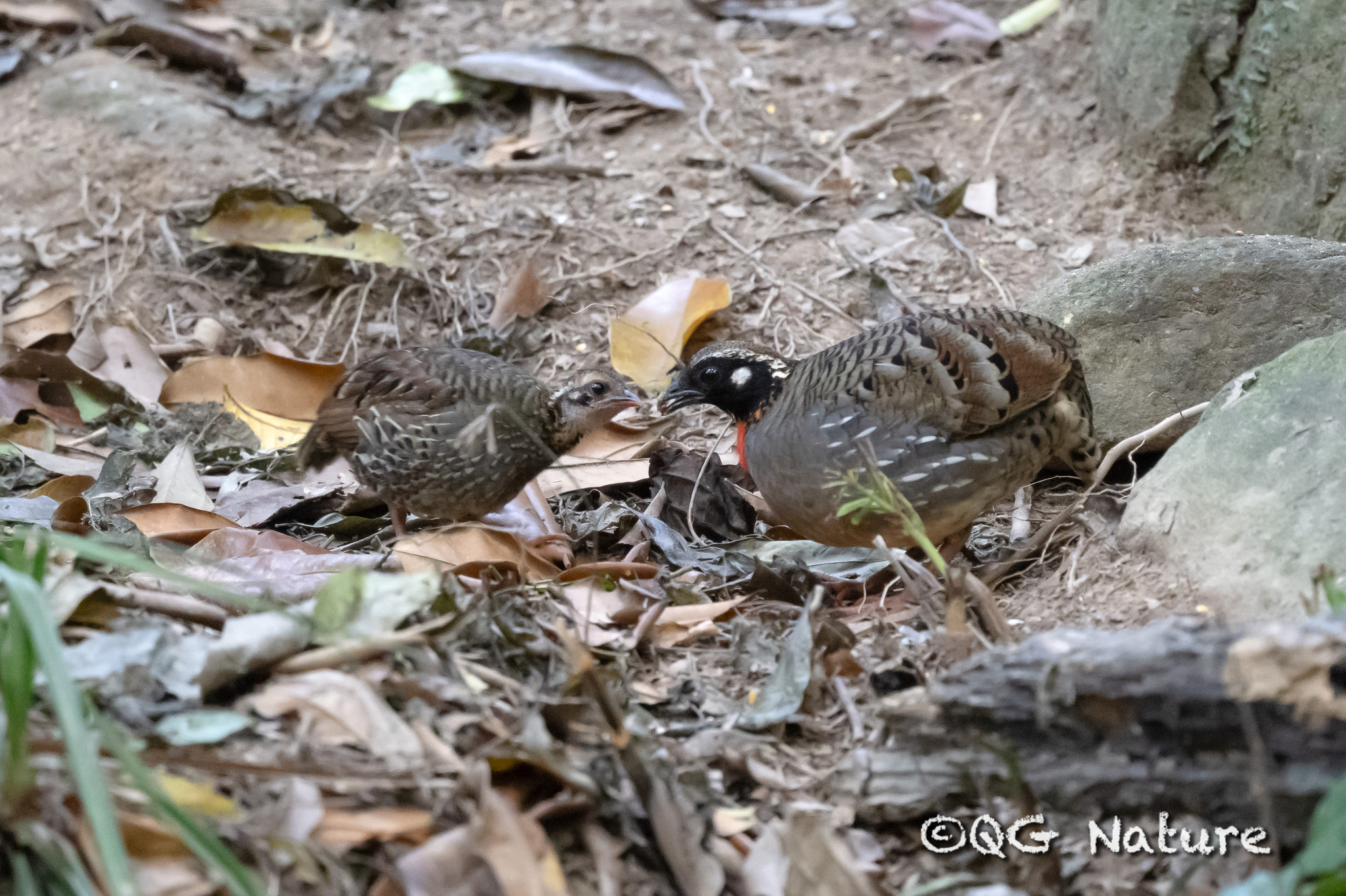
Hainan Partridge
Arborophila ardens
海南山鹧鸪
Introduction
This gamebird is endemic to Hainan Island, China. It inhabits primary evergreen forests at mid to high elevations within the island's central mountain range. The species exhibits concealed behavior in dense understorey vegetation. Its vocalization consists of a distinctive two-note call. Conservation status is Vulnerable. Protected areas have been established, and new populations were discovered since 2002.
Description
A compact, ground-dwelling bird measuring 26-28 cm in length. Males weigh approximately 300g while females are smaller at around 237g. The head appears blackish overall, featuring a distinctive white patch on the ear coverts and a whitish supercilium. The crown and nape display dark brown plumage marked with black mottling. Upperparts show olive-brown coloration with characteristic black scaling. The throat and sides of the neck are blackish, set off by an orange collar encircling the lower neck. Underparts are predominantly grey with buffish coloring on the central belly. Wings are greyish-brown. The beak is black, eyes are brown, and legs are dull reddish. Females resemble males but are smaller and less brightly colored.
Identification
This species is distinguished by its combination of a blackish head with white ear patch and supercilium, orange neck collar, and scaled upperparts. The scaled olive-brown upperparts and orange collar help distinguish it from other partridges in the region. Its small size and ground-dwelling habits in evergreen forest understory are characteristic. The blackish head pattern with white markings is diagnostic within its range. Individuals appear almost black-headed at distance, with the orange collar becoming more visible as the bird moves through dense vegetation.
Distribution & Habitat
Endemic to Hainan Island in southern China, with unsubstantiated reports from Guangxi province. Inhabits primary evergreen forests, both broadleaved and mixed coniferous-broadleaved types, at elevations of 600-1,600 meters. Also occurs in secondary forests recovering from previous logging operations. The total suitable habitat covers approximately 660 square kilometers, with around 410 square kilometers currently protected within nature reserves including Hainan Bawangling National Nature Reserve, Jianfengling, Wuzhishan, Diaoluoshan Limushan, and Nanweiling.
Behavior & Ecology
Behavior remains poorly studied, but individuals are typically encountered alone, in pairs, or in small coveys. The species forages on the forest floor, consuming snails and seeds. Its vocalization consists of a distinctive two-note call repeated in series, described as 'ju-gu ju-gu ju-gu'. Often, a second bird responds with quick single notes. As with other members of its genus, it presumably maintains territories through calling and remains hidden within dense vegetation throughout much of the day.
Conservation
Classified as Vulnerable by the IUCN due to its small, declining population and restricted range. The global population is estimated at 2,500-9,999 mature individuals, likely experiencing rapid decline from habitat loss. Forest clearance for timber extraction and agricultural expansion, combined with illegal hunting, constitute primary threats. Climate change may pose additional risks. However, new populations discovered since 2002 and expanded protected areas covering significant suitable habitat suggest the decline may have slowed. The species receives national protection in China, with 62% of suitable habitat within nature reserves.
Culture
The Hainan partridge holds protected status within China's conservation framework, reflecting its significance as an endemic species of limited distribution. No significant folklore or cultural traditions specific to this species are documented in available sources.
Source: Wikipedia · CC BY-SA 3.0
Taxonomy
- Order
- Galliformes
- Family
- Phasianidae
- Genus
- Arborophila
- eBird Code
- haipar1
Distribution
montane forest of Hainan (off southern China)
Data Sources
Species description from Wikipedia, licensed under CC BY-SA 3.0.
Bird images and sounds sourced from GBIF, contributed by citizen scientists worldwide under Creative Commons licenses.
Taxonomy data from AviList 2025.