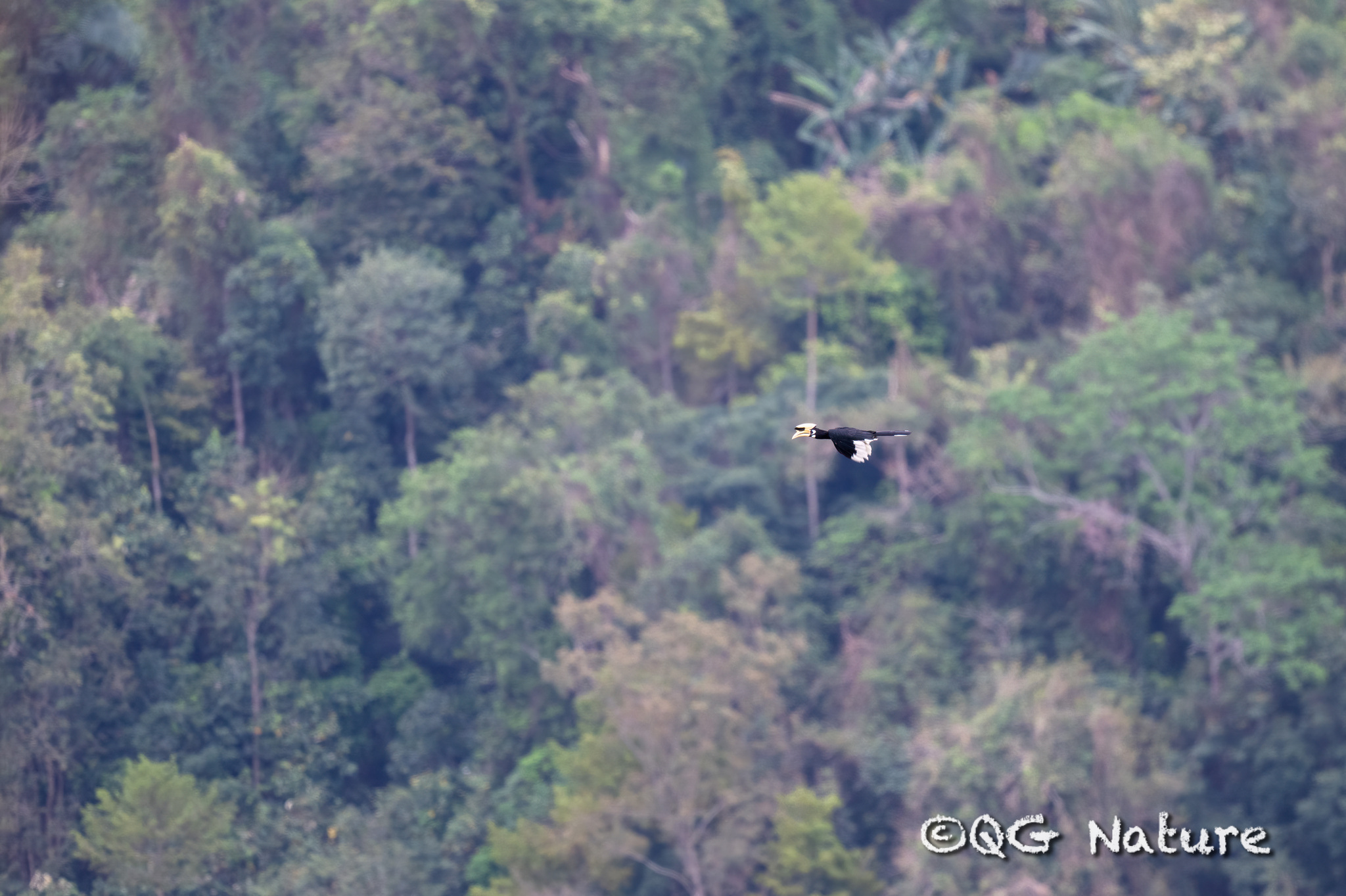
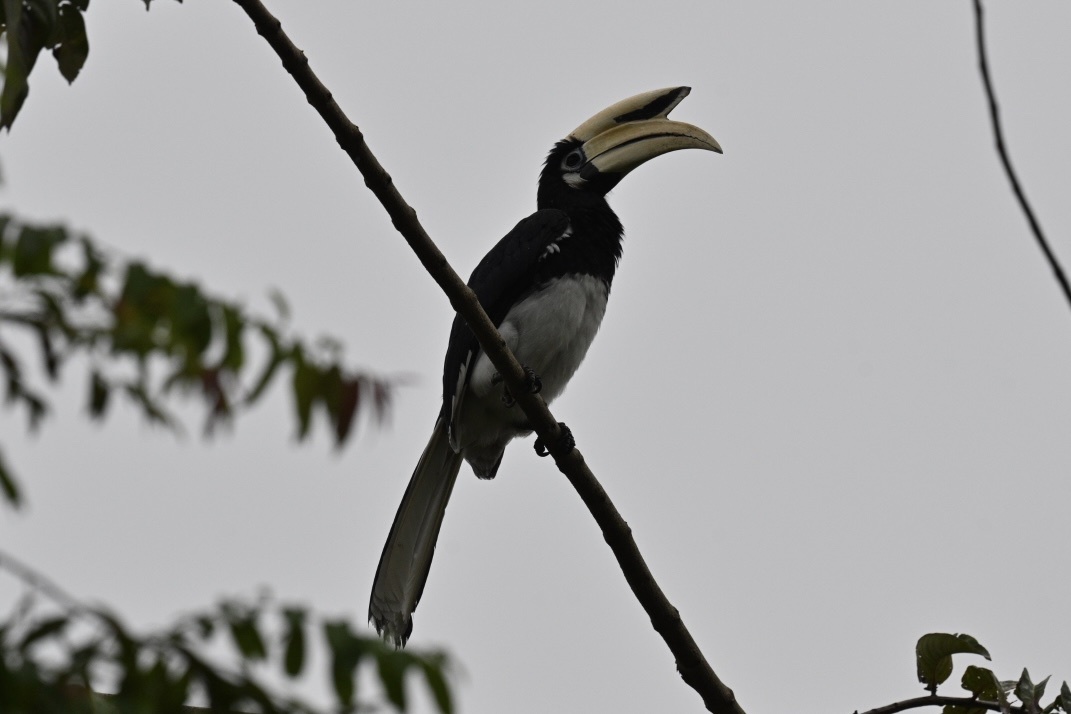
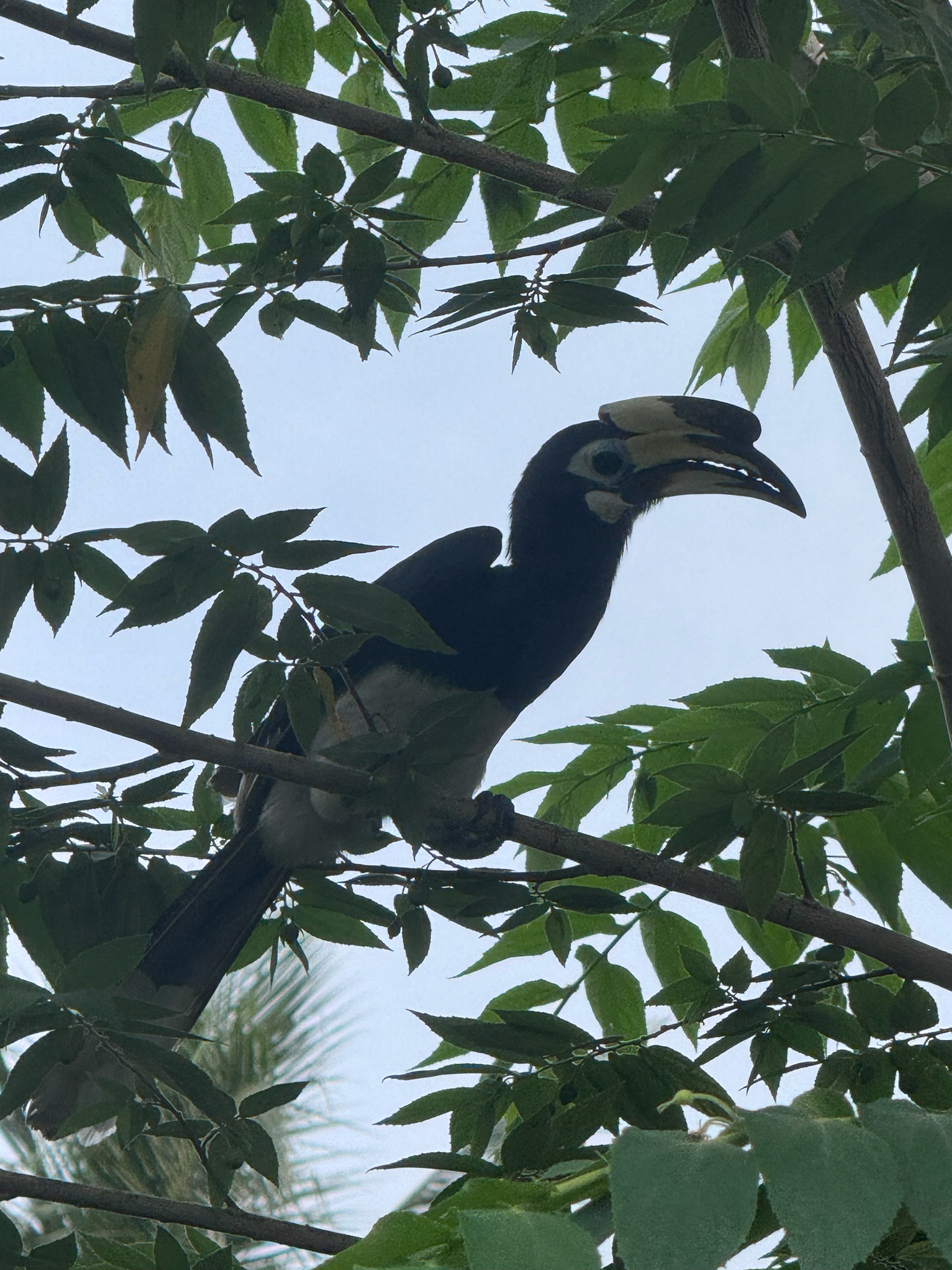
Oriental Pied Hornbill
Anthracoceros albirostris
冠斑犀鸟
Introduction
Small to medium-sized Asian hornbill. Black and white plumage with massive curved bill and distinctive casque. Inhabits primary and secondary forests, secondary growth, and plantations. Forages actively in the canopy, often in small flocks outside breeding season. Vocalizations include harsh, crow-like squawks and braying calls. Important seed disperser, particularly for large-seeded plant species. Shows tolerance for disturbed habitats but requires nesting cavities and fruit resources.
Description
This medium-sized hornbill measures 55-60 cm from head to tail with a wingspan of 23-36 cm. Adults weigh 600-1050 g, with males averaging slightly heavier at 900 g compared to females at 875 g. The massive bill reaches 19 cm in males and 16 cm in females, crowned by a distinctive laterally flattened casque resembling a protruding horn. The plumage is predominantly black with a green sheen on the head, neck, back, wings, and upper breast, while the lower breast, abdomen, thighs, and under-wing areas are white. The black tail features white tips on all feathers except the central rectrices. The bare skin around the eyes and throat is white, often showing a blue tinge in adults. Sexes appear similar but can be distinguished: males have larger bodies, bright red eyes, and yellow bills with black bases, while females have grayish-brown eyes and yellow bills with black or brown patches on the mandible. Juveniles resemble adults but lack the green gloss and have undeveloped casques.
Identification
The combination of black upperparts, white underparts, and massive yellow bill with casque is diagnostic within its range. The white tail tips help distinguish it from all-black hornbill species. Compared to larger hornbill species such as the great pied hornbill and wreathed hornbill, this species is noticeably smaller and has a more contrasting black-and-white pattern. The relatively rounder cavity entrance shape and preference for lower elevations also aid identification. Sexing is straightforward in adults: the bright red eyes of males contrast sharply with the grayish-brown eyes of females, and the black bill patching differs between sexes. The species' tolerance for disturbed habitats means it may be encountered in secondary forests and plantations where other hornbills are absent.
Distribution & Habitat
This species holds the largest distribution of any Anthracoceros hornbill, spanning the Indian subcontinent and all of Southeast Asia. Its range extends through eastern and northern India, Nepal, Bangladesh, Bhutan, Tibet, Myanmar, Thailand, Laos, Cambodia, Vietnam, Peninsular Malaysia, Singapore, Indonesia, Brunei, and the Sunda shelf islands. It occupies subtropical and tropical moist lowland forests including dry and semi-evergreen forests, dry and moist deciduous forests, subtropical broadleaf forests, secondary forests, plantations, and woodlands. While primarily a resident species, individuals may expand their range during the breeding season when seeking abundant fruiting trees. The species demonstrates particular tolerance for human-modified landscapes compared to other hornbills, though it remains most abundant in undisturbed forest habitats.
Behavior & Ecology
These hornbills are predominantly frugivorous, feeding extensively on wild figs, melanoxylon berries, rambutans, palm fruit, papaya, and liana fruits, with a particular preference for trees in the Annonaceae, Meliaceae, and Myristicaceae families. Their diet also includes large insects, small birds, reptiles, amphibians, fish, bats, and eggs and hatchlings from other birds' nests. Breeding occurs from January to June, typically beginning in February with the onset of rains and peak fruit abundance. They are monogamous secondary cavity nesters, selecting natural tree hollows created by branch breakage or other birds. Females seal themselves inside the cavity during incubation, leaving only a small opening through which the male delivers food. Nest sites are carefully chosen based on fruiting tree availability and cavity quality, often near water sources. Chicks remain in the nest for several months. Flocks form during the non-breeding season, and their vocalizations include harsh crowlike sounds, brays, and screeches.
Conservation
The species is not currently considered threatened due to its extremely wide range and remarkable adaptability to habitat alterations. However, population declines have been reported throughout parts of its range. The primary threats are legal and illegal logging, which reduces availability of suitable nesting and fruiting trees. Additional pressures include hunting for their casques, which are sold as souvenirs, and capture for the pet trade. The species has been almost completely extirpated from southern China, and Singapore's population went locally extinct in the 1960s before recovering in the 1990s. Conservation measures include captive breeding and reintroduction programs, though breeding success remains low. In Cambodia, artificial nests made from iron tanks are installed to provide alternative nesting sites when natural cavities are scarce. Nests in human-disturbed areas often prove unsuccessful, highlighting the species' continued need for adequate forest habitat.
Culture
The cultural significance of this hornbill varies across its range, where hornbills in general hold important symbolic value in many Southeast Asian cultures. The distinctive casque has made hornbills targets for the souvenir trade in some regions. In certain communities, hornbill casques have been traditionally used in decorative items and ritual objects. Conservation education programs in countries like Cambodia and Singapore have worked to raise local awareness about the species' ecological importance, particularly its role as a seed disperser critical to forest regeneration. The bird's striking appearance and interesting behaviors have made it a draw for ecotourism in some areas, contributing to local economies while incentivizing habitat protection.
Source: Wikipedia · CC BY-SA 3.0
Taxonomy
- Order
- Bucerotiformes
- Family
- Bucerotidae
- Genus
- Anthracoceros
- eBird Code
- orphor1
Vocalizations
Subspecies (2)
-
Anthracoceros albirostris albirostris
India to Assam, Nepal, Myanmar, southern China, and Indochina
-
Anthracoceros albirostris convexus
southern Thailand, Malay Peninsula, and Greater Sundas and adjacent islands
Data Sources
Species description from Wikipedia, licensed under CC BY-SA 3.0.
Bird images and sounds sourced from GBIF, contributed by citizen scientists worldwide under Creative Commons licenses.
Taxonomy data from AviList 2025.