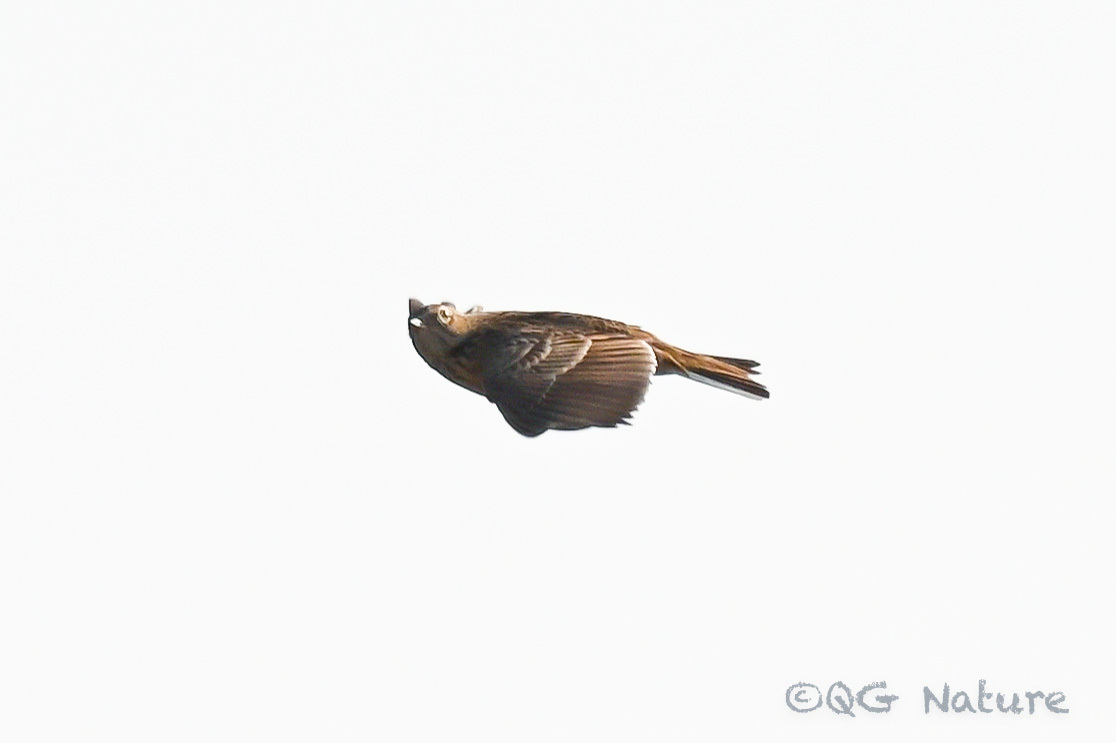
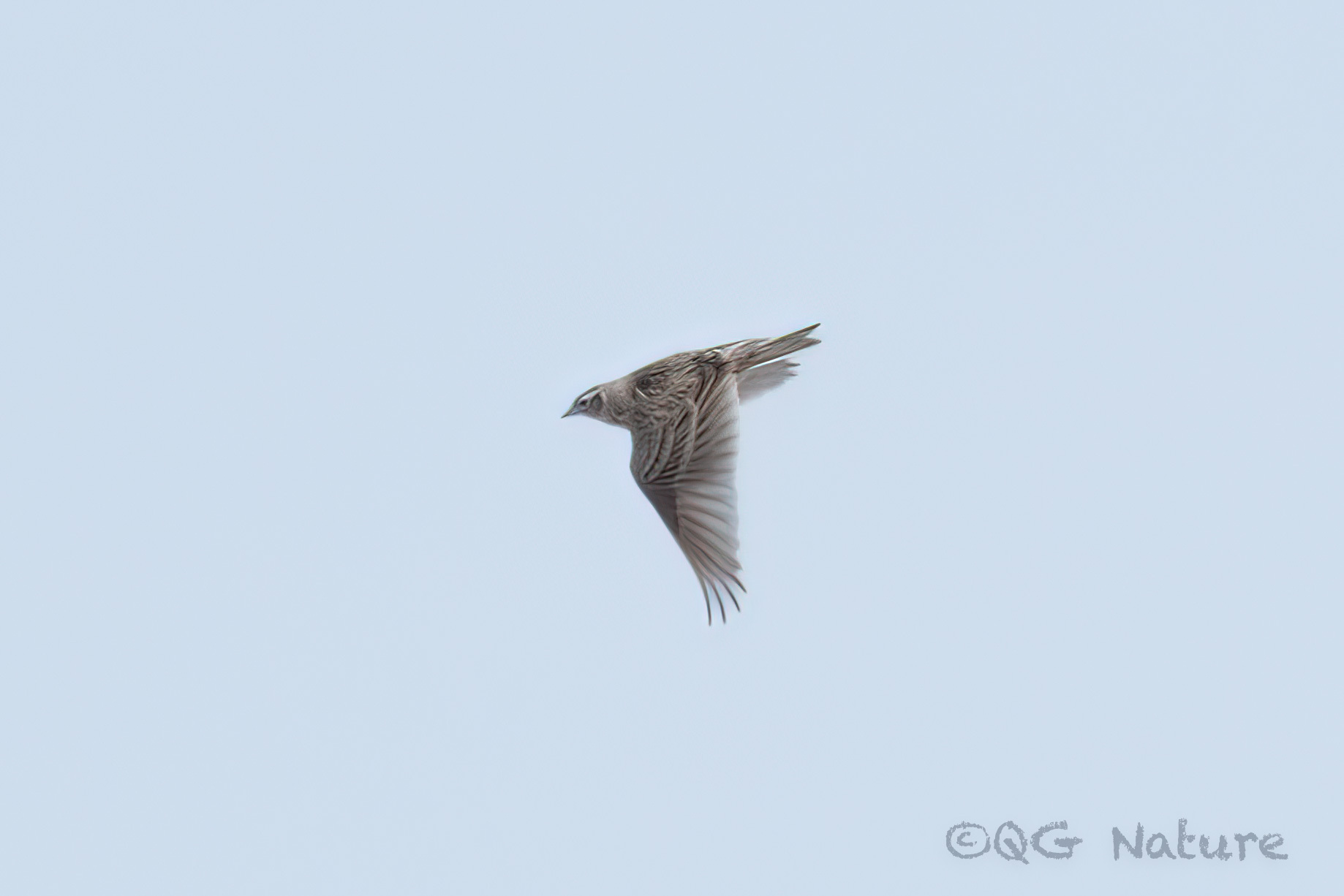
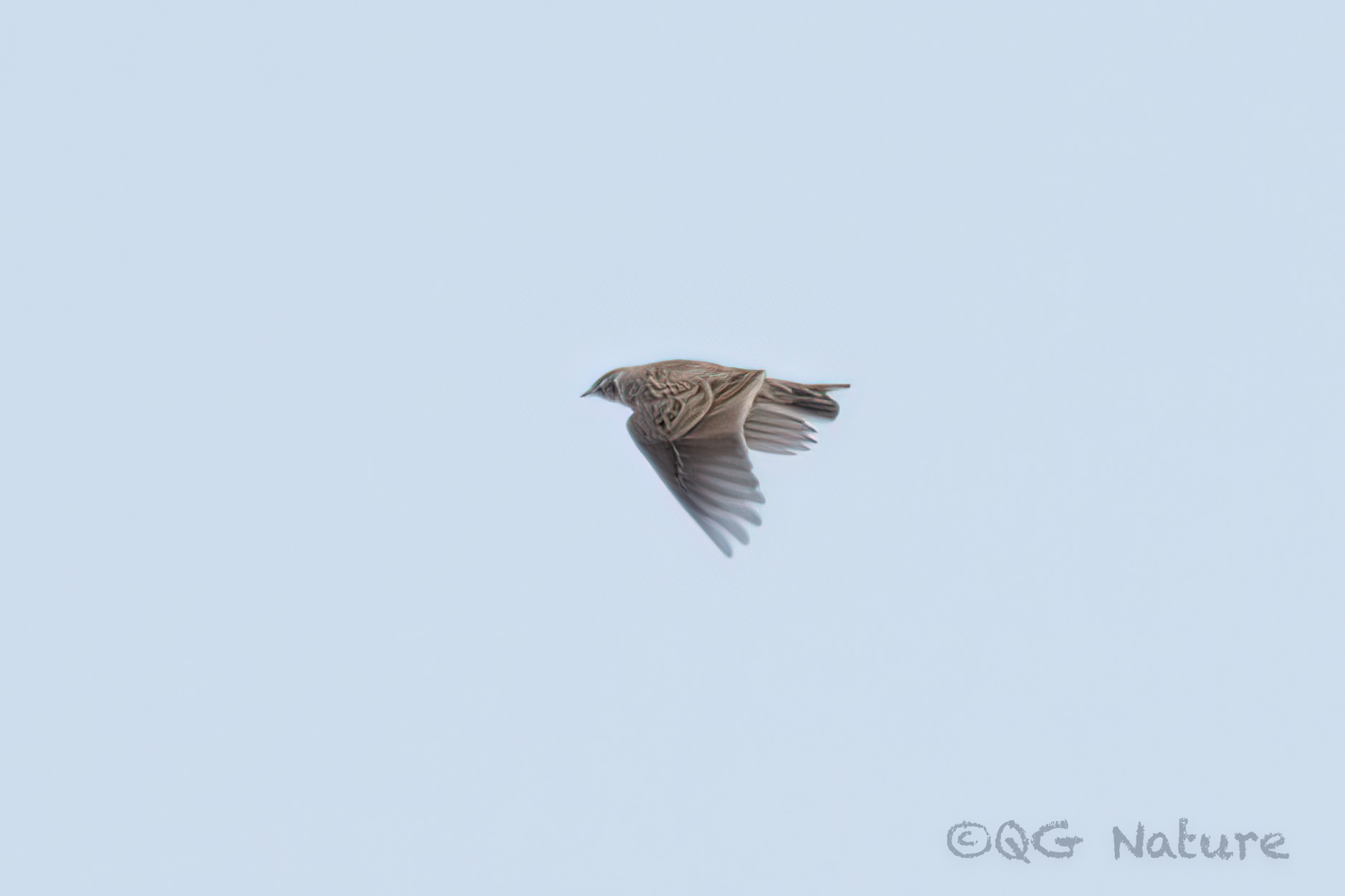
Eurasian Skylark
Alauda arvensis
云雀
Introduction
Passerine bird in the lark family Alaudidae, genus Alauda. Widespread across Europe and the Palearctic, with introduced populations in Australia, New Zealand, and the Hawaiian Islands. Inhabits open farmland and heathland. The most distinctive trait is the male's song, delivered in sustained hovering flight from heights of 50 to 100 metres. The sexes are alike in appearance.
Description
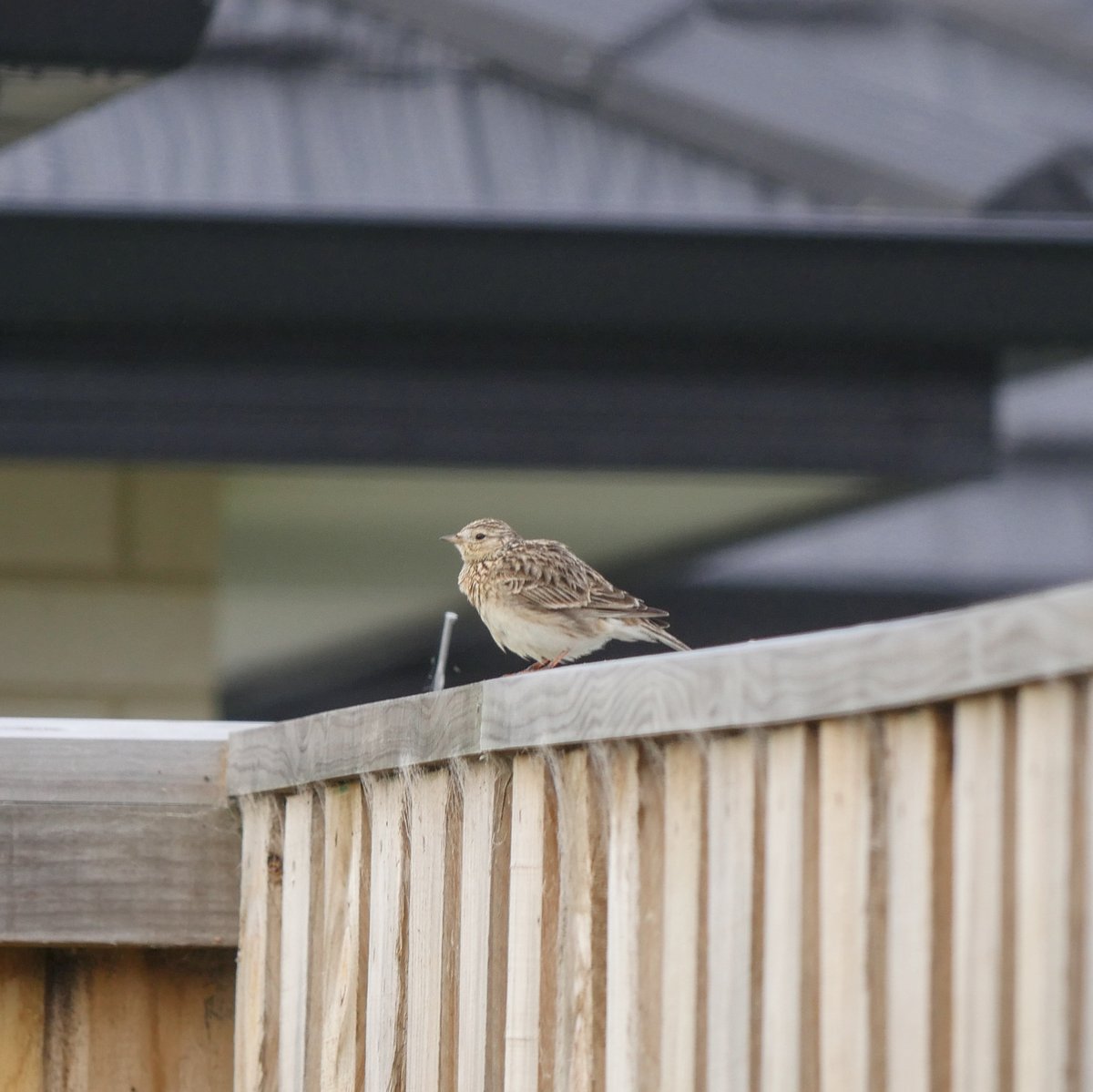
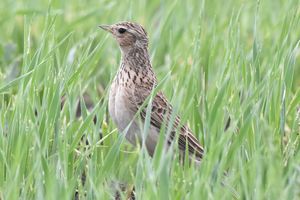
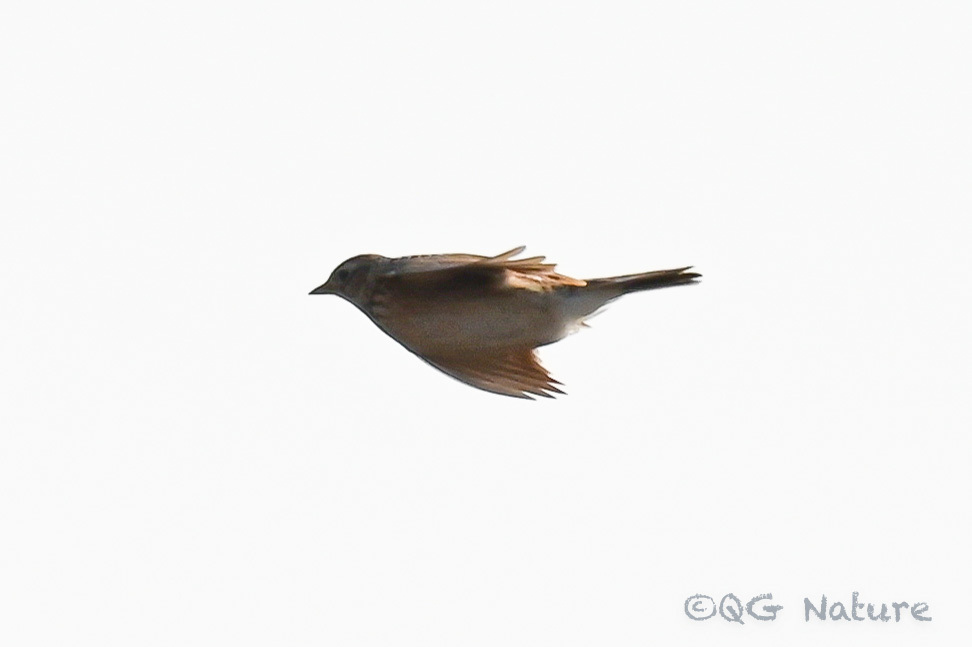
Small to medium-sized lark, 18–19 cm in length. Upperparts mainly brown, underparts paler with streaked greyish-brown breast and buff-white belly. Has a short blunt crest on the head that can be raised or lowered. In flight shows short tail and short broad wings with white edges visible when the bird flies away. Male has broader wings than female, an adaptation for more efficient hovering during song displays.
Identification
The raised crest is a useful识别特征 when perched. The white edges to the tail and rear wing feathers are visible in flight, but only when the bird is moving away. Compared to other larks, the combination of crest, relatively short tail, and white wing/tail markings helps distinguish it. The song delivered in hovering flight is characteristic and rarely confused with other species.
Distribution & Habitat
Breeds across most of Europe and Asia and in the mountains of north Africa. Western populations are largely resident, while eastern populations migrate south in winter. Even in mild western areas, many birds move to lowlands and coasts for winter. Introduced populations established in Australia (widespread in southeast), New Zealand (both main islands), Hawaiian Islands (Hawaii and Maui), and Vancouver Island, Canada.
Behavior & Ecology
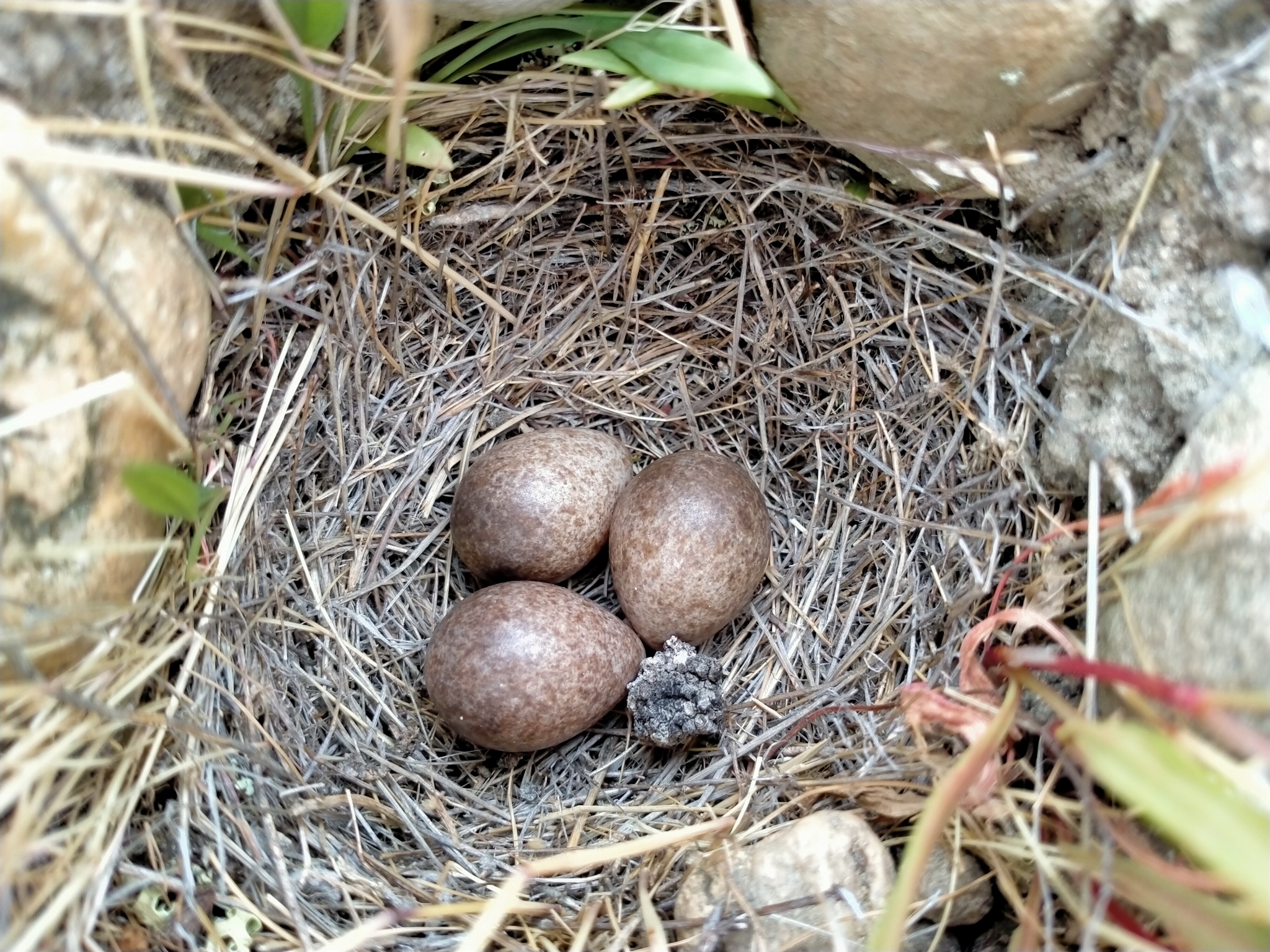
Forages on the ground, walking to search for insects and plant material including seeds and young leaves. Seeds are swallowed whole with the husk. Breeding begins at one year; the female builds an open nest in a shallow ground depression and lays 3-5 eggs incubated for 11 days. Both parents feed the young, which leave the nest at 8-10 days but are not fully independent until about 25 days. Parents raise up to 4 broods per season. The male's song is a clear, bubbling warble lasting 2-3 minutes, delivered in sustained hovering flight.
Conservation
UK populations have declined significantly since the 1970s due to agricultural intensification. Estimates suggest a 4-10% decline over the last decade and 6-28% decline over 22-25 years. The primary driver is the shift from spring-sown to autumn-sown cereals, which create dense crop stands that prevent ground foraging. Conservation interventions include encouraging spring cereal cultivation and leaving untreated stubble over winter, supported by schemes like Environmental Stewardship.
Culture
Collective noun is an 'exaltation,' a term traced to John Lydgate circa 1430. The verb 'skylark' means to play tricks or engage in horseplay, originally a sailors' term. The bird has inspired poetry, notably Percy Bysshe Shelley's 'To a Skylark' and George Meredith's 'The Lark Ascending,' which Ralph Vaughan Williams set to music. It is the emblem of Kumamoto Prefecture in Japan.
Source: Wikipedia · CC BY-SA 3.0
Taxonomy
- Order
- Passeriformes
- Family
- Alaudidae
- Genus
- Alauda
- eBird Code
- skylar
Subspecies (11)
-
Alauda arvensis armenica
Transcaucasia and eastern Türkiye to southwestern Iran (Zagros and Elburz mountains)
-
Alauda arvensis arvensis
British Isles and northern Scandinavia eastward to central Europe; introduced to southeastern Australia including Tasmania, North, South, Stewart, and Chatham islands (New Zealand), Hawaii, and Vancouver Island (southwestern British Columbia, southwestern Canada)
-
Alauda arvensis cantarella
southern Europe to Balkans, Crimea, and Iran; winters to northern Africa
-
Alauda arvensis dulcivox
breeds southeastern Russia to Yenisey basin and Afghanistan; winters to northwestern India
-
Alauda arvensis harterti
mountains of northwestern Africa
-
Alauda arvensis intermedia
breeds breeds in southeastern Siberia and Korea, probably also in northeastern China; winters in southeastern China
-
Alauda arvensis japonica
breeds Japan and Jeju Island (South Korea); winters in southern Japan and Ryukyu Islands (southern Japan)
-
Alauda arvensis kiborti
breeds southern Siberia to northern Mongolia, Manchuria, and Korea; winters to eastern China
-
Alauda arvensis lonnbergi
breeds breeds northeastern Siberia, northern Korean Peninsula, and Shantar and Sakhalin islands, northeastern Russia); winters in northeastern China, Korea, and Japan
-
Alauda arvensis pekinensis
northeastern Siberia to Sea of Okhotsk, Kamchatka Peninsula, and Kuril Islands
-
Alauda arvensis sierrae
Portugal to central and southern Spain
Data Sources
Species description from Wikipedia, licensed under CC BY-SA 3.0.
Bird images and sounds sourced from GBIF, contributed by citizen scientists worldwide under Creative Commons licenses.
Taxonomy data from AviList 2025.